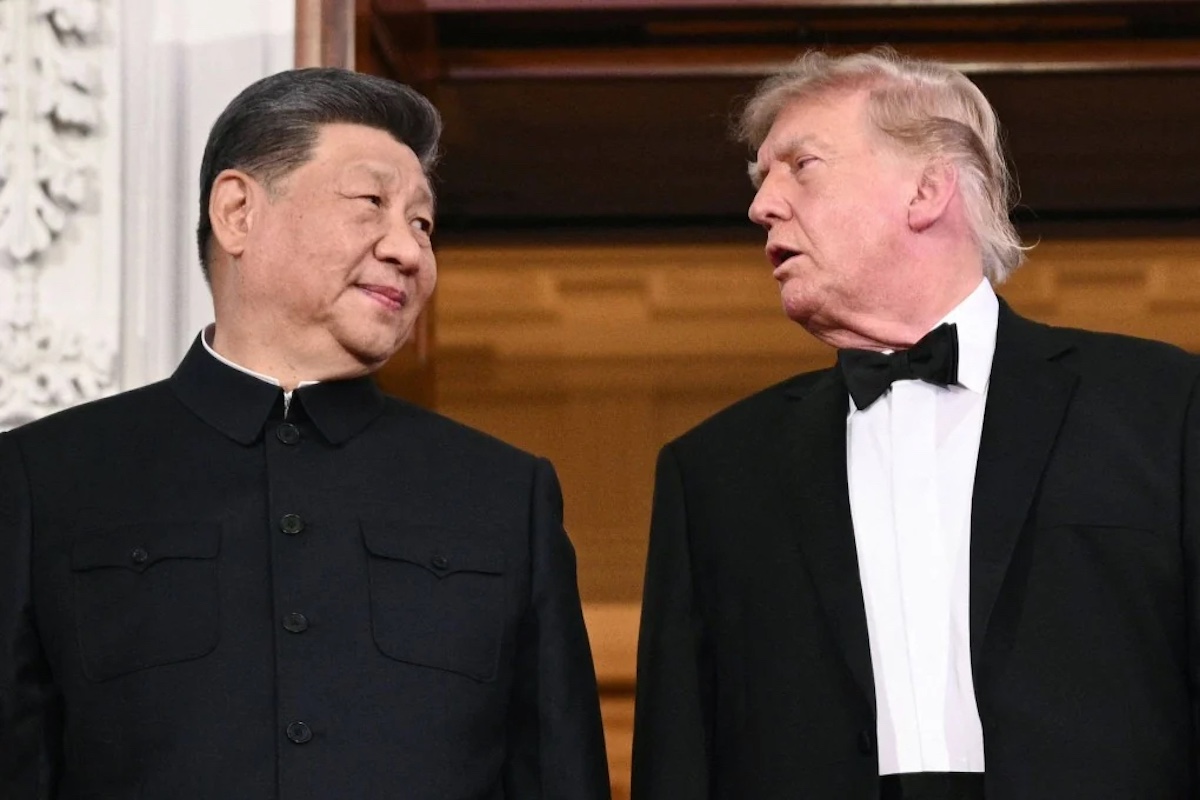
Fresh off disappointing US midterm election results that handed Democrats full control of Congress starting in 2027, and reeling from a high-profile Silicon Valley spy-linked scandal that has upended US semiconductor policy, former US President Donald Trump is set to travel to Shenzhen on November 19 for an unprecedented three-way summit with Chinese President Xi Jinping and Russian President Vladimir Putin. The closed-door talks carry echoes of 20th-century great-power horse-trading, leaving US allies across Kyiv, Tokyo, and beyond deeply anxious about whether their core security and economic interests could be bargained away behind closed doors. The lead-up to the high-stakes meeting has been overshadowed by the abrupt resignation of Nvidia CEO Jensen Huang, who stepped down after admitting to a personal relationship with Alice Huang, a former executive at Singapore-based cloud firm Megaspeed now at the center of allegations that top-tier US AI chips have been illegally diverted to China. The scandal has thrown a harsh spotlight on two deeply controversial Trump administration decisions: the move to allow Nvidia to continue selling high-end AI semiconductors to Chinese buyers, and widespread accusations that Commerce Secretary Howard Lutnick deliberately dragged his feet on implementing strict semiconductor export curbs, a delay that critics allege benefited companies tied to his family’s financial firm Cantor Fitzgerald. Even Treasury Secretary Scott Bessent has begun publicly distancing himself from Lutnick, while a rare bipartisan coalition of congressional Democrats and China-focused Republican hawks is demanding full public accountability, with multiple lawmakers calling for senior administration resignations over the missteps. Trump’s top immediate priority for the Shenzhen APEC-hosted summit is to extend the fragile US-China tariff ceasefire set to expire on January 10, a goal that has grown far more complicated than administration officials initially anticipated. Since the US imposed sweeping “Liberation Day” tariffs on Chinese goods back in April 2025, Xi has repeatedly demonstrated his ability to outmaneuver Trump in trade negotiations, with the US president typically walking away from past talks with nothing more than vague, non-binding promises of future discussions. This dynamic plays directly to Beijing’s advantage, as rising US inflation, underwhelming domestic economic growth, and widespread voter perception that the existing tariffs act as a hidden tax on household budgets contributed directly to the Democratic wave midterm victories on November 3. To justify the economic pain his tariff policies have imposed on American consumers, Trump needs to secure a high-profile “grand bargain” he can market to voters as a clear win, and Xi holds most of the negotiating leverage – including near-dominant control over global supplies of critical rare earth minerals essential to advanced tech manufacturing. Analysts from Union Bancaire Privée, including economist Carlos Casanova, warn that the upcoming APEC gathering is unlikely to deliver market-moving breakthroughs, as tight domestic political constraints on both sides rule out major concessions or substantive new policy announcements. The most plausible outcome, Casanova notes, is a series of face-saving, low-stakes gestures – such as China placing large new orders for Boeing aircraft or US soybeans – that allow both leaders to claim a public victory without altering the underlying structural tensions between the two economies. Even if Trump manages to keep the Nvidia scandal off the formal summit agenda, independent geopolitical analysts warn the long-term political damage is already irreversible. London-based Enodo Economics chief Diana Choyleva points out that the scandal has effectively silenced the most influential Washington voices pushing for relaxed semiconductor export rules, leaving Nvidia completely unable to lobby against upcoming congressional restrictions. With Democrats set to take control of both chambers of Congress in January 2027, pressure to tighten tech curbs on China will only intensify, even as Beijing is left with even less confidence in the long-term stability of the existing US-China trade truce. For Beijing, tighter chip restrictions only reinforce the wisdom of its long-running push for full technological self-reliance, and its rare earth export controls give it a powerful, ready-made retaliatory tool. Choyleva adds that the Nvidia scandal has accelerated the already inexorable “Great Decoupling” between the world’s two largest economies, a trajectory that will continue even if all parties involved in the Megaspeed probe are fully exonerated. Eurasia Group analyst Dominic Chu echoes this assessment, noting that Huang’s resignation removed the US tech industry’s most effective lobbyist and his direct line of communication to Trump, leaving congressional negotiators free to advance three sweeping new semiconductor restriction bills that would have faced far more pushback previously. The fallout extends far beyond geopolitics, with Deutsche Bank analysts warning that a potential collapse of the current US AI boom poses an existential threat to the long-standing global dominance of the US dollar as a safe-haven asset, the primary invoicing currency for global oil trade, and the backbone of stability for US Treasury and equity markets. Deutsche strategist Mallika Sachdeva argues that the decades-old “petrodollar” system is rapidly being replaced by a new “chip-dollar” order, where the greenback’s value is increasingly tied to volatile foreign inflows into US AI and tech stocks rather than long-term Treasury holdings, making the currency far more prone to sudden swings. The Trump administration’s recent push to designate two dozen major AI and tech firms – including Amazon, Anthropic, Microsoft, and OpenAI – as state-backed “national champions,” with access to fast-track licensing and public financing for overseas expansion, has drawn widespread criticism for copying the industrial policy playbook long used by the Chinese Communist Party. Observers have noted a rapidly growing list of parallels between current US economic policy and the state-centric systems Washington once publicly criticized in Beijing: government equity stakes in chip firms like Intel, a “golden share” veto over the Nippon Steel acquisition of US Steel, informal demands for a 25% cut of Nvidia’s China chip sales, increased political pressure on independent media, less transparent official economic data, and growing interference in the judicial system. Last year, Trump famously moved to fire the head of the Bureau of Labor Statistics over unsubstantiated claims of “rigged” jobs numbers, and pressured Goldman Sachs to dismiss its chief economist after he publicly labeled Trump’s tariff policies inflationary, leading critics to accuse the administration of resurrecting formal cronyism in US governance. Even the historically independent US Federal Reserve, long viewed as the bedrock of global financial credibility, has come under unprecedented political pressure under Trump’s watch. Led by Chair Kevin Warsh since May 2025, the Fed is struggling to maintain its independence even as US national debt surpasses $40 trillion and the US loses its last remaining AAA credit rating. Former Chair Jerome Powell previously pushed back against Trump’s threats to fire him, arguing that central bank policy must be set based on empirical economic data rather than political intimidation, and drew rare bipartisan support from congressional leaders to defend the institution’s autonomy. Still, political meddling continues: Fed Governor Stephen Miran, on partial leave from his White House advisory role, recently called for 150 basis points of emergency interest rate cuts in January 2026, a proposal wildly out of step with current inflation projections that rattled global bond markets. Trump has also pressured government-sponsored housing enterprises Fannie Mae and Freddie Mac to purchase $200 billion in mortgage-backed securities – a policy tool previously reserved for the Fed to deploy only during extreme credit crises, which Allianz economist Mohamed El-Erian has dubbed “people’s QE.” While the Chinese yuan is not on track to displace the dollar as the world’s primary reserve currency in the near term, analysts warn that sustained political interference in US central bank policy puts the greenback’s long-term stability at serious risk. Beyond trade and tech, the three-way Shenzhen summit is also set to cover regional security flashpoints including Iran, where the three leaders share overlapping interests in keeping the Strait of Hormuz open to maintain stable global energy prices and preventing Tehran from acquiring nuclear weapons. The very fact that Xi and Putin are joining Trump for coordinated discussions on Middle East security is already causing unease in Tehran, while Beijing is positioning itself to emerge as the primary global security guarantor for states across the Global South. Atlantic Council analyst Andrew Peek notes that the hastily arranged trilateral meeting will matter far more for its global optics and precedent than any concrete signed agreements, marking a historic shift in the global order away from decades of US-led unipolar governance toward a new era of overt great-power rivalry. Ahead of the Shenzhen trip, Trump made a stop at the ASEAN summit in Manila, where he delivered largely empty public rhetoric but secured few tangible trade or security commitments, failing to deliver results for American voters exhausted by years of tariff-driven inflation. While Trump may leave Shenzhen with a carefully staged headline victory to sell to domestic voters, and Xi may walk away with another quiet tactical win, analysts agree that neither outcome will reverse the deep, structural forces driving the US and China further apart. The core question no longer is whether US-China decoupling will continue, but how much economic and geopolitical turbulence the rest of the world will face as the two superpowers steadily disentangle their deeply interconnected economies.