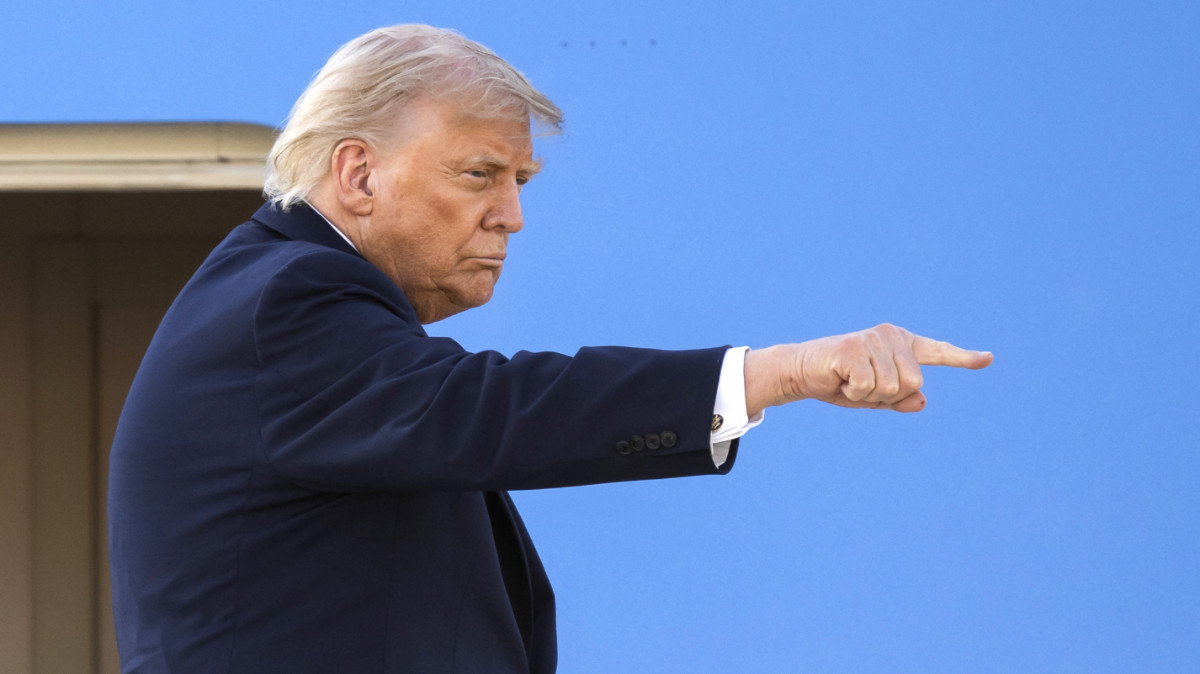
Speaking to reporters on the sidelines of the G-7 Summit in Evian, France on Wednesday, former U.S. President Donald Trump laid out contradictory stances on his administration’s newly announced 60-day ceasefire agreement with Iran, blending aggressive military threats against Tehran with key concessions that have already drawn fierce criticism from hardline pro-Israel allies in his own Republican Party.
The core of the agreement is a temporary memorandum of understanding (MOU) that keeps the strategic Strait of Hormuz, a vital global chokepoint for oil and maritime trade, toll-free for the next two months. Under the terms of the deal, Iran will negotiate the future governance of the strait alongside Oman and other Persian Gulf littoral states in line with international law, leaving open the possibility of navigation fees being imposed after the ceasefire period ends. The White House has framed the ceasefire extension, announced publicly this past Sunday, as a first step toward reaching a permanent end to the ongoing conflict that has roiled global energy markets.
In unusually candid remarks, Trump acknowledged his biggest political risk tied to the conflict: economic fallout that could sink his presidency, echoing the political fate of Republican President Herbert Hoover, who left office in disgrace after the 1929 stock market crash and the onset of the Great Depression. “The one president I did not want to be was the late, great, Herbert Hoover,” Trump said, noting that stock markets have shifted directly in response to signals about whether the conflict would end or escalate. “The stock market is more brilliant than anybody there is, including the people on this stage, other than me, of course.”
The president went on to stress that Tehran’s blockade of the Strait of Hormuz had inflicted enough economic damage globally to push his administration to agree to the ceasefire extension. Even so, he adopted a belligerent tone when discussing enforcement of the MOU, repeating multiple times that he would resume large-scale military bombing of Iran if he disapproved of Tehran’s compliance. “It’s a memorandum of understanding. And if I don’t like it, we’ll go back to shooting at them, dropping bombs on their head,” Trump said. “If I don’t like it, if they don’t behave, we’ll go right back to dropping bombs right smack in the middle of their head, OK?”
The deal has already come under intense fire from Iran hawks and pro-Israel voices in the U.S., who have pushed for a full rollback of Iran’s nuclear program, ballistic missile arsenal, and regional military influence. Trump acknowledged that the terms of the MOU would amplify this criticism: the agreement does not address Iran’s nuclear program in any detail, leaving that critical issue for future negotiations during the 60-day ceasefire period.
Pushing back against demands that the U.S. seize Iran’s existing enriched uranium stockpiles, Trump argued that the material is buried deep in underground facilities that only the U.S. and China have the technical capacity to access, adding that international cameras are already in place to monitor suspect sites. He also rejected longstanding Israeli demands that Iran be barred from any enrichment activity entirely, noting that neighboring countries in the region maintain their own nuclear energy programs. “It’s a little hard when other people have it, other adjoining states have it, and you’re not letting them have it for purposes of electricity and things like that. You have to use a little common sense,” he said.
This stance marks a clear shift from Trump’s 2017 decision to unilaterally withdraw from the Obama-era Joint Comprehensive Plan of Action (JCPOA), the multilateral nuclear agreement that placed strict limits on Iran’s nuclear program in exchange for sanctions relief. Trump has framed his new framework as different from the JCPOA, arguing that the threat of ongoing U.S. military force prevents Iran from ever acquiring a nuclear weapon. “Whoever sells them a nuclear weapon would get nuked themselves,” he claimed, though the JCPOA already explicitly barred Iran from pursuing a nuclear weapons program.
Trump also dismissed demands from hawks and Israel that Iran be forced to completely eliminate its ballistic missile program, which he previously cited as a core justification for launching U.S. strikes against Iran. Arguing that it is unreasonable to bar Tehran from possessing any missiles when neighboring Gulf states like Saudi Arabia maintain their own arsenals, Trump claimed that U.S. strikes have already destroyed roughly 80 percent of Iran’s existing missile capacity. “Doesn’t work that way,” he said of demands for full disarmament.
On economic policy, Trump confirmed that the U.S. will not directly invest in Iran to help rebuild the country, which he estimated has sustained around $2 trillion in damages from U.S. and Israeli strikes. He added that Washington will not block neighboring Arab Gulf states from investing in Iran if a final peace deal is reached, a stance that is already fueling speculation that states including the UAE, Saudi Arabia, Kuwait and Qatar will move to normalize economic ties with Tehran in the coming months.
The president also drew backlash from hawks by confirming that he is open to returning billions of dollars in Iranian assets that have been frozen by Western sanctions, stating that the assets “is not our money” and will eventually need to be returned. The move is certain to please Tehran while hardening opposition from pro-Israel lawmakers in Washington.
Trump’s remarks swung between sharp criticism of Iran and faint praise for the country’s leadership. He referred to Iran as having a “primitive culture” while also acknowledging that Iran’s leaders “love their country.” He also openly boasted about U.S. strikes on Iranian civilian infrastructure, specifically highlighting the April 1 bombing of the Karaj B1 bridge, which he compared to New York’s George Washington Bridge.
In a surprising acknowledgment, Trump thanked both Chinese President Xi Jinping and Russian President Vladimir Putin for maintaining neutrality during the conflict, noting that both countries could have made the military campaign far more difficult for the U.S. Multiple independent outlets have previously reported that China and Russia provided Iran with arms and intelligence support during the fighting. “I just want to thank them because they made it a lot better,” Trump said. “I want to thank China, President Xi. I was with him, and he stayed neutral, totally neutral, and I appreciate it. And I want to thank Vladimir Putin; he was very neutral. They could have made it much more difficult for us.”
Trump also confirmed that the United Arab Emirates participated directly in offensive airstrikes against Iran during the conflict, saying he was caught off guard by the scale of the UAE’s military involvement. “He was dropping bombs last week, I said, ‘who the hell’s dropping all those bombs?’ It was the UAE. He’s a good fighter,” Trump said of UAE President Mohamed bin Zayed. The comments were made during a wide-ranging, rambling press conference flanked by top senior administration officials including Secretary of State Marco Rubio, Secretary of Commerce Howard Lutnick and Treasury Secretary Scott Bessent.