Escalating tensions across the Middle East reached a new boiling point on Sunday, as former President Donald Trump delivered a stark ultimatum to Iran, demanding Tehran immediately accept a U.S.-brokered peace deal or face catastrophic consequences that would leave the Islamic republic “nothing left.”
The regional conflict, which began on February 28 when joint U.S. and Israeli military forces launched large-scale strikes against Iran, has remained deadlocked for weeks, failing to produce any breakthrough toward de-escalation even as it sends shockwaves through global energy markets and upends security across the Middle East. In a post published Sunday on his Truth Social platform, Trump doubled down on pressure against Tehran, writing, “For Iran, the Clock is Ticking, and they better get moving, FAST, or there won’t be anything left of them. TIME IS OF THE ESSENCE!”
Beyond the core U.S.-Iran conflict, the war has triggered widespread secondary instability across the region. It has effectively blocked the Strait of Hormuz, the strategic global chokepoint through which roughly 20% of the world’s peacetime oil exports pass. It has also dragged neighboring Israel and Lebanon into a violent parallel confrontation, even as fragile ceasefires hold in name on multiple fronts.
Iran, which provides military and financial support to the Lebanese militant group Hezbollah, has set a precondition of a permanent ceasefire in southern Lebanon before it will enter any broader peace negotiations with the U.S. That demand comes as Trump has grown increasingly frustrated by Tehran’s refusal to accept terms on Washington’s schedule.
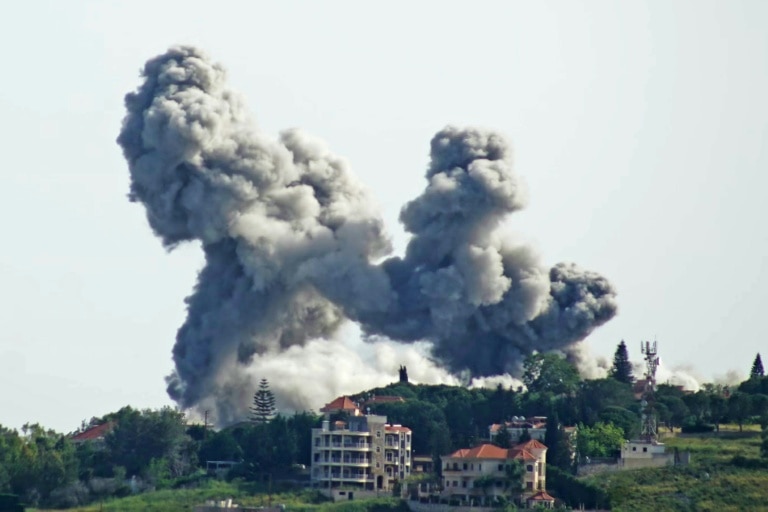
The situation on the Lebanese border remained deadly over the weekend, despite a recently extended ceasefire between Israel and Hezbollah. An unnamed Israeli military official confirmed Sunday that Hezbollah launched approximately 200 projectiles at Israeli territory and military positions over the previous 48 hours. In response, new Israeli airstrikes across southern Lebanon killed five people, including two children, according to Lebanon’s health ministry. Lebanese official data underscores the scale of the human toll: since the broader regional war began, more than 2,900 people have been killed in Lebanon, with 400 of those deaths occurring after a partial truce took effect on April 17.
While a bilateral truce between Washington and Tehran went into effect on April 8, peace negotiations have remained completely stalled, with low-level sporadic attacks continuing across multiple fronts. On Sunday, Iranian state media pushed back against U.S. negotiating positions, reporting that Washington had failed to offer any concrete concessions in its latest response to Iran’s proposed negotiation agenda.
According to Iran’s semi-official Fars News Agency, the U.S. delivered a five-point proposal that includes extreme demands: requiring Iran to operate only a single nuclear facility and transfer its entire stockpile of highly enriched uranium to U.S. control. The report added that Washington has also refused to release even 25% of the billions of dollars in Iranian assets frozen abroad, and has rejected any calls for reparations to cover war-related damage to Iranian infrastructure. Another major Iranian state outlet, Mehr News Agency, summed up Tehran’s view of the negotiation impasse, noting that “the United States, offering no tangible concessions, wants to obtain concessions that it failed to obtain during the war, which will lead to an impasse in the negotiations.”
Unrest spread beyond the core conflict zones on Sunday, as authorities in the United Arab Emirates confirmed that a drone strike sparked a fire near a nuclear power plant in Abu Dhabi. Officials reported no injuries and no disruption to plant operations or radiation levels, but the attack underscores the spread of violence to Gulf states. The strike follows a pattern of recent attacks linked to Iranian-backed armed groups, which maintain drone-equipped factions in Iraq, while Tehran’s Yemeni ally the Houthi movement also operates advanced combat drones capable of long-range strikes.
Diplomatic efforts to break the impasse continued Sunday, with Pakistan stepping in as a third-party mediator. Pakistani Interior Minister Mohsin Naqvi held talks in Tehran with Iran’s chief negotiator and parliament speaker Mohammad Bagher Ghalibaf. Following the meeting, Ghalibaf emphasized the far-reaching destabilizing impact of the U.S.-Israeli war on the entire Middle East. “Some governments in the region believed that the presence of the United States would bring them security, but recent events showed that this presence is not only incapable of providing security, but also creates the grounds for insecurity,” he said in a social media statement.
Earlier this week, Trump held a high-stakes summit with Chinese President Xi Jinping where the Iran conflict was a core topic of discussion, but the meeting produced little visible progress toward a diplomatic resolution. Trump claimed after the meeting that Xi assured him China would not provide military assistance to Iran. For its part, the Chinese Foreign Ministry released a statement Friday calling for the immediate reopening of global shipping lanes through the Strait of Hormuz, aligning with global calls to restore critical energy trade routes.