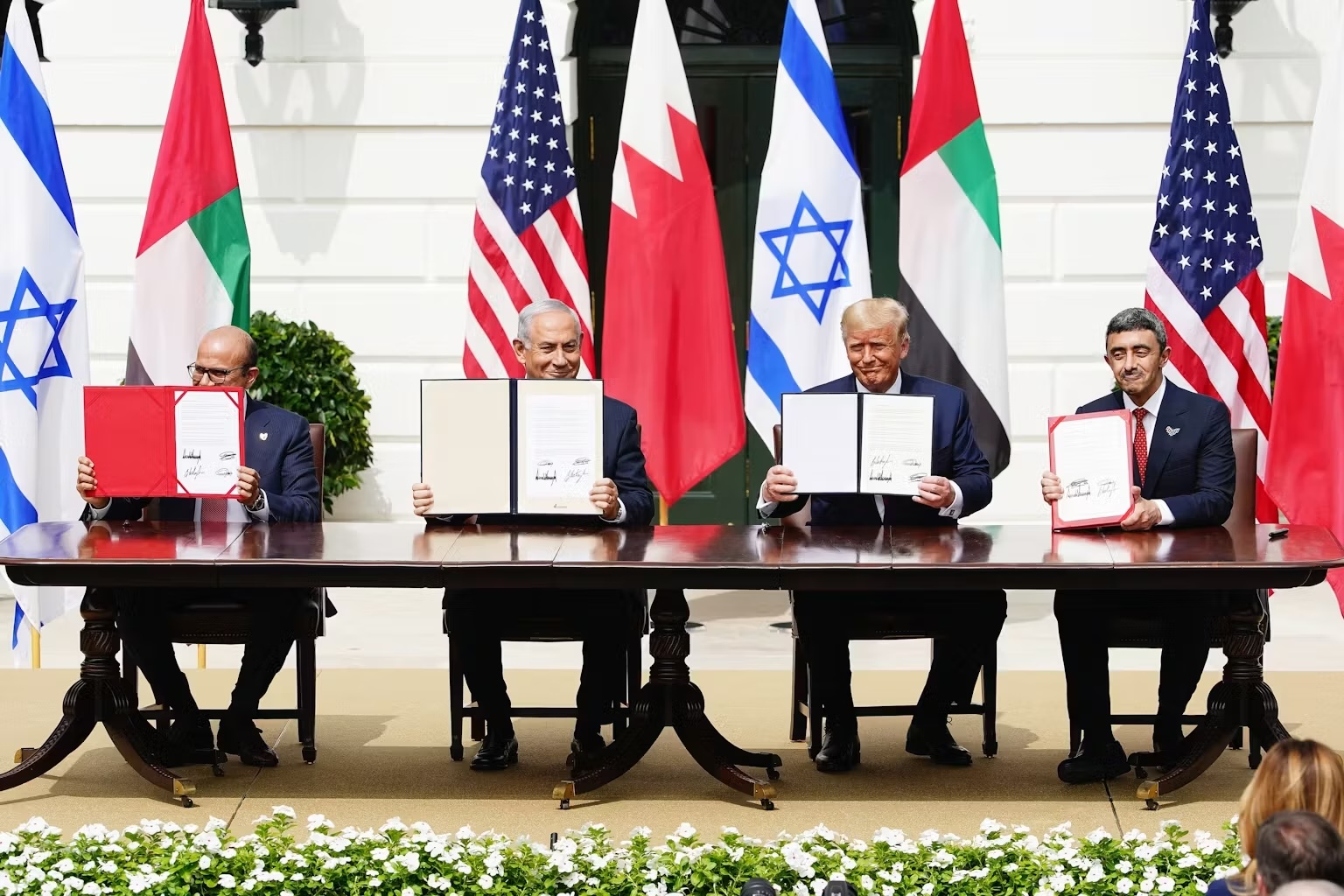
As Washington and Tehran work toward a potential peace agreement to end months of open conflict, former President Donald Trump has thrown a new, contentious requirement onto the negotiating table: any final deal must include commitments from regional Middle Eastern nations to join his Abraham Accords framework, normalizing their formal diplomatic relations with Israel. This unexpected demand comes against a backdrop of shifting strategic fortunes for the U.S. and Israel, which launched their joint military operation ‘Operation Epic Fury’ against Iran back in late February. Today, both nations find themselves in a weaker position militarily, strategically, and economically than they were on the eve of that offensive. The long-standing alliances Washington built with Persian Gulf states are now facing major reevaluation, as those partnerships failed to stop Iran from launching retaliatory attacks on Gulf territory. Meanwhile, despite months of devastating strikes that killed dozens of top Iranian political and military leaders, Iran emerges from the conflict with greater regional influence than it held before. Against this unsteady landscape, both Trump and Israeli Prime Minister Benjamin Netanyahu face urgent domestic political pressures: both are seeking a symbolic, electorally appealing win ahead of key upcoming votes — the U.S. midterm elections and Israel’s Knesset vote, both scheduled for later this year. This political calculus is a core driver behind Trump’s push to resuscitate the Abraham Accords, a policy he has repeatedly highlighted as one of the signature foreign policy achievements of his first presidential term. Over the weekend, Trump held a series of phone calls with regional leaders from Saudi Arabia, Qatar, Pakistan, the United Arab Emirates, Bahrain, Turkey, Egypt, and Jordan, where he made clear that their inclusion in any final Iran peace deal would be contingent on their full participation in the accords, a requirement that obligates them to formalize full diplomatic ties with Jerusalem. First conceptualized during Trump’s first term, the Abraham Accords were a set of U.S.-brokered diplomatic initiatives overseen by then-White House senior advisor Jared Kushner, Trump’s son-in-law. The framework was framed as a groundbreaking attempt to resolve the decades-long Palestinian-Israeli conflict and broader tensions between Arab states and Israel. The dispute over Palestinian statehood has cast a shadow over Arab politics since the founding of Israel and the 1948 Arab-Israeli War, and it remains the most politically salient issue for Arab public opinion today, even as many regional leaders have sought to distance themselves from the conflict in recent years. Over decades of U.S.-backed diplomatic outreach, Israel has gradually eroded collective Arab opposition to its presence in the occupied Palestinian territories, beginning with the 1979 peace treaty with Egypt and the 1994 agreement with Jordan, a process that accelerated with the 2020 launch of the Abraham Accords. In the lead-up to the 2020 accords, the Trump administration took a series of steps widely seen as pro-Israel concessions: it moved the U.S. embassy from Tel Aviv to Jerusalem, shuttered the Palestine Liberation Organization’s official Washington office, and reversed long-standing U.S. policy by declaring that Israeli settlements in the West Bank were no longer considered illegal under international law. That same year, the administration launched its ‘Peace to Prosperity Plan’, which departed from decades of prior peace efforts by sidelining Palestinian demands for full statehood, instead promising economic development to the region in exchange for abandoning Palestinian statehood claims. The UAE and Bahrain became the first signatories to the Abraham Accords in September 2020, followed by Morocco in December 2020, Sudan in January 2021, and Kazakhstan in November 2025. In exchange for their recognition of Israel, the U.S. offered participating states significant incentives, including economic cooperation deals, advanced military hardware, and diplomatic concessions. For example, the UAE secured access to cutting-edge U.S. military technology, while the U.S. formally recognized Morocco’s claim to sovereignty over the Western Sahara. The long-held top priority for U.S. and Israeli negotiators has been securing Saudi Arabia’s signature on the accords. Many analysts believe this was a core motivating factor behind Hamas’ October 2023 attacks on Israel, as the group sought to derail ongoing normalization talks between Riyadh and Jerusalem. Since Israel’s full-scale retaliatory war in Gaza began, Saudi Arabia has remained a vocal international advocate for Palestinian statehood, and has publicly stated it will not join the Abraham Accords without ironclad international guarantees for Palestinian self-determination. Other major regional powers, including Pakistan, Qatar, and Turkey, also face massive domestic pressure from their populations, who overwhelmingly support Palestinian statehood, making participation in the accords politically toxic. For any of these nations to reverse course, the U.S. would need to offer unprecedented economic and security incentives while applying extreme diplomatic pressure. To date, Pakistan has already formally rejected Trump’s demand, and all indications suggest Saudi Arabia will do the same. As currently structured, the Abraham Accords remain far too politically unpopular across most of the region for leaders to entertain participation, even when tied to the critical goal of ending the Iran war. Despite these headwinds, Trump and Netanyahu show no signs of backing away from their push. For Netanyahu, securing new signatories to the accords would allow him to frame closer regional integration as a political win as his military continues its offensive against Hezbollah and its occupation and destruction of southern Lebanon. Even so, this would be a minor gain compared to his long-stated core goal of eliminating the Iranian threat to Israel, and it is unlikely to ease growing domestic backlash against his government from an increasingly overstretched Israeli military that is facing growing casualty and equipment losses. Expanded regional ties with Israel also will not reverse the rapid shift in regional public opinion that has turned sharply against Jerusalem in recent years, a shift that is even visible among portions of Trump’s own MAGA base in the U.S. For the Trump administration, a win on the Abraham Accords would help offset political damage from the costly Iran conflict, which has left U.S. weapons stockpiles severely depleted, fueled a global energy crisis that has stoked widespread domestic discontent in the U.S., eroded Gulf allies’ confidence in the U.S. security umbrella, and created friction with Netanyahu, who has openly opposed any peace deal with Iran. But as the Middle East undergoes a dramatic strategic reorientation, an increasing number of regional leaders view the Abraham Accords as a U.S.-imposed framework that prioritizes Washington and Jerusalem’s interests over regional needs. Many regional states are now pursuing their own independent initiatives to reshape regional security to their benefit. Most notably, Saudi Arabia has recently proposed a regional non-aggression pact that would include Iran, modeled on the Cold War-era Helsinki Accords that de-escalated tensions between European blocs. Some analysts speculate that Trump’s push to expand the Abraham Accords is partially intended to counter this independent Saudi initiative, while also shoring up political support from pro-Israel factions ahead of the midterms. The widespread silence that has greeted Trump’s latest demand, however, suggests that many regional states are no longer willing to comply with U.S. demands, even when offered major incentives in return.