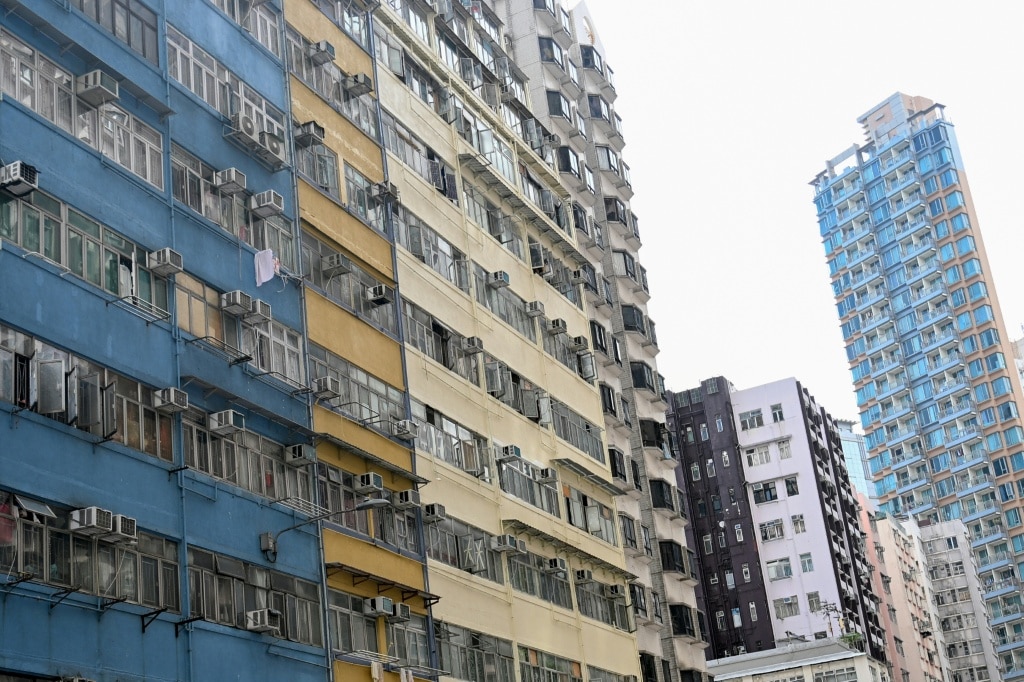
For decades, Hong Kong has grappled with a crippling housing crisis: sky-high rents, acute supply shortages, and deep-rooted inequality have pushed hundreds of thousands of low-income residents into cramped, substandard living spaces known as “shoebox flats.” Now, a long-awaited regulatory reform aimed at phasing out these unsafe, tiny units has pushed the city’s most vulnerable households into limbo, as early evictions and a lack of affordable alternatives leave many unsure where they will go next.
The new regulation, which came into force in March, grew out of a directive from Chinese President Xi Jinping for the global financial hub to address its long-running housing woes. Under the new rules, any subdivided unit smaller than 8 square meters (86 square feet) is banned, and mandatory safety and hygiene standards are imposed – requirements including at least one openable window, an enclosed toilet space, and permanent access to a sink. Property owners who register their subdivided units are given until 2030 to complete required renovations or restructure their properties, but many landlords have already moved ahead with eviction notices to clear out tenants ahead of the deadline.
Forty-eight-year-old Lisa Lau, a welfare recipient who receives roughly $930 per month, $330 of which goes to rent, has been living in a 3-square-meter (32-square-foot) subdivided unit in Sham Shui Po, one of Hong Kong’s poorest neighborhoods. Her unit is one of nine separate cubicles split from a single apartment in a 60-year-old walk-up, separated only by thin wooden dividers. With no space for a kitchen, Lau cooks soup and noodles on a rice cooker placed directly on her bed, and shares a single toilet and shower with all other residents of the unit. To keep out rodents and cockroaches, she has taped a foam board across the bottom of her doorway. Months ago, she received an eviction notice, and like many other low-income tenants, she has no clear plan for what comes next.
“I’ll stay here day by day,” Lau told Agence France-Presse. “I don’t know where to go. I’m scratching my head.” Despite the cramped, unsanitary conditions, Lau is reluctant to leave the neighborhood where she has built a small social network, and is waiting to hear if her application for nearby transitional housing will be approved. “As long as the landlord doesn’t come to evict residents, we are so at peace, we are so comfortable,” she said.
Local authorities estimate that more than 220,000 people across Hong Kong’s 7.5 million population live in these shoebox subdivisions, with roughly one-third of all units requiring major structural upgrades to meet the new standards. The Hong Kong Housing Bureau says that more than 100 households have already moved out of Lau’s building, and officials are working to support the remaining 40 households to secure alternative accommodation. In response to inquiries, a government spokesperson noted that authorities have significantly expanded public housing supply, with a target of delivering roughly 196,000 new public units over the next five years, and have sped up application processing for residents waiting for public housing. These measures, the spokesperson said, will reduce overall demand for subdivided units and help keep private market rents stable.
But advocacy groups working with low-income communities say the reform does not go far enough to address the underlying shortage of affordable housing in central, well-connected areas of the city. The Society for Community Organization, a non-profit that supports underprivileged groups, acknowledges that the new rules will help eliminate some of the most dangerous living conditions in the city. But deputy director Sze Lai-shan argues that without more accessible government-supported housing, many poor residents will be left without viable options.
“Don’t expect these people who live in very small flats to move into the new basic housing units. They won’t be able to afford it,” Sze said. “A lot of the poorest people will be very dependent on the government to resettle them.” The organization has documented roughly 300 households already facing forcible eviction – a far higher number than the 35 eviction notices the government says it has received – and Sze expects hundreds more cases to emerge in coming months. While some evicted residents have moved into public or transitional housing, many others have simply relocated to other unregulated, substandard subdivided flats as a temporary stopgap.
The crisis hits even closer to home for low-income workers like 63-year-old Liu Xiaoli, who faces eviction from her current subdivided unit. Divorced, Liu works two part-time jobs as a cook and cleaner to support her daughter and granddaughter on mainland China, and already stretches her income to cover current rent. “If the rent here or in other places goes up, I really can’t afford it,” Liu said. She has been unable to find any alternative accommodation in the area that meets the government’s new size and safety requirements, so she is only delaying the inevitable. “Right now, I’m just delaying as much as I can.”
Notably, the new regulations do not extend to Hong Kong’s even more cramped “coffin homes” – stacked cubicles that resemble oversized bunk beds in dilapidated shared dormitories. Sixty-four-year-old Wan Hon-cheung has lived in a plywood coffin home roughly the size of a single bed for 10 years. He suffers from mobility issues that require a cane, making climbing into his elevated cubicle difficult, and is regularly bitten by bedbugs. He says he hopes the government will eventually extend reforms to improve conditions for people like him, but he has accepted his circumstances. “For us lower classes… this is reality, there’s nothing to complain about.”