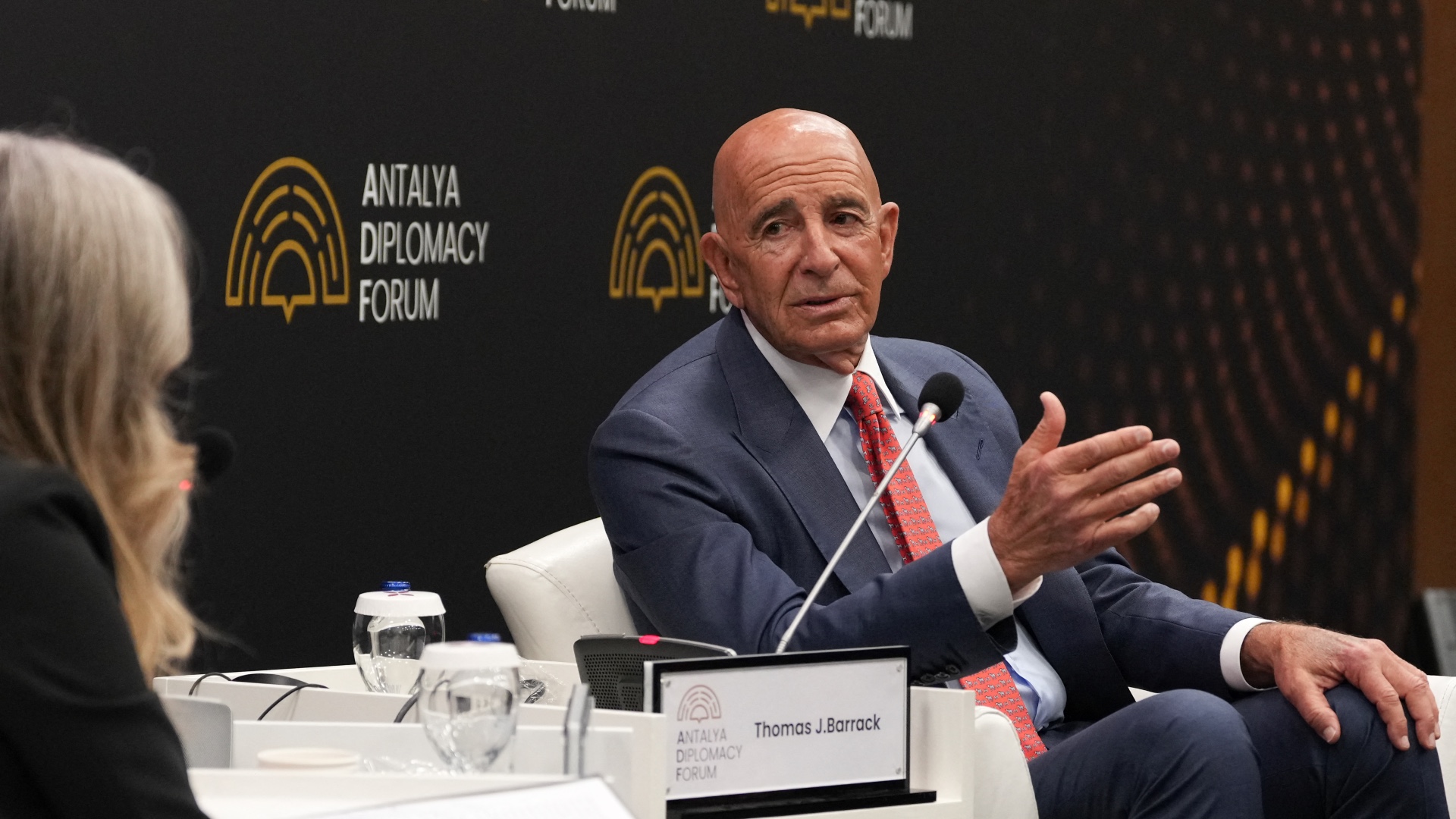
In the wake of an Israeli air strike targeting the Abu al-Duhur military air base in northern Syria, the United States’ special envoy for Syria, Tom Barrack, has publicly broken with common US framing to defend the new Syrian administration, labeling the attack an unnecessary escalation of regional tensions.
Barrack, who met one day prior with Syrian Foreign Minister Asaad al-Shaibani in Istanbul, Turkey, laid out his assessment in a public post on the social platform X. “The Al-Sharaa government has neither adopted a predatory posture nor maintained proxy forces,” he wrote. “It has, in fact, repeatedly indicated a preference for de-escalation with Israel.” Barrack added that Washington views the strike with deep concern, noting “[This] does not advance regional stability.” While Israeli officials have not officially acknowledged responsibility for the attack, Barrack explicitly confirmed Israel carried out the operation.
Details released by the Syrian government confirm that eight precision strikes targeted the runway of the currently defunct air base in the early morning hours of Tuesday, local time. The Syrian Observatory for Human Rights later contextualized the strike, noting that the attack came days after a Turkish military delegation visited the airfield as part of ongoing efforts to reactivate the facility for operational use.
The strike is part of a consistent pattern of Israeli military activity inside Syria following the December 2024 departure of former president Bashar al-Assad, who fled to Russia amid a government transition. Since that leadership change, Israel has launched repeated strikes on targets across northern Syria and along the country’s western border, with a stated goal of degrading what remains of the Syrian Air Force. Israeli ground forces have also pushed into the UN-patrolled buffer zone that has separated the two countries under the terms of a decades-old disengagement agreement.
Despite this sustained military pressure, Syrian President Ahmed al-Sharaa confirmed last year that indirect diplomatic talks have been held between the two neighboring states. Syria and Israel have not maintained formal diplomatic relations since the 1967 Arab-Israeli War, when Israel seized control of Syria’s Golan Heights and later unilaterally annexed the territory in a move not recognized by the international community. Under the rule of former president Hafez al-Assad, the two sides signed a 1974 disengagement agreement that established a formal border security regime to reduce the risk of open conflict.
In comments previously given to The Washington Post, Sharaa explained his administration’s deliberate choice to avoid immediate retaliation for the thousands of Israeli air strikes that have hit Syrian territory in recent years. “Because we want to rebuild Syria, we didn’t respond to these aggressions,” he said. Sharaa also pushed back on Israel’s longstanding justification for its strikes, the claim that it targets Iranian-aligned Shiite militant proxies operating inside Syria. “we are the ones who expelled those forces out of Syria,” he noted, adding that Israeli incursions into Syrian territory stem not from legitimate security concerns but from clear expansionist ambitions.
Just last month, Foreign Minister Shaibani issued a formal condemnation of ongoing Israeli military activity, warning that Israel’s unlawful occupation of Syrian territory beyond the 1974 disengagement line poses a direct threat to overall regional security. Israeli officials reaffirmed as recently as last week that they intend to keep military forces deployed inside Syrian territory indefinitely.
Outlining the United States’ formal policy position on Tuesday, Barrack said Washington would continue to facilitate diplomatic discussions to encourage both nations to prioritize dialogue over military confrontation. “The United States has in the past, and will continue in the future, to host discussions to encourage diplomatic cadence over kinetic frustration for both nations,” Barrack said. “The United States continues to believe that restraint and engagement offer the more constructive course. We encourage all parties to prioritize logical discourse over further military incidents.”