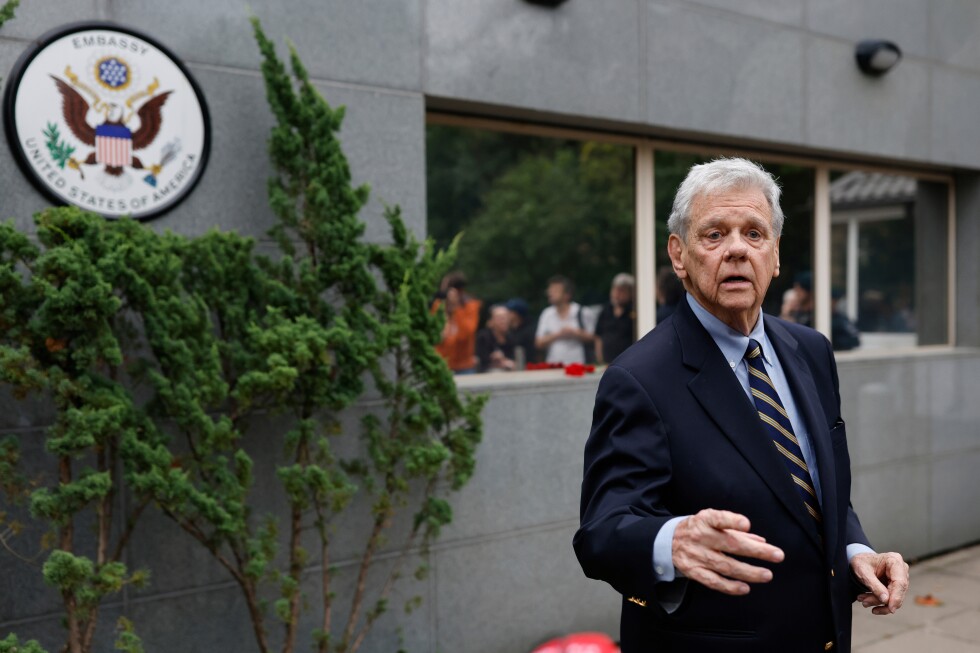
In a striking demonstration of unconventional diplomacy, U.S. Special Envoy to Belarus John Coale has revealed the unorthodox methods employed to secure the release of hundreds of political prisoners from the Eastern European nation. During a recent appearance at Arizona State University’s McCain Institute, Coale detailed how he deliberately mirrored the vulgar language and drinking customs of Belarusian President Alexander Lukashenko to establish rapport.
The envoy described how during their first meeting, which extended into a two-hour luncheon, he echoed Lukashenko’s disdain for European leadership using crude language that matched the autocrat’s tone. ‘I had him in my hand from then on,’ Coale stated regarding the moment he matched Lukashenko’s anti-European sentiments. To navigate the alcohol-heavy proceedings, Coale admitted to discreetly pouring vodka shots onto the floor when his host wasn’t watching, while some State Department colleagues became intoxicated after consuming eight toasts.
This approach appears to have yielded significant diplomatic gains. Last week marked the largest single release of political prisoners in Belarus’s history, with 250 individuals pardoned following Coale’s meeting with Lukashenko in Minsk. The release came as part of a bilateral agreement that resulted in the lifting of certain U.S. sanctions against the Belarusian regime.
Coale, a Maryland attorney appointed by former President Donald Trump in March 2025, defended his methods in an interview with The Associated Press: ‘If I have to use locker room language to get 500 political prisoners released, I will do it every time.’ His appointment came after he helped secure the release of 14 political prisoners in June 2025, which led to his elevation to special envoy.
The diplomatic breakthrough represents a strategic shift for Lukashenko, who has ruled Belarus with an iron fist for over three decades while maintaining close ties with Russian President Vladimir Putin. Since Trump’s return to the White House, Lukashenko has sought improved relations with the West, resulting in the gradual release of political prisoners in exchange for sanctions relief.
The released prisoners include prominent figures such as Nobel Peace Prize laureate Ales Bialiatski and opposition leaders Siarhei Tsikhanouski, Viktar Babaryka, and Maria Kolesnikova. Coale characterized the mass release as a ‘significant humanitarian milestone’ and credited Trump’s ‘commitment to direct, hard-nosed diplomacy’ for the progress.