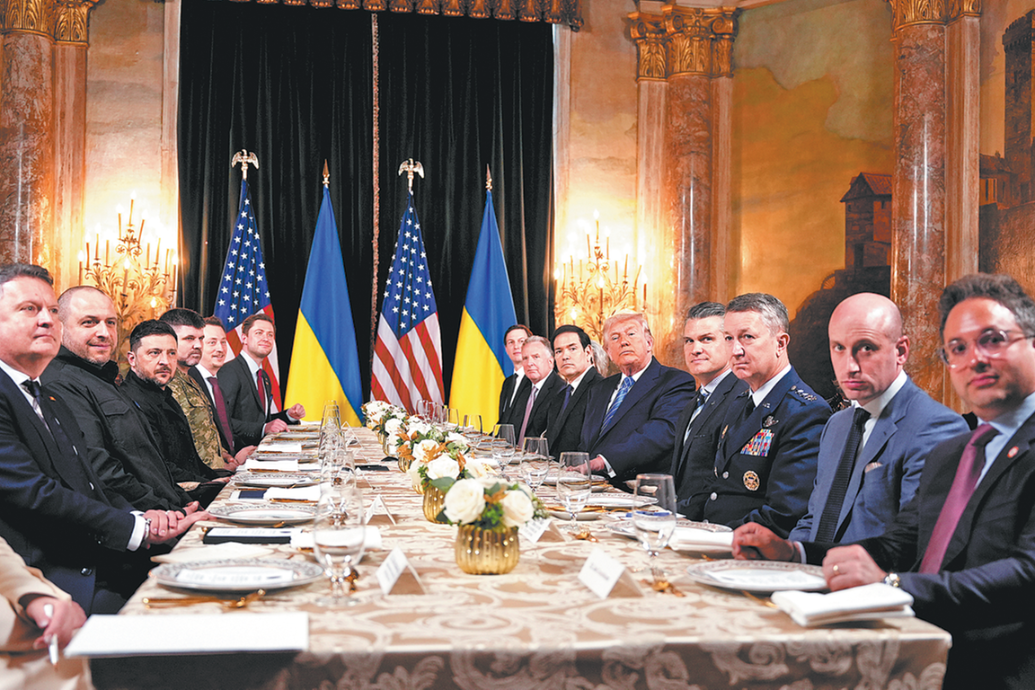
In a significant diplomatic development at his Mar-a-Lago estate, U.S. President Donald Trump characterized his Sunday meeting with Ukrainian President Volodymyr Zelensky as “terrific,” acknowledging substantive advancements toward a peace agreement while conceding that complex territorial issues remain unresolved in Europe’s deadliest post-WWII conflict.
The closed-door negotiations, attended by U.S. Secretary of State Marco Rubio and Defense Secretary Pete Hegseth alongside Ukrainian Economy Minister Oleksii Sobolev, produced limited public details but notable optimism from both leaders. Trump announced that considerable progress had been achieved, particularly regarding security arrangements, though he emphasized the complexity of the process, stating, “This is not a one-day process deal. This is very complicated stuff.”
President Zelensky revealed that approximately 90% of the peace framework had been agreed upon, with security guarantees constituting the cornerstone of the proposed agreement. The Ukrainian leader disclosed that Washington had offered “solid” 15-year security commitments with potential for extension, mirroring protections afforded to NATO members. This development suggests a potential compromise wherein Ukraine might suspend its NATO membership aspirations in exchange for equivalent security assurances from Western allies.
The negotiations occur against a backdrop of competing peace proposals, including a 28-point plan believed to originate from Moscow and a 20-point Ukrainian counter-proposal. Kremlin spokesman Yury Ushakov revealed that Trump and Russian President Vladimir Putin shared a “broadly similar view” during their pre-summit discussion that temporary ceasefires would merely prolong the conflict. Moscow continues to insist on Ukrainian withdrawal from Donbas and permanent retention of captured territories, including the Crimean Peninsula.
European coordination appears integral to the process, with Zelensky and Trump conducting joint telephone discussions with key European leaders following their meeting. French President Emmanuel Macron has announced a forthcoming gathering of Kyiv’s allies in Paris during early January, while Zelensky suggested potential multilateral talks in Washington next month.
Despite the measured optimism, both leaders refrained from establishing concrete deadlines, though Trump projected clarity within “a few weeks” regarding the viability of successful conflict resolution. The U.S. president characterized the remaining territorial disputes as “thorny issues” but expressed confidence they would be resolved, noting, “Russia would like to see it end, and Ukraine would like to see it end, and I think it’s time to end.”