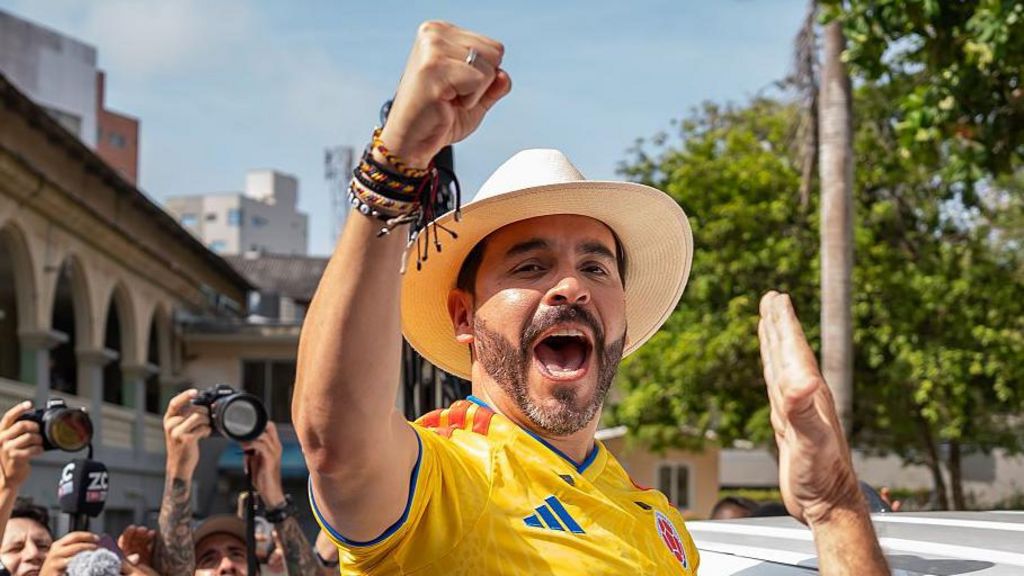
Colombia is facing a seismic political shift after preliminary runoff election results showed right-wing outsider candidate Abelardo de la Espriella, who goes by the nickname “El Tigre” (The Tiger), has secured a razor-thin victory over his left-wing opponent Iván Cepeda, a close ally of sitting president Gustavo Petro. With more than 99% of ballots counted in the June runoff, initial tallies put de la Espriella at 49.7% of the vote, compared to Cepeda’s 48.7% — a margin of just one percentage point that has left the nation deeply divided.
A lawyer and businessman with no prior elected political experience, de la Espriella campaigned on a hardline platform centered on reversing Petro’s flagship peace negotiation strategy and cracking down on the country’s spiraling armed conflict and drug trade. Endorsed early by former U.S. President Donald Trump, he has pledged to abandon all talks with illegal armed groups, including FARC dissidents, the ELN, and Clan del Golfo, and instead ramp up military operations against these organizations, expand cooperation with U.S. security agencies, and construct new maximum-security mega-prisons in remote jungle regions. He has also outlined plans to shrink the size of the national bureaucracy and overhaul Colombia’s public health system.
Colombia’s decades-long internal conflict has escalated sharply in recent years: armed group membership has doubled over the last five years, as factions fight for control of profitable cocaine trafficking routes and illegal mining operations. As the world’s top cocaine producer, Colombia has seen output hit record highs, and a 2025 offensive along the Venezuela border displaced more than 30,000 people. Critics of Petro’s “total peace” initiative, which prioritized ceasefires and negotiations with armed groups, argue the policy has allowed criminal organizations to expand their territory and power unchecked, creating a opening for de la Espriella’s tough-on-crime message to resonate with voters.
Raised on Colombia’s Caribbean coast, de la Espriella drew overwhelming regional support, and celebrated the preliminary result alongside thousands of jubilant supporters in Barranquilla, addressing the crowd from a stage lined with images of his face. “Tonight marks the beginning of a new story for the nation, tonight a new era begins, a change of order,” he told the gathered crowd. He emphasized he would govern for all Colombians — both his supporters and those who backed his opponent — and pledged unwavering loyalty to the country’s 1991 constitution. Supporters waved national flags, donned yellow Colombian national football jerseys (a staple of de la Espriella’s campaign that critics have slammed as politicization of the national team), and chanted slogans including “Petro out!” and “Make Colombia Great Again” on red baseball caps echoing Trump’s iconic campaign merchandise. Fireworks capped off the evening of celebration.
The narrow margin has sparked immediate backlash from the left, however. Cepeda has refused to concede the race, noting that the preliminary count is not official or legally binding. “Once the official canvass takes place and its final result is produced, and the corresponding verifications have been carried out, we will recognize the official result that emerges from that structure,” he said. According to Reuters reporting, the official verification process produced almost no changes to preliminary counts in the May 31 first round, reducing the likelihood of a major shift in the final runoff result. Even so, sitting president Petro has already backed calls for a full audit of voting software, repeating unsubstantiated claims that dozens of polling stations were “compromised” and suggested neither candidate should be declared president based on preliminary results.
Across the country, deep unease lingers over the divided result. Left-wing activists and Cepeda supporters say the razor-thin outcome lays bare the nation’s extreme polarization. “Such a narrow margin also worries us, because it reflects how divided the country is and the enormous challenges we face in defending democracy, peace, and people’s rights,” Catalina La Grande, a student activist in Barranquilla, told the BBC. While most post-result protests remained peaceful, late Sunday saw violent clashes break out in Cali, Colombia’s third-largest city, where demonstrators burned U.S. flags and police deployed tear gas to disperse crowds angered by the outcome.
De la Espriella’s political profile carries unusual international context: he has held U.S. citizenship since 2023, after years of living and working in Miami, Florida. As a defense attorney, he previously represented high-profile clients including Alex Saab, an ally of Venezuela’s ousted leader Nicolás Maduro who faces U.S. money laundering charges, and David Murcia Guzman, one of Colombia’s most notorious convicted fraudsters. De la Espriella has described this work as standard practice for a defense lawyer. Observers have frequently drawn comparisons between de la Espriella and El Salvador’s populist hardline president Nayib Bukele, both for his aggressive security agenda and similar personal style, including his signature beard. He often speaks to crowds behind bulletproof glass, and his supporters regularly perform military-style salutes at campaign events.
The result has already been celebrated by conservative leaders across the hemisphere and in the United States. Trump called the win in a post on Truth Social: “He Won, BIG!”, and had previously promised de la Espriella the “total support and strength of the United States” if he won. Argentina’s populist right-wing President Javier Milei released a statement praising Colombians for choosing “economic freedom, prosperity, unwavering security, and telling organised transnational crime and drug trafficking ENOUGH ALREADY.” Chile’s right-wing president José Antonio Kast added that “a new stage of freedom begins for Colombia that will allow them to recover security and prosperity.”
De la Espriella’s victory caps a broader regional shift to the right across Latin America, where rising public concern over violent crime and insecurity has propelled hardline conservative candidates to power in recent years. It also marks a potential reset in U.S.-Colombia relations, which have become strained during Petro’s presidency, marked by public clashes between Petro and U.S. leaders over migration policy, trade tariffs, and military intervention in the region. For Colombia, the coming weeks will center on official vote verification, as the nation waits to confirm whether the narrow preliminary result will stand, and what “El Tigre’s” hardline new era will mean for the country’s decades-long conflict.