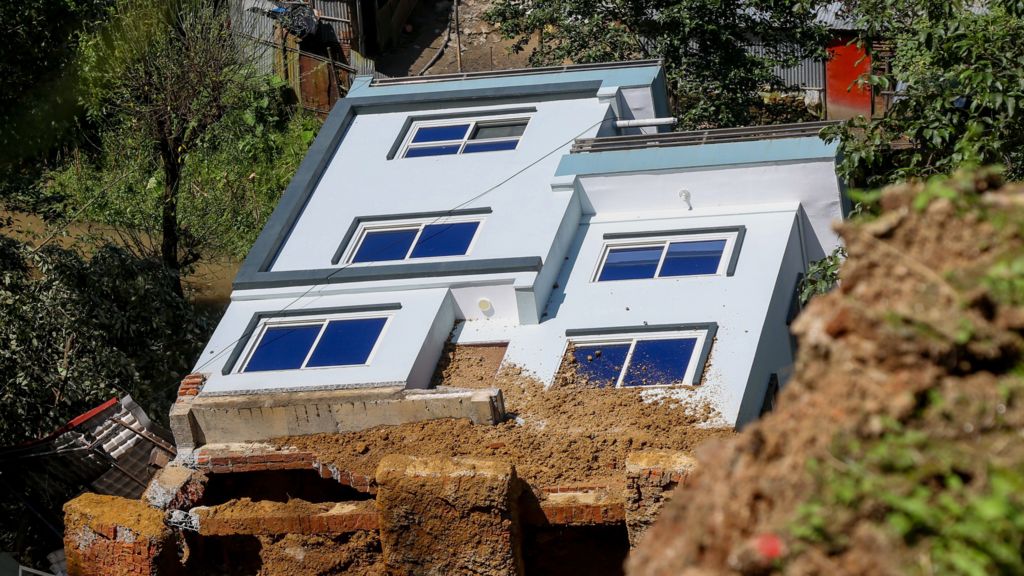
Just weeks after catastrophic August flooding that claimed more than 1,400 lives and left thousands unaccounted for, Nepal is facing a second deadly onslaught of extreme weather, with fresh landslides and torrential monsoon rains driving the death toll to nearly 30 and triggering widespread destruction across the Himalayan nation.
According to Nepal’s national disaster management authority, the latest weather event, which began late last week, has impacted over 1,900 families across the country. More than 240 residential homes have suffered severe damage, while critical infrastructure including public roads, government buildings, and river crossings has been washed away by rushing floodwaters. Dramatic footage captured one government structure collapsing completely into a swollen river, underscoring the ferocity of the current disaster.
The crisis has hit Nepal’s $1.5 billion trekking industry particularly hard, centering on the iconic Annapurna Circuit – a multi-week high-altitude trek that draws tens of thousands of international visitors annually and is a core driver of local and national economic activity. Hundreds of trekkers who had already started the route have been forced to cut their journeys short and evacuate to safer terrain, with many extracted from the high-altitude districts of Manang and Mustang via military and civilian rescue helicopters.
For many trekkers, the journey off the mountain has been a perilous ordeal marked by unstable terrain and repeated hazards. Jake Stacy, a 21-year-old hiker from Suffolk, United Kingdom, became stranded alongside his guide in Yak Kharka in upper Manang after unseasonable heavy snowfall blocked his path to Thorang La pass, the circuit’s highest point. After deciding to turn back, the pair were forced to carve their own route along steep mountain slopes above rushing rivers. “It was quite steep and we were clambering because there was river below… It was very muddy and very wet,” Stacy recounted after reaching safety in Pokhara on Tuesday night. “Many trekkers were helicoptered out.”
Australian trekker Andrew Graham described a similarly dangerous experience, noting he and his guide Prem KC had to cross more than 15 active landslide zones on their descent from Manang village. The pair became trapped in the evacuated village of Chame, where a massive landslide has partially dammed the local river, creating a temporary natural lake that has flooded local homes and a critical bridge. Forced to spend a night in the surrounding jungle after their path was blocked, Graham noted that “a few of them were quite dangerous, the residual risks have grown now.” Local residents told the BBC that authorities have worked for three consecutive days to release water from the temporary lake using heavy excavators, with limited progress so far.
Tse Ring Doma, a veteran local trekking guide, led her group across 28 separate landslide sites during their evacuation. She explained that the psychological toll of the journey far outweighed the physical challenge, with residents and trekkers alike still reeling from the trauma of last month’s catastrophic flood. “Even thunder would make us run and come out to see if anything was coming our way,” she said.
Her client, Norwegian visitor Ellen Wahlström, noted that while trekkers only faced the loss of personal luggage, local communities confronted the total loss of their homes and ancestral land. She did praise local authorities for their rapid response in clearing blocked routes.
Local officials confirmed that no fatalities have been recorded in the Annapurna trekking region so far, despite severe road damage, destroyed bridges, and intermittent communications blackouts in Manang district. However, a separate avalanche near the base of Himlung Peak, close to Nepal’s border with the Tibet Autonomous Region of China, has left four people dead and 12 others still missing.
Authorities have blocked access to the Annapurna Circuit entirely for new visitors, leaving roughly 700 waiting trekkers stranded in the lakeside hub of Pokhara. “We have been holding back all these people who want to go to the Annapurna Circuit trek, although we are under pressure from the trekking industry to announce the route open,” said a representative from the Annapurna Conservation Area Project, the local body that manages the trekking route.
Officials have also diverted Hindu pilgrims traveling to the sacred Muktinath Temple, asking them to fly between Jomson and Pokhara rather than take the overland route, which has been cut off by flood damage. With main paved roads and modern trekking routes washed out in multiple sections, many returning trekkers have had to rely on long-abandoned historic trails that fell out of regular use after road construction reached most parts of the circuit in recent decades. Only small sections of the original route in Manang and Mustang remained in regular use before the disaster.
For local residents displaced by the latest extreme weather, the situation remains desperate. Many are now living in leaky emergency tents after losing their homes entirely. “We used to live in a hut, but now there is nothing. We have lost so many of our relatives,” said Buti Tamang, speaking to BBC Nepali from his water-damaged temporary shelter in Battar, a town northwest of the capital Kathmandu. Fellow displaced resident Ramesh Ghale added: “Now it is raining and the tent leaks, so we’ve been facing a difficult situation. We have nowhere to go.”