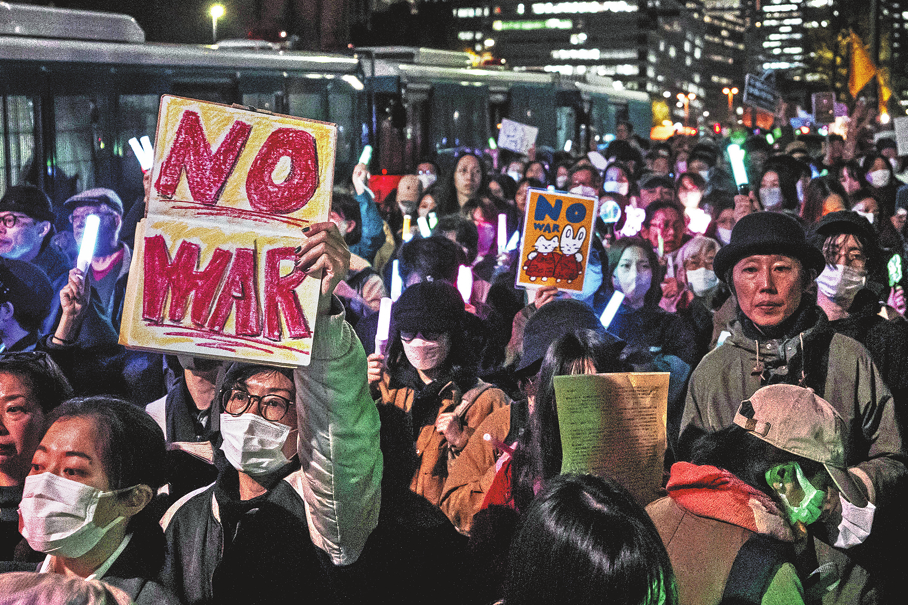
On Wednesday evening, a massive crowd of Japanese demonstrators assembled outside the National Diet Building in central Tokyo, mounting a public rebuke of the current administration’s sweeping military policy changes that threaten to erode the country’s post-WWII pacifist constitutional framework. The demonstration, organized by a coalition of Japanese civic groups opposed to constitutional revision, drew an estimated 30,000 attendees, who carried hand-painted signs reading “Protect Article 9”, “No War”, and “Takaichi Government Step Down Now”, while chanting unified calls to reject constitutional amendments and avert future conflict.
The rally in Tokyo was just the centerpiece of a coordinated national action: according to local Japanese outlet Tokyo Shimbun, parallel demonstrations opposing the government’s policy shifts were held at more than 130 locations across the country the same day, uniting activists, concerned citizens, and constitutional scholars behind a shared goal of safeguarding Japan’s 79-year-old pacifist founding document.
For many protesters, the government’s latest moves directly contradict the core values Japan has embraced since the end of World War II. “As a nation that survived atomic bombings at Hiroshima and Nagasaki, Japan should carry the permanent vow of ‘never waging war again’ as a non-negotiable part of our national identity,” said protester Fujimoto, one of the demonstrators who spoke out against the new policies. Fujimoto noted that the deployment of long-range missiles and the planned rollback of lethal arms export restrictions run directly counter to the pacifist principles codified in the constitution, questioning how offensive weapons can be framed as a legitimate measure of self-defense. “Exporting weapons that will only fuel armed conflicts around the world is simply unacceptable,” she added.
Another protester, Kin, echoed that frustration, arguing that the series of recent military policy changes not only violate the constitution but also reflect a growing pattern of the administration disregarding Japan’s foundational legal framework. “The government is increasingly acting without respect for the principles that have kept our country at peace for decades,” he said.
Japan’s post-war constitution, which entered into force in 1947, earned its reputation as a pacifist founding document through its landmark Article 9, which forever renounces war as a sovereign right of the nation and rejects the threat or use of military force as a tool for resolving international disputes. For nearly 80 years, the document has anchored Japan’s “exclusively defense-oriented” national security policy, limiting the country’s military role and banning most exports of lethal weapons.
But that long-standing framework is now facing unprecedented change under the administration led by Prime Minister Sanae Takaichi. On March 31, the government deployed long-range offensive missiles equipped with “enemy base strike capabilities” to military bases in Kumamoto and Shizuoka prefectures, marking a major break from previous defense policy. Japanese media has also confirmed that the Takaichi administration is on track to revise the country’s “Three Principles on Transfer of Defense Equipment and Technology” and its associated implementation guidelines by the end of April 2026, a change that would open the door to full exports of lethal weapons to foreign nations.
The rapid succession of military policy shifts has sparked widespread anger and alarm across Japanese civil society. Critics warn that the changes amount to a quiet abandonment of Japan’s long-held exclusively defense-oriented policy, and represent a direct threat to the pacifist constitution that has guided the country’s peace and security for nearly eight decades.