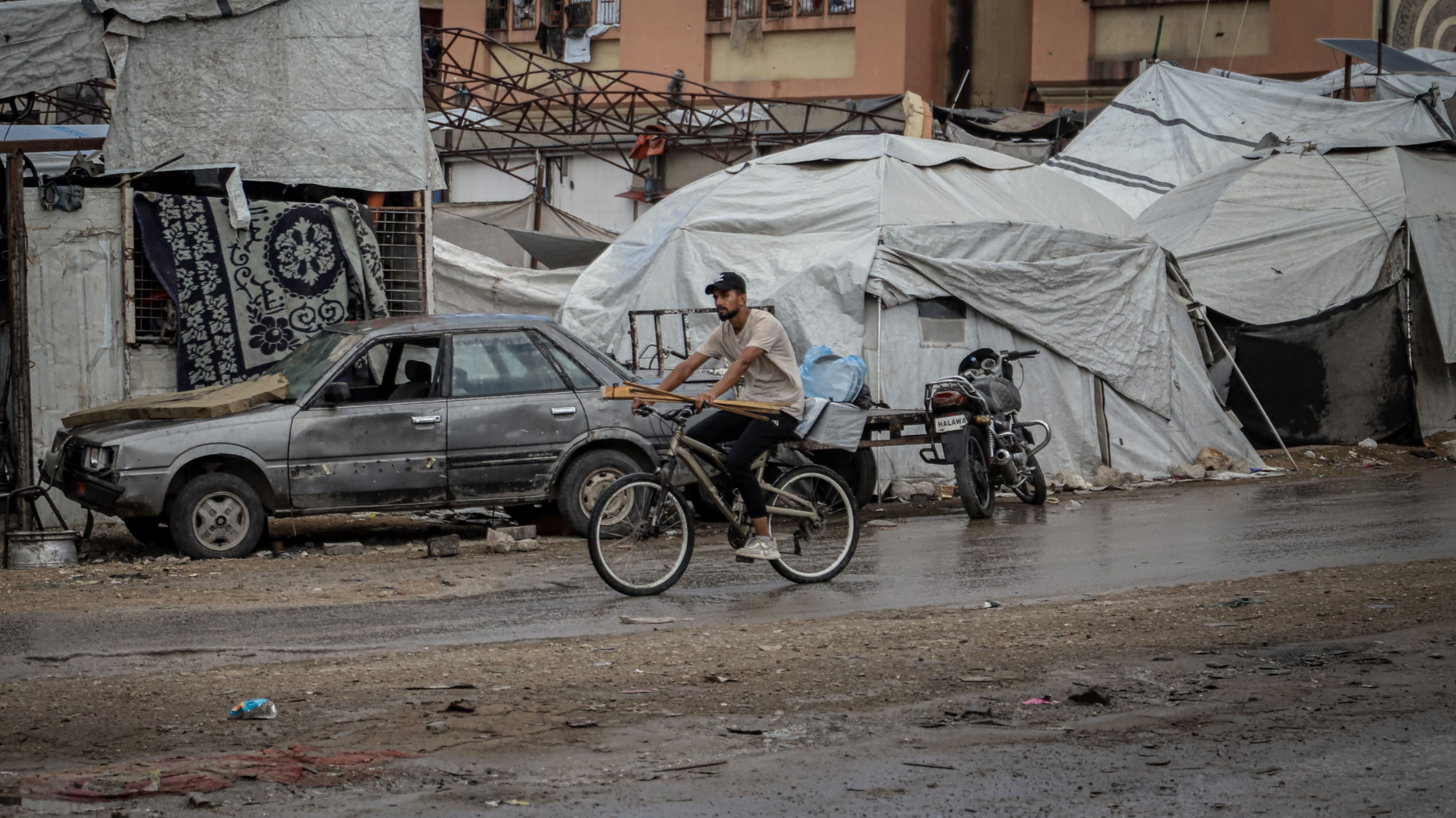
For 48-year-old Palestinian displaced mother Dima Awad, moving out of a rain-prone makeshift tent before the winter cold and wet season arrives hinges on one simple, increasingly unattainable item: a toilet seat.
Awad, who now lives with her only son after being separated from her husband when he left Gaza for medical treatment during the ongoing conflict, has already paid rent on a small garage in western Gaza City and moved most of her few belongings into the space. But the unfit structure lacks a working bathroom, and she has been searching unsuccessfully for two weeks for an affordable toilet seat to complete the basic conversion.
“Of course there is no way to find a new toilet seat at an affordable price right now. The second-hand options are also unsuitable, and still far out of my budget,” Awad explained to Middle East Eye. Current market prices for the scarce basic fixture now run between 1,500 and 2,000 Israeli shekels, or $486 to $648 — more than twice the 600 shekel ($194) monthly rent Awad pays for the garage. She had chosen the space after finding all other available housing completely unaffordable, and hoped to avoid repeating last year’s experience of sleeping in a flooded tent as winter rains poured through.
The scarcity of toilet seats in Gaza is no accident. For nearly 20 years, Israel has enforced a blockade on the besieged enclave, barring or restricting entry to hundreds of everyday items classified as “dual-use” goods that Israel claims could be repurposed for military activity. The restricted list has long included core civilian necessities: construction materials, water and sewage pumps, electrical equipment, generators, medical devices, and even mobility aids like wheelchairs and crutches.
When the large-scale conflict began in October 2023, Israel sealed Gaza’s border crossings entirely and drastically cut the flow of all commercial and humanitarian goods, including food, medicine, and fuel. A ceasefire agreement reached in October 2025 required Israel to lift restrictions and allow unimpeded entry to international aid — but nearly a year later, the vast majority of restrictions remain in place.
Aid workers refer to the unpublicized roster of banned items as a “ghost list”: hundreds of goods have been added to the restricted roster since Israel last published an updated public list in 2017, leaving traders and aid groups to navigate an opaque system where shipments can be rejected without clear explanation. The ban extends far beyond construction and medical materials to include mundane, everyday items that most of the world takes for granted: batteries, lighters, children’s toys, and even hair clips.
Imad Sersawi, a 45-year-old father of five displaced from Gaza’s Shujaiya neighborhood, says the constant disappearance of goods from local markets has made daily survival an unpredictable struggle. A single disposable lighter, a critical tool for families cooking over open fires, now costs 90 shekels ($29) and is rarely found in stock. Sersawi’s lighter is shared by the entire displacement camp whenever anyone needs to start a fire.
“One day you find something; the next day it’s banned and disappears for God knows how long. Some things haven’t been allowed in for years,” Sersawi said. He promised his children new toys once the war ended, but even after the ceasefire, toys remain banned. Existing pre-war stock is sold at exorbitant prices: a small rubber ball now costs 100 shekels ($32), enough to feed his entire family for two days. “People outside Gaza might say that basic necessities are missing and that we are focusing on these secondary things. But the fact is that we are being left without either the essentials or the non-essentials,” he explained.
The shortage of ordinary goods has also eroded small, routine comforts for Gazan women, many of whom live in crowded displacement camps with limited access to basic personal items. Palestinian journalist Baidaa Othman, who remains displaced in Deir al-Balah after her Gaza City home was destroyed, recently traveled across two governorates just to find a simple hair claw clip, eventually paying 10 times the original pre-conflict price. A clip that once cost 4 shekels ($1.3) set her back 45 shekels ($14.5).
“Now it’s not just about being able to get the basic necessities. It has reached a point where, when you want to buy something very simple, you have to go to extraordinary lengths to find it,” Othman said. “Even the simplest things as basic as a hair clip have become difficult to find. On top of all the basic necessities that are unavailable in Gaza, now the everyday things that no one would normally think twice about have become unavailable.”
Palestinian physiotherapist Sojood Hasan noted that while a missing hair clip does not cause immediate physical harm, the constant lack of even small, routine items wears away at Gazans’ sense of control over their own lives. For Othman, the shortage of ordinary goods is a deliberate policy, not a random side effect of conflict.
“On top of the displacement and all the hardships we face, including having to cook with firewood, it’s only natural for women to want to put their hair up to keep it off their faces and necks in the heat. So it’s not a secondary item any more,” she said. “The Israeli occupation knows exactly what it is doing. This is not random; it is a policy of making even the simplest things a struggle for Gazans.”