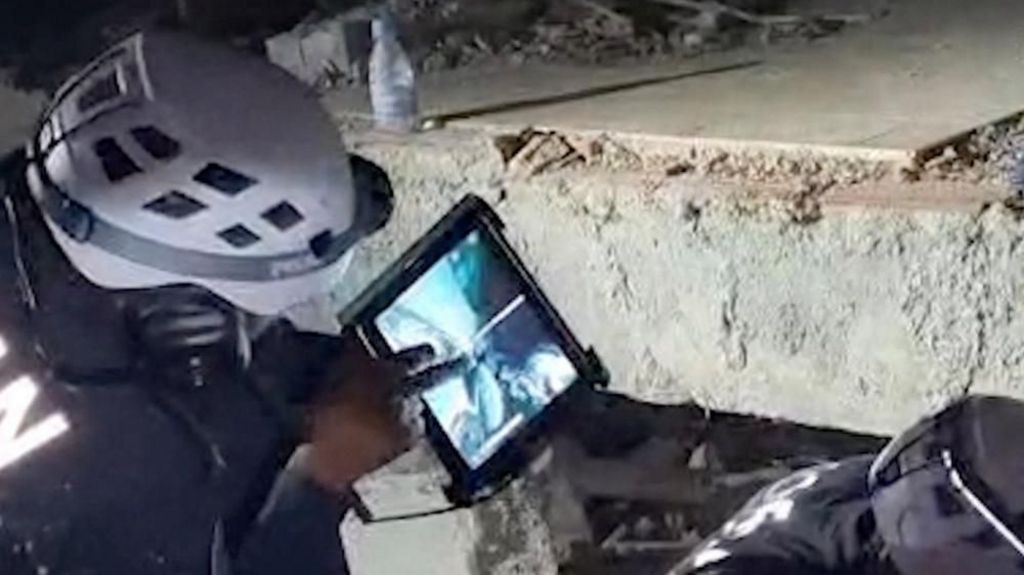
Six days after a pair of powerful back-to-back earthquakes tore through Venezuela, a 3-year-old toddler named Klieber Morán has been pulled alive from the collapsed rubble, a Jordanian rescue team confirmed in a groundbreaking discovery that has reignited hope across the disaster-stricken nation. Released video footage captured by Jordanian Public Security shows the moment rescuers erupted in cheers as the small child was extracted from the wreckage in La Guaira, one of the hardest-hit regions of the disaster. Delcy Rodríguez, a senior Venezuelan government official, called the remarkable survival an “unexpected moment of hope” for a country grappling with overwhelming loss. This miracle extraction comes far beyond the 72-hour window that experts identify as the period with the highest odds of finding trapped survivors alive, making the child’s survival all the more extraordinary.
Initial assessments of NASA satellite data confirm the catastrophic scale of the destruction: the 7.2 and 7.5 magnitude quakes that struck last week have damaged or destroyed at least 58,870 buildings across the country. As of Tuesday, the official death toll has climbed to 1,943, with more than 10,000 people injured and tens of thousands still unaccounted for, leaving countless families waiting for word of missing loved ones. At a makeshift morgue set up at La Guaira’s port, local resident Wilker Molalla told reporters he was waiting to identify the remains of 9 of his family members, including his sister and her children. Only he and one other relative survived, he said, because they were away at work when the tremors hit.
After receiving immediate on-site first aid from the Jordanian rescue team, Klieber was transferred to a hospital in the capital city of Caracas, where Venezuelan Assembly President Jorge Rodríguez confirmed the toddler’s vital signs are stable and good. Rodríguez emphasized that the successful rescue proves there is still reason to continue searching for other possible survivors, adding that domestic rescue teams and international responders from more than 30 countries including the United States and Mexico are continuing to comb through collapsed structures with search dogs and heavy moving equipment. Shelters for displaced residents have already been opened across La Guaira and other affected regions, he noted.
Despite the small spark of hope from the rescue, the overall humanitarian situation in the impacted areas remains dire. The United Nations has issued urgent warnings that tens of thousands of displaced survivors are in critical need of life-saving food, clean water, and emergency shelter. The UN High Commissioner for Refugees (UNHCR) reported Tuesday that widespread food shortages have already taken hold in La Guaira, where basic public services have collapsed and most communication lines remain cut off. “Community tensions are rising as access to assistance remains constrained,” the agency said in an official statement. Local 18-year-old Daniela Armas, who was injured in the quake when she fell from a motorbike during the tremors, told reporters that even when supplies are distributed, competition is so fierce that people often come to blows over scarce rations, comparing the scene to a violent cockfight.
The World Health Organization (WHO) added that local health systems are already operating under extreme pressure, increasing the risk of deadly outbreaks of preventable contagious diseases. WHO spokesperson Christian Lindmeier explained that low pre-existing vaccination coverage in the region leaves communities vulnerable to outbreaks of measles and diphtheria as public health infrastructure remains disrupted. To address the growing crisis, UNHCR has requested an initial $15 million in emergency funding to scale up protection services, deliver core relief supplies, and provide temporary shelter for 30,000 displaced survivors over the next six months. Some international aid has begun to arrive: a 47-tonne shipment of UN humanitarian supplies landed in the country Tuesday, including emergency medical kits, safe childbirth supplies, and materials for disease prevention. As search efforts continue, the nation has begun the painful process of burying the dead recovered so far, with thousands more families still waiting for answers about their missing loved ones.