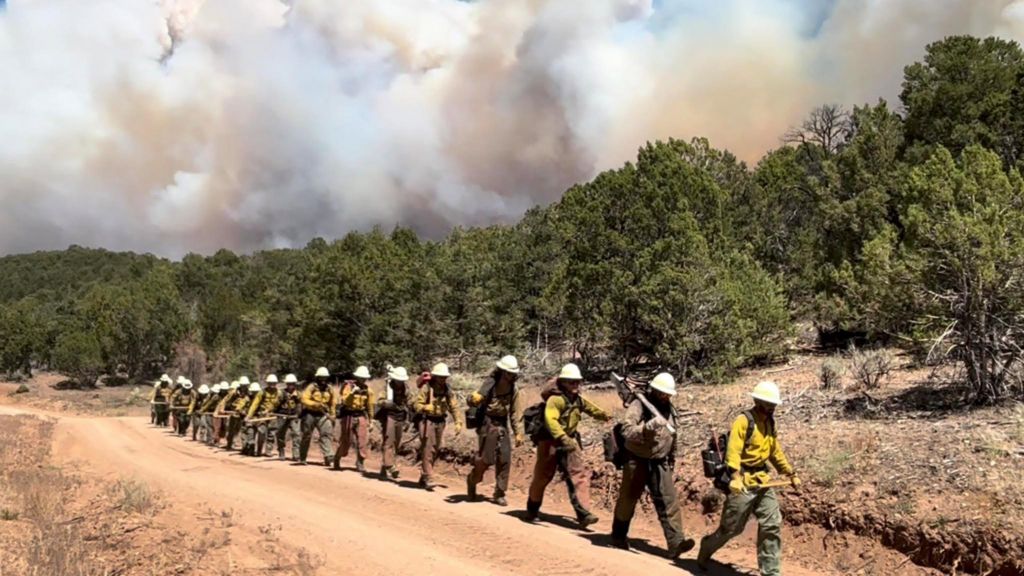
A devastating wildfire disaster on the Colorado-Utah border has claimed the lives of three elite federal firefighters and left two others with burn injuries, after a sudden, fast-moving blaze trapped the crew during containment operations on Saturday.
The fallen first responders were assigned to the Knowles and Gore fires, two separate blazes that have since merged with other wildfires to form the massive Snyder Mesa complex. As of Saturday evening, the merged fire had already scorched more than 28,000 acres of parched western land, according to a statement from Colorado Governor Jared Polis’s office.
According to the U.S. Department of the Interior, the crew was overwhelmed without warning by shifting flames as the fire expanded at an explosive rate. The incident is classified as a burnover — a rare but extremely dangerous scenario where rapid fire spread cuts off all escape routes for on-the-ground crews, forcing firefighters to deploy emergency last-resort fire shelters as their only chance of survival. The two injured crew members were airlifted to nearby medical facilities for treatment of their burns.
Identities of the deceased firefighters have not yet been released to the public, as agencies continue to notify next of kin. In the wake of the tragedy, officials have focused on supporting the affected families, friends, and fellow crew members through the crisis. “Our immediate focus is on supporting their families, friends, and fellow crewmates during this incredibly difficult time,” said a representative from the U.S. Wildland Fire Service. “The US Wildland Fire Service stands united with the USDA Forest Service in grief and in our unwavering support for the loved ones left behind. Their bravery, dedication, and sacrifice will never be forgotten.”
All five firefighters involved in the incident were employees of federal public land management agencies: the U.S. Wildland Fire Service and the U.S. Forest Service. Notably, the U.S. Wildland Fire Service, an agency under the Department of the Interior, was only established in January of this year to streamline cross-agency wildfire response across millions of acres of federal public land.
Hours after the fatal incident, Governor Polis issued a formal state of emergency for Colorado, activating the Colorado National Guard to assist overwhelmed local and federal firefighting teams. “I’m devastated about the loss of three heroic firefighters who died in the line of duty in Western Colorado,” Polis said in an official statement. “To the loved ones of those lost, and to their fellow crew members – some who are still battling the flames – know that the State of Colorado mourns alongside you.”
The disaster comes as the entire western U.S. faces an early and intense wildfire season, with dozens of active blazes burning across Colorado and Utah. In Utah, the largest active fire is the Cottonwood Fire, which had expanded to more than 93,000 acres by Sunday and remained 0% contained, per U.S. Forest Service updates. Utah Governor Spencer Cox has pre-emptively issued an emergency ban on all recreational fireworks ahead of the Fourth of July weekend, a popular holiday where firework use often sparks accidental wildfires in dry conditions.
While most of the fires burning across the two states are concentrated in sparsely populated rural areas, they have already started to threaten mountain resorts and remote recreational cabins, prompting evacuation orders for some local communities. The current outbreak of large blazes has been driven by a combination of record warm winters, persistent drought, and unseasonably high winds that have turned much of the region’s vegetation into tinder.
Climate scientists have long warned that human-caused climate change is increasing the frequency and severity of extreme weather conditions that fuel catastrophic wildfires, including prolonged heat waves and deep drought. Researchers project that without major action to cut greenhouse gas emissions and reform wildfire management, wildfires will only grow more frequent and intense across the American West in coming decades.