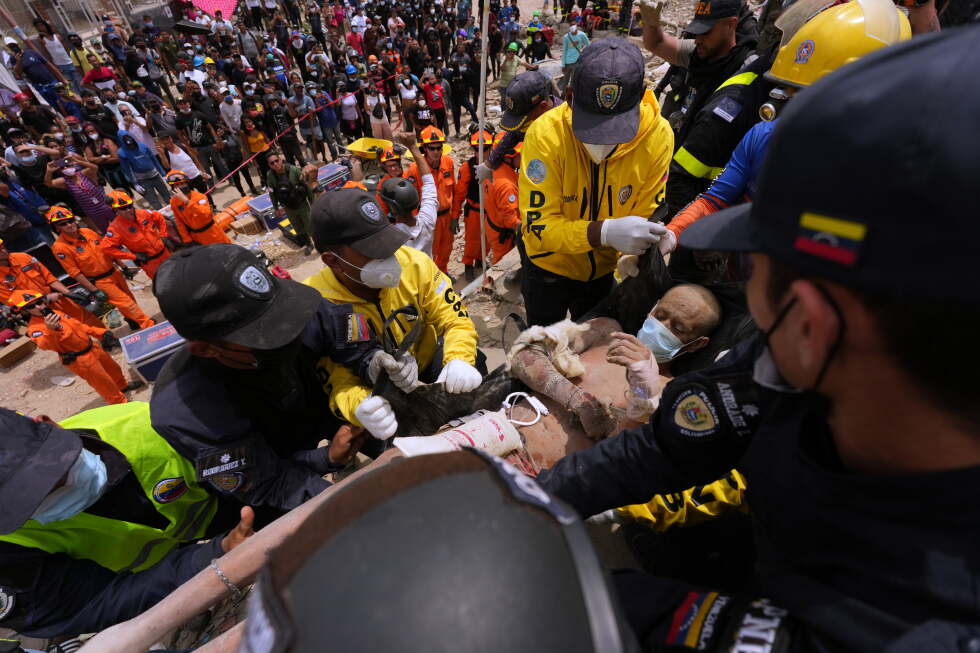
Four days after two powerful shallow earthquakes rocked Venezuela’s northern coastal state of La Guaira, local civilian volunteers and international rescue teams are locked in a desperate race against time to pull any remaining survivors from crumpled building rubble, even as the window for life-saving extraction narrows and public anger grows over the government’s slow, inadequate response.
As of Saturday, the Venezuelan government had confirmed more than 1,400 deaths from the disaster, but crowdsourced digital databases maintained by families searching for missing loved ones indicate thousands more remain unaccounted for. Acting President Delcy Rodriguez announced Saturday that 33 survivors had been pulled from debris on Friday, but declined to release an updated casualty count when she spoke publicly again Sunday.
The disaster has emerged as one of the first major tests for Rodriguez, who took office in January following the U.S. capture and removal of former President Nicolás Maduro. For more than a decade, Venezuela has grappled with crippling economic instability, and large swathes of the public already reject the legitimacy of the political movement Rodriguez leads. That public distrust has boiled over in the aftermath of the quakes, with many residents in affected areas saying they have seen almost no presence from government emergency services even as civilian-led search efforts have outpaced official action.
On Sunday morning, a U.S. rescue team deployed from Virginia pulled an adult man and his son alive from collapsed ruins. A crowd gathered to watch as the dust-covered survivors, given IV hydration, were carefully carried on a black tarp to a waiting ambulance. Moments like this have provided rare glimmers of hope for grieving families who have spent days searching for any sign of missing relatives. But for most, the reality is grim: aid groups universally mark the first 48 to 72 hours after a natural disaster as the critical window for rescuing people alive, a window that closed late Saturday. While survival can be extended for those with access to food and water, temperatures in La Guaira have been punishing, and the stench of decomposing bodies already hangs over devastated coastal communities.
Rodríguez stated Saturday on state television that more than 14,000 military and police personnel have been deployed to patrol La Guaira, where entry is now restricted to those with special government permits. But on the ground, accounts contradict that official claim. Civilians have been forced to conduct searches without proper safety gear, many wearing only motorcycle helmets in place of required hard hats. Frustration boiled over recently when a group of residents blocked a state-owned excavator from leaving a collapse site and pulled the operator out of the cabin, after government workers took selfies in front of the flattened structures and left without assisting in the search.
In parts of the state where bodies have been recovered, workers load stacks of remains—some wrapped in white body bags, others unclothed—onto white trucks from an improvised staging area in the dirt parking lot of a local hospital, where identification efforts are ongoing. Family members like Yonahí Regalado have spent day and night climbing over broken concrete, calling out the names of missing relatives: Regalado has been searching for her sister, 1-year-old nephew and godson since 1 a.m. the day after the quakes, only stopping when international search teams arrived to take over systematic searches. “It doesn’t matter who it is, whoever, whether it’s family or somebody else. If there is anyone alive, let’s get them out,” she told reporters, as rescue helicopters circled overhead.
Experts note the scale of destruction was amplified by two key factors: the quakes were shallow, and they struck in quick succession. In the days since the initial tremors, dozens of aftershocks have continued to rattle Caracas and La Guaira, including a 4.8-magnitude tremor recorded Saturday, forcing rescuers to pause operations repeatedly for safety.
By Saturday, the United Nations confirmed that more than 2,200 rescue workers from nations across the globe had arrived in Venezuela to assist with search and recovery efforts, with additional teams still en route. Mexican military rescuers were among the first foreign groups on the ground, climbing over pancaked concrete and shouting into voids for any signs of life: “We’re rescuers from the Mexican military, if there’s anyone down there still alive, make noise or scream. Now!” one rescuer called Saturday. Small acts of humanity play out alongside the grief: one widely shared video captured a Venezuelan rescuer calming an elderly woman trapped beneath rubble, who feared shifting her body would cause the remaining structure to collapse. “The roof won’t cave in. If it falls, I’ll be here with you,” the rescuer told her.
U.S. officials have outlined the scope of American assistance: Jeremy Lewin, a senior State Department official leading foreign disaster response efforts, told reporters that Simón Bolívar International Airport, the main air hub serving Caracas that was heavily damaged in the quakes, now has one operational runway, with U.S. crews working to fully repair the critical infrastructure. A U.S. Navy transport ship is also docked off the Venezuelan coast, ready to receive airlifted survivors requiring urgent advanced medical care. “This is a race against the clock,” Lewin said of the ongoing operation.
Messages of solidarity have poured in from world leaders and global figures, with Pope Leo offering public prayers for the victims. “I pray for the eternal rest of the deceased,” he said. “Likewise, I express my gratitude and encouragement to all those who are generously working in the search and rescue efforts.”
The International Organization for Migration estimates more than 6 million people across Venezuela have been affected by the disaster, with roughly 2 million of those living in the capital, Caracas.