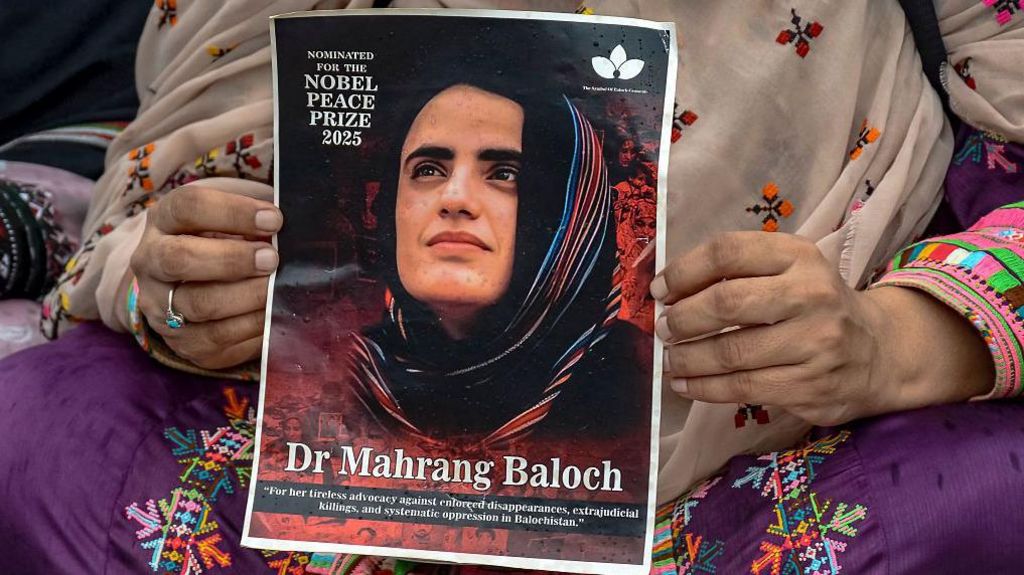
Thirty-three-year-old Mahrang Baloch, a doctor turned human rights activist and 2025 Nobel Peace Prize nominee, has been sentenced to life in prison by a Pakistani anti-terrorism court, in a ruling that has drawn global attention to the long-running crisis of enforced disappearances in Pakistan’s restive southwestern province of Balochistan.
Mahrang’s journey into activism did not begin as a political mission, but as a deeply personal fight for justice. When she was just 16 years old in 2009, her father Abdul Ghaffar Langove, a local political activist, was allegedly taken into custody by Pakistani security forces and never seen alive again. Nearly three years later, his tortured, decomposed body was found dumped in an unmarked grave in Lasbela district. Speaking in her final interview with the BBC before her 2025 arrest, Mahrang described the devastating discovery: her father’s body was still clothed in the same tattered outfit he wore the day he was abducted, bearing clear marks of brutal abuse. The trauma of this loss would go on to shape every chapter of her adult life.
The crisis that Mahrang dedicated her life to addressing is one of the most intractable human rights issues in South Asia. For more than two decades, thousands of ethnic Baloch people have vanished across the province, according to human rights activists and local campaigners. Many of these disappearances are alleged to be carried out by state security forces as part of a counterinsurgency strategy targeting separatist groups that have waged an armed movement for an independent Balochistan since the late 1940s. Critics say the practice is also used to suppress peaceful dissent over the region’s long-running grievances: Balochistan is Pakistan’s largest province by territory, holding vast reserves of natural gas, coal, copper, and gold, but it remains the country’s poorest and most underdeveloped region, with restricted access for outside journalists, crumbling infrastructure, and widespread shortages of basic necessities like clean water and electricity.
Pakistani government officials have repeatedly denied allegations of systemic enforced disappearances. Senior leaders including Balochistan Chief Minister Sarfraz Bugti argue that many reported missing people have joined separatist insurgent groups or left the province voluntarily, framing widespread claims of disappearances as “systematic propaganda” against the state. The government says roughly 80% of the more than 2,900 reported disappearance cases since 2011 have been resolved, while activists put the total number of missing people closer to 7,000. No independent body has been able to verify either figure. The crisis escalated dramatically after 2006, when prominent Baloch leader Nawab Akbar Bugti was killed in a military operation, sparking a surge in both insurgent attacks and state crackdowns.
For Mahrang, the personal cost of this crisis deepened in 2017, when her brother was detained by security forces for nearly three months. “I had made my mother believe that what happened to my father wouldn’t happen to my brother. But it did,” she recalled. “I was scared of looking at my phone, because it might be news of my brother’s body being found somewhere.” That experience pushed her to step into formal leadership of the movement for missing persons. As a trained medical doctor, she rose to prominence through the Baloch Yakjehti Committee (BYC), an organization that campaigns against enforced disappearances and extrajudicial killings while advocating for greater local control over Balochistan’s natural resources.
Over the next decade, Mahrang became the most recognizable face of the Baloch missing persons movement, leading massive peaceful protests, organizing a 1,600-kilometer long march from Balochistan to the capital Islamabad in 2023, and centering the voices of generations of Baloch women who have spent decades waiting for answers about their missing fathers, husbands, brothers, and sons. Despite facing repeated death threats, travel bans, and arrests, she built an international profile: she was named to the BBC’s 100 Women list in 2024, included in TIME magazine’s TIME100 Next list of emerging global leaders, and nominated for the 2025 Nobel Peace Prize for her human rights work.
State officials have long accused Mahrang and the BYC of amplifying separatist narratives, allegations she consistently rejected. In her final pre-arrest interview, she emphasized her campaign was rooted in a demand for basic rights: “We want the right to live on our own land without persecution. We want our resources, our rights. We want this rule of fear and violence to end.”
Mahrang was ultimately taken into custody in March 2025 while leading a protest in Quetta over the burial of 13 unclaimed bodies, which activists believe were missing Baloch people. Authorities claimed the dead were militants killed after a train hijacking in the Bolan Pass, a claim that could not be independently verified. On Monday, the anti-terrorism court convicted Mahrang and fellow activist Sibghatullah Shah of terrorism, sedition, and murder in connection with the 2024 death of a paramilitary soldier during a protest in Gwadar. Both activists deny all charges, and their legal team says they will appeal the verdict.
Nadia Baloch, Mahrang’s sister and a member of her legal team, told the BBC the trial was fundamentally unfair. “It was not transparent,” she said, explaining that the court replaced the family’s chosen legal team with state-appointed lawyers after the family demanded an open public trial, and denied Mahrang access to witness statements and other key evidence. “She was not given a chance to a fair trial.” Nadia added that the family remains defiant in the fight to overturn the verdict, even as she acknowledged the emotional toll of the conviction: “I don’t have the courage to see her in prison, because I feel I have failed her by not getting Mahrang justice.”
Authorities maintain the conviction is based on criminal conduct, not political activism, and frame the case as a law enforcement matter. But Mahrang’s supporters and family view the life sentence as an attempt to silence widespread dissent in Balochistan. Before her arrest, Mahrang said she had long accepted that imprisonment was a possible outcome of her work, and she did not fear it. According to her family, she remains resolute in prison, and her message to supporters remains unchanged: the struggle for justice will continue.