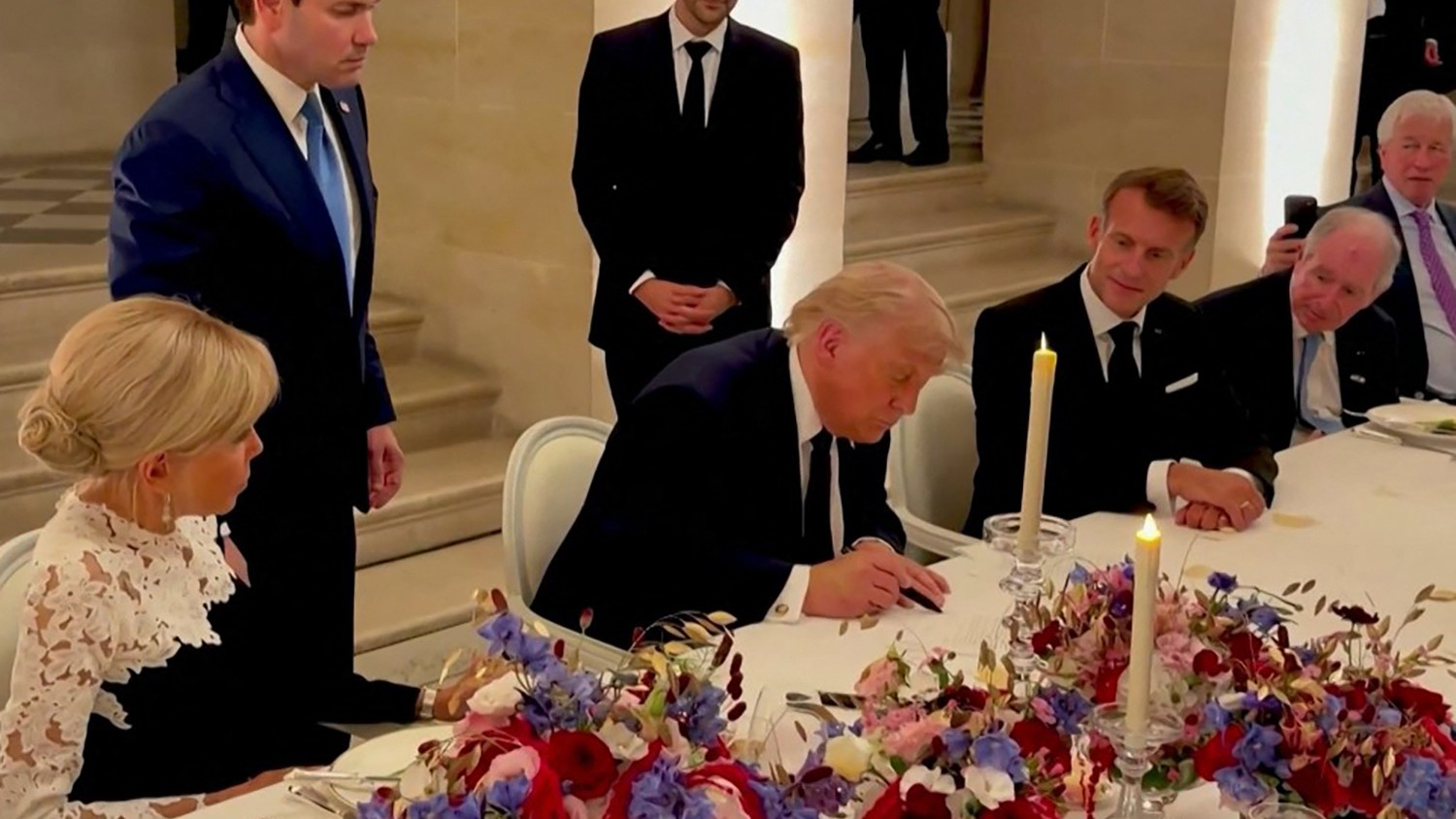
On the sidelines of the G7 Summit near Paris, US President Donald Trump and Iranian President Masoud Pezeshkian have formally signed a landmark memorandum of understanding (MoU) on Wednesday to bring an end to a regional conflict that has plunged the Middle East into crisis since late February. The White House has confirmed the digital signing of the agreement, which follows an initial preliminary accord reached Sunday that was signed by US Vice President JD Vance and Iran’s chief negotiator Mohammad Bagher Ghalibaf, with Trump in attendance. Trump first announced that both sides had reached a framework deal back on June 14.
Trump carried out the signing during the summit at the Palace of Versailles, ahead of a working dinner hosted by French President Emmanuel Macron, who later shared a social media clip capturing the moment. In footage of the event, Trump acknowledged the arduous path to the agreement, noting “This was not easy.”
The conflict that the MoU seeks to end began on February 28, when the United States and Israel launched unprovoked coordinated air strikes against Iranian targets that were widely condemned by the international community as illegal. The strikes killed long-time Iranian Supreme Leader Ali Khamenei alongside multiple senior Iranian officials, prompting widespread retaliatory action from Iran against Israel, US military bases across the Middle East, and several Gulf Arab states. Iran also moved to close the Strait of Hormuz — a critical global chokepoint through which roughly 20% of the world’s oil and liquefied natural gas supplies pass — triggering a major global fuel market crisis. A fragile ceasefire has been in place across most fronts since April 8.
Under the terms of the Islamabad Memorandum of Understanding, the two sides have been given a 60-day window to negotiate a full, final comprehensive peace treaty, a timeline that can be extended if both parties consent. Trump made clear the stakes if talks collapse, stating bluntly: “If it doesn’t get done in 60 days, that’s all right. We go back to bombing. I don’t want to do that, because it’s so good, but we might have to, because we’re never going to let them have a nuclear weapon.”
While no in-person physical ceremony was held due to the digital signing, delegations from both nations are scheduled to convene in Geneva this coming Friday, though Iranian foreign ministry spokesman Esmaeil Baghaei has confirmed that a formal bilateral meeting has not yet been finalized.
The 14-point agreement lays out core guiding provisions that cover the full reopening of the Strait of Hormuz, targeted relief from US financial sanctions on Iran, and a framework for future technical negotiations over Iran’s nuclear program. Most critically, both parties have committed to an immediate and permanent end to all military operations across every front, including Lebanese territory, and have pledged not to launch new offensive military action against one another.
Specifically, the US has committed to begin lifting its naval blockade of Iran immediately upon signing, with full removal of the blockade to be completed within 30 days. In exchange, Iran has agreed to guarantee safe passage for commercial shipping through the Persian Gulf and Sea of Oman for the full 60-day negotiating period.
On the nuclear front, the MoU reaffirms Iran’s longstanding 50-year commitment not to pursue the development of a nuclear weapon, and establishes a process for further negotiations over the future of Iran’s existing stockpile of highly enriched uranium. Currently, Iran holds an estimated 440 kilograms of uranium enriched to 60% purity — a level that can be refined to weapons-grade material with only minimal additional processing. Under the agreement, Iran will down-blend its existing stockpiles on its own territory under the direct supervision of International Atomic Energy Agency (IAEA) inspectors, with broader terms for Iran’s civilian nuclear program to be finalized during the 60-day negotiation window. Baghaei emphasized that Iran will not transfer its enriched uranium stockpile to any third country, framing on-site dilution as the only acceptable path forward. He also made clear that Iran’s ballistic missile program will not be part of any upcoming talks, stating plainly: “Iran’s missiles are only for firing, not for negotiation.”
Baghaei added that Tehran will monitor US compliance with the agreement “without any leniency”, and will suspend its own commitments if Washington fails to uphold its end of the deal. A key economic component of the MoU outlines a planned $300 billion reconstruction fund for Iran that will be developed with contributions from regional partners, with full details to be worked out during the 60-day talks. US administration officials have stressed that the agreement does not require any direct US government funding for Iran, instead relying on sanctions relief that will allow Gulf states to invest in Iranian infrastructure. The US Treasury will immediately issue new waivers allowing resumed Iranian oil exports, and the two sides will negotiate terms for the release of billions of dollars in frozen Iranian assets.
The agreement marks a notable shift in the Trump administration’s position on Iran’s nuclear program. Speaking at a press conference in Evian, Trump appeared open to allowing Iran to retain a civilian nuclear program for energy production, noting: “It is a little hard, though, when you say that somebody wants it, other people have it, other, adjoining states have it. And you’re not letting them have it for purposes of electricity and things like that.” He also walked back months of public insistence that seizing Iran’s enriched uranium stockpile was a core war aim, saying there was “no rush” to take possession of the material, and adding that while the US wanted it “psychologically”, it was not a priority worth derailing the deal over.
These remarks represent a sharp departure from the original justifications for the war, where both Washington and Tel Aviv cited preventing Iran from acquiring weapons-grade material as the central objective of their military campaign, dubbed Operation Epic Fury. The shift drew immediate scrutiny from policy observers.
The summit also saw Trump make a highly public break with Israeli Prime Minister Benjamin Netanyahu, a rift that caught even US allies off guard. Speaking Tuesday, Trump criticized Israel’s prolonged campaign against Hezbollah in Lebanon, saying “too many people are being killed” and adding: “You don’t have to knock down an apartment house every time you’re looking for somebody, because there are a lot of people in those apartment houses and they are not all Hezbollah.”
Israel was not a signatory to the MoU, and has rejected the agreement’s provisions related to Lebanon. A senior Israeli official close to Netanyahu told Reuters Thursday that Israel has “no intention” of withdrawing its troops from southern Lebanon, and is currently engaged in tense negotiations with Washington over the terms. The deal is widely viewed domestically in Israel as a major political defeat for Netanyahu. Far-right National Security Minister Itamar Ben Gvir stated that “Trump’s agreement does not bind us”, while centrist opposition figure Benny Gantz called it a “strategic failure”, and a lawmaker from the opposition Yesh Atid party described it as “the best thing that has happened to Iran in a generation”. A recent poll published by Israeli public broadcaster Kan found only 18% of Israeli adults support the agreement, with 55% opposed, and 70% saying they still perceive a major Iranian threat despite the months-long military campaign.
For its part, Iran has warned that any continued Israeli military presence or offensive action in Lebanon counts as a violation of the ceasefire agreement. Iranian Foreign Minister Abbas Araghchi clarified that Tehran views the US and Israel as a single party to the deal, with Iran and Hezbollah forming the opposing side. The Iranian military has reported that Israel has violated the existing ceasefire in Lebanon 84 times since the framework deal was announced Sunday.
The five-month conflict has already left a staggering humanitarian toll across the Middle East. At least 3,600 people have been killed in Iran alone, including more than 1,700 civilian casualties. In Lebanon, Israeli strikes have killed more than 3,750 people since fighting resumed in early March, and displaced over one million Lebanese from their homes. Iranian retaliatory strikes targeted Bahrain, Kuwait, Oman, Qatar, Saudi Arabia, the United Arab Emirates, Israel, Iraq, and Jordan, killing dozens of civilians and causing widespread damage to airports, hotels, energy infrastructure, and residential buildings across the region. Thirteen US service members were also killed in retaliatory attacks on American military bases in the region.