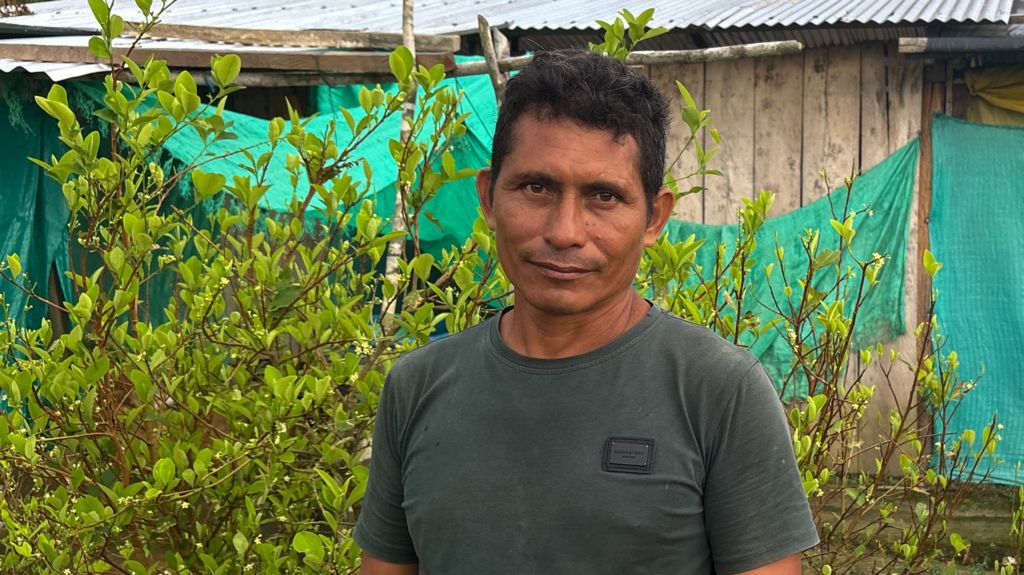
Deep in the river-accessed remote farmlands of Colombia’s Meta province, coca farmer Juan Perea once made a promise: after pulling up every one of his coca bushes, he would never return to the crop that forms the base of illegal cocaine production. He replaced his illicit crop with legal staples – cassava and plantain – joining tens of thousands of Colombian smallholders who signed on to state-run initiatives designed to wean rural communities off coca cultivation. But for Perea, the support the government had guaranteed never materialized. Cut off from markets by a lack of paved roads and battered by repeated seasonal flooding that destroyed portions of his harvest, he had no way to earn a stable income to feed his family. By 2024, disillusioned and desperate, he replanted his fields with coca. “It’s a tragedy,” Perea said, standing amid the green bushes surrounding his small wooden home. “But when you have children and no work, what choice do you have? If no help ever arrives, you go back to growing it.”
Coca has deep ancestral roots in Colombia, where indigenous communities have long used the leaf in traditional teas and remedies. Today, however, roughly 70% of the world’s illegal cocaine supply originates from Colombian coca crops, making the country central to the global trade in illicit drugs. For smallholder farmers, coca holds inherent economic advantages that legal crops struggle to match, explains Lucas Marín Llanes, a Colombian researcher specializing in the coca economy and substitution policy. Farmers can harvest three to four crops a year, the compact leaf is far easier to transport over unpaved rural terrain than bulkier legal produce, and growers face far less price volatility than they do with traditional agricultural goods. Marín’s own research found that between 2014 and 2019, coca cultivation boosted municipal GDP by as much as 10% in heavily affected growing regions, embedding the crop deeply into local economic systems.
The most ambitious effort to date to reverse this trend grew out of the 2016 peace accord between the Colombian government and former guerrilla group FARC: the National Comprehensive Programme for the Substitution of Illicit Crops, known by its Spanish acronym PNIS. Launched nationally in 2017, the programme promised roughly 100,000 participating households 36 million Colombian pesos (around $11,000) in staggered financial support over two years, alongside technical agronomic guidance and support for soil management to help farmers transition to sustainable legal livelihoods. For Elena Hernández, who moved to Guaviare’s coca-growing region in the 1990s lured by higher wages, the initiative seemed like a path out of the violence and insecurity that had long defined the coca trade. Armed groups had battled for control of trafficking routes for decades, while government crackdowns – including manual eradication, aerial fumigation, and mass arrests – left families without income but failed to meaningfully reduce cultivation. “The way it was presented to us, it seemed very promising for the development of our territory,” Hernández said.
In its early days, PNIS delivered results: across parts of southern Meta and Guaviare, coca fields were cleared and replaced with lemon groves, banana plantations, and small livestock operations. But systemic flaws quickly undermined progress. Payments were repeatedly delayed, and promised technical support rarely reached remote rural communities. Weak state presence in isolated growing regions and poor inter-agency coordination left thousands of participating farmers without the help they had been guaranteed. When Iván Duque took office as president in 2018, political priorities shifted back to forced eradication and security-focused crackdowns, draining momentum from the substitution initiative. By the time current President Gustavo Petro took office in 2022, PNIS was years behind schedule and failing to reach most target communities. Today, despite decades of interventions, Colombian coca cultivation sits at an all-time high, covering more than 250,000 hectares, with thousands of former substitution participants reporting they have been abandoned by the state.
The programme has not been without its success stories, however. For Doralba Bejarano, a farmer in Puerto Rico, southern Meta, the stalled PNIS support eventually arrived, and her life has transformed for the better. “Before the programme we were terrified,” she explained. “We had to hide the coca paste because the police, the military, would put us in jail.” Today, she moves freely through her community without fear of arrest, and her local group now receives government support to market and sell legal produce. “I go wherever I want. I have no reason to hide,” she said.
Beyond domestic policy failures, external forces continue to drive coca expansion. Global demand for cocaine remains high across traditional markets in the United States and Europe, and is growing rapidly in new markets around the world. “Right now there is expanding demand, and so there will be supply to meet that,” said Michael Weintraub, co-director of the Centre for the Study of Security and Drugs at Bogota’s University of the Andes. “That means Colombia will grow coca for the foreseeable future.” Weintraub added that Colombia’s ongoing security fragility further undermines substitution efforts: while the 2016 peace deal disbanded most of FARC, new armed groups have moved in to control trafficking routes and local coca economies, creating an unstable environment for legal development. The Petro administration’s “Total Peace” policy, which seeks to negotiate ceasefires with all active armed and criminal groups, has so far made limited progress, analysts note.
In response to PNIS’s shortcomings, the government launched a new initiative, RenHacemos, last year, rolling it out first in pilot regions. The new programme retains the core commitment to financial support for participating farmers, but expands its scope beyond just crop replacement to tackle the entire local coca economy. Planned interventions include upgrading rural road infrastructure, expanding access to higher education, improving digital connectivity, and upgrading rural housing. “Coca is a business,” explained Gloria Miranda, director of the Colombian government agency in charge of illicit crop substitution. “It’s a criminal enterprise, but it functions like any other business. RenHacemos aims to replace not only the coca plant, but the entire economy surrounding it – from processing and agro-industry to transport and logistics.”
Still, analysts remain sceptical that the new approach will deliver lasting change. Marín notes that the continuing record growth of coca cultivation demonstrates that decades of repeated policy interventions have failed to resolve the root drivers of the trade. For Perea and thousands of farmers like him, there is little confidence that government support will arrive any time soon. “The state has completely abandoned us,” he said. “We live day to day, sometimes even running out of food.” For now, he will keep growing coca – not out of a desire to participate in organized crime, he says, but because it is the only option he has to support his family. “We are not the drug traffickers – if I was, I wouldn’t be living like I do.”