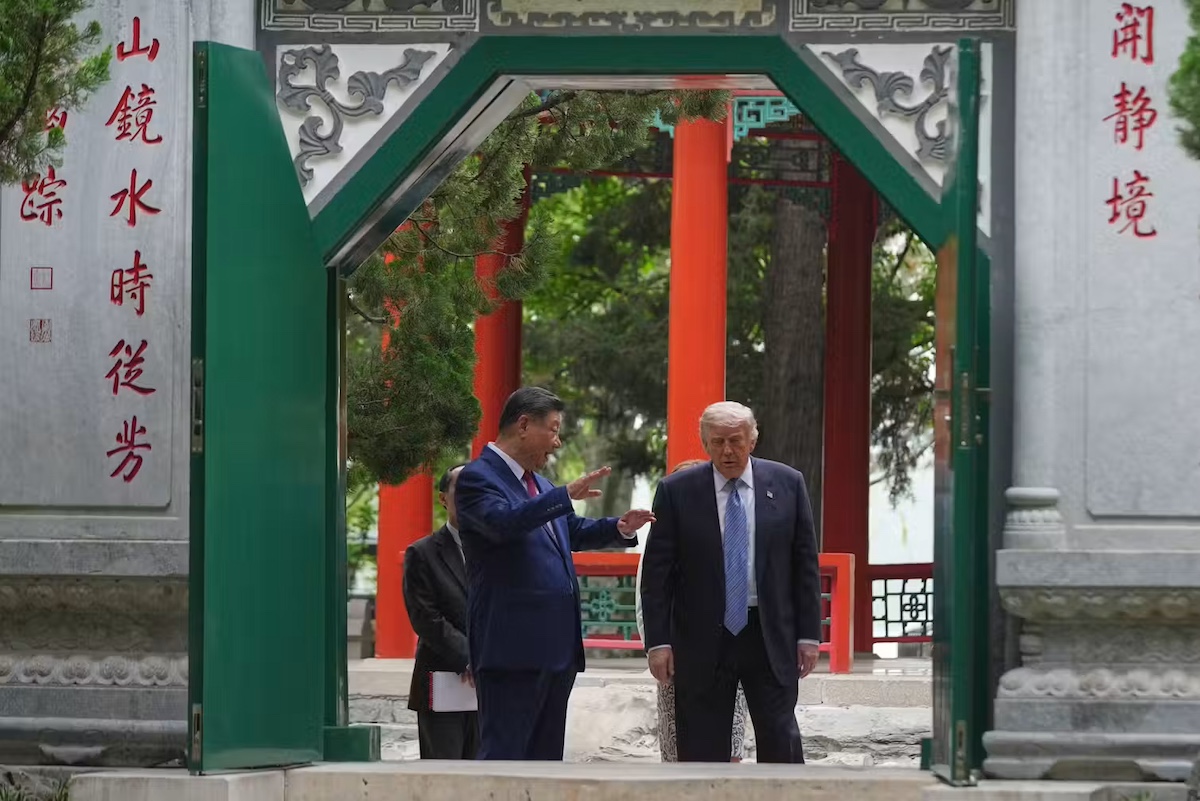
In recent weeks, consecutive back-to-back state visits to Beijing by Russian President Vladimir Putin and former U.S. President Donald Trump have thrust China’s role in global diplomacy into the center of international discussion. Many international analysts have framed this flurry of high-level summits as proof of China’s emerging status as a stabilizing global actor: a capable broker capable of hosting two competing major powers within days, and a core pillar of global order. Other observers go further, arguing that the wave of visits cements China’s position as an indispensable global power, and its leader as a central global figure that must be engaged and courted by the international community.
Chinese analysts add broader context to this trend, noting that Putin and Trump’s visits are not isolated events. Over the past six months, Beijing has welcomed heads of state from across the globe, including France, the United Kingdom, Canada, South Korea and Germany. Notably, many of these trips marked long-awaited returns to Beijing for top leaders: it was the first UK prime ministerial visit in eight years, and the first such trip in nine years for leaders from Canada, South Korea and the United States. Chinese state media has embraced this narrative, describing Beijing as a global “living room” that offers much-needed stability amid global turbulence, with one headline declaring the world has entered “Beijing time.”
But while the string of summits has undeniably elevated China’s global profile, these celebratory interpretations overlook three critical, underreported factors that change the picture of Beijing’s growing diplomatic centrality.
First, the true motivation behind many leaders’ trips to Beijing remains unclear. While many frame the visits as a victory for proactive Chinese diplomacy, a large share of these trips are instead driven by foreign leaders’ desire to gain greater leverage in their own tense dealings with the second Trump administration. For example, when Canadian Prime Minister Mark Carney traveled to Beijing in January, widespread analysis framed the trip as a direct response to Canada’s deep structural economic dependence on the United States, paired with growing policy volatility under the second Trump administration. Many international outlets noted Carney was effectively playing the “China card” to strengthen his hand in upcoming trade negotiations with Washington.
Second, access to Beijing’s diplomatic “living room” comes with a high tangible price, and many visits have been tied to significant policy concessions from visiting leaders. During his 2025 Beijing trip, for instance, Trump reversed earlier campaign and policy proposals that would have blocked Chinese nationals from purchasing U.S. farmland and imposed strict caps on Chinese university students studying in the United States. Chinese state media itself was quick to highlight the fierce backlash these concessions drew from Trump’s own MAGA base and rival Republican lawmakers in Washington.
Similarly, Carney’s trip yielded a major trade concession for Beijing: a new bilateral deal that cut Canadian tariffs on Chinese-made electric vehicles to 6.1% for the first 49,000 imported vehicles annually. This marked a sharp reversal from late 2024, when Canada imposed a 100% tariff on Chinese EV imports, and even clashed with Carney’s own 2025 election campaign rhetoric, where he called China the “biggest geopolitical threat” to the West. The tariff reversal drew sharp criticism from Canadian opposition politicians, who warned it would open the door to a flood of low-cost Chinese EV imports without securing any binding guarantees for reciprocal Chinese investment in Canada’s domestic economy.
Third, the string of high-profile visits has not produced any measurable shift in China’s long-held core foreign policy positions, despite repeated appeals from visiting leaders. European leaders’ diplomatic outreach, for example, has not altered Beijing’s ongoing material support for Russia’s full-scale invasion of Ukraine, nor has it reduced China’s persistent large bilateral trade surplus with the European Union. Similarly, Beijing refused to commit to supporting the Trump administration’s policy goals around Iran, even after Trump publicly praised Xi Jinping’s leadership and paused a controversial planned arms sale to Taiwan that Beijing had strongly opposed. Even Vladimir Putin, a close strategic partner of Beijing, left his Beijing visit without resolving longstanding disagreements over the Power of Siberia 2 natural gas pipeline, a project Putin has prioritized for years. If completed, the pipeline would carry 50 billion cubic meters of Russian gas to China annually — equal to roughly 12% of China’s total domestic gas consumption in 2025.
So what does this wave of visits actually signal, if not a rise in China’s effective global leadership? The surge in top-level trips to Beijing is more a reflection of growing systemic uncertainty across the existing global order, argues author Czeslaw Tubilewicz, a senior lecturer in the Department of Politics and International Relations at Adelaide University. The sharp, unpredictable shifts in U.S. foreign policy under the second Trump administration have sparked deep anxiety among Washington’s long-standing traditional allies, creating a vacuum that China has been quick to fill by positioning itself as a reliable, stable alternative partner after years of more confrontational “wolf-warrior diplomacy.”
Yet this growing diplomatic visibility does not equate to more effective Chinese diplomacy. Domestic economic pressures and competing conflicting international priorities still severely limit the tangible concessions and outcomes Beijing can deliver to global partners. To prevent widespread factory closures and hit official annual economic growth targets, for example, Beijing provides massive state subsidies to key domestic manufacturing sectors, generating massive surplus output that is exported to global markets (including the EU) at artificially low prices. Beijing cannot afford to rein in these exports, even as it fuels trade tensions with Western economies that are critical to China’s own long-term economic growth.
At the same time, China has continued to provide diplomatic and material support to Russia and Iran as they challenge U.S. and European security order, even as this ongoing support creates lasting rifts with Western economies that are central to China’s economic development. The end result is that high-profile summits in Beijing deliver heavy ceremony and global visibility, but very few tangible, lasting policy outcomes.
In sum, the recent visits by Putin, Trump and a stream of other world leaders have certainly made China appear far more central to global diplomatic affairs. But this newfound visibility does not automatically translate into effective, influential global leadership.