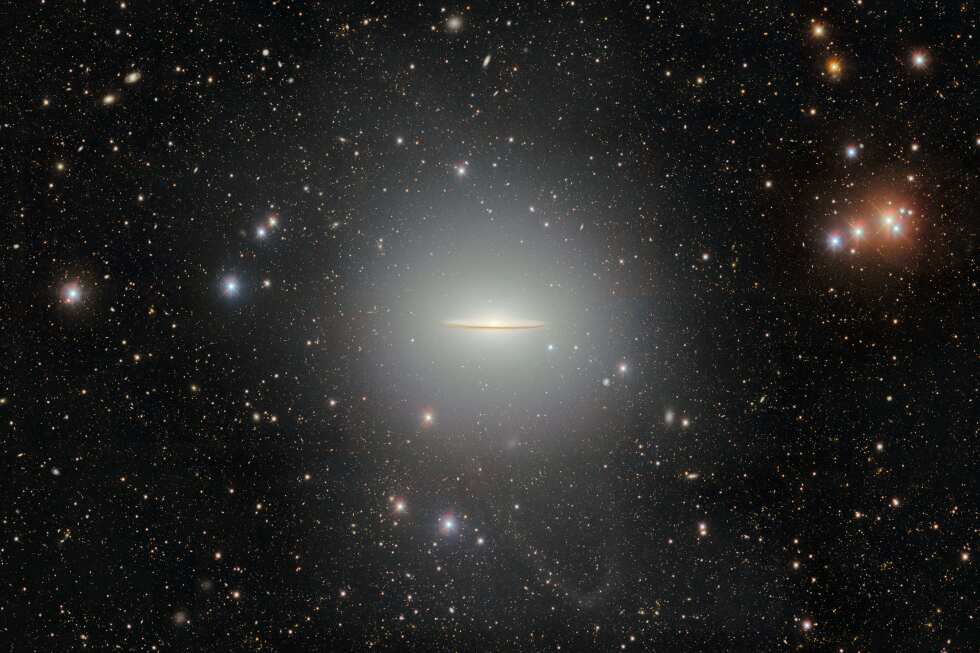
CAPE CANAVERAL, Fla. – One of the night sky’s most iconic and beloved celestial objects, the distinctive Sombrero Galaxy, has been revealed in unprecedented detail in a breathtaking new image released by U.S. astronomers.
The image, published Friday by the U.S. National Science Foundation’s NOIRLab, is the result of years of work to process data gathered four years earlier by a powerful telescope based in Chile. While observational data of the galaxy was collected years ago, full color processing that brings out subtle celestial features was only finalized this week, producing the sharpest view of the galaxy ever created.
Formally cataloged as Messier 104, this striking spiral galaxy gets its common name from its unique hat-like shape, marked by a bright central bulge and a sweeping dark dust lane that creates the silhouette of a wide-brimmed sombrero hat. Sitting roughly 30 million light-years from Earth, it ranks among the largest members of the Virgo constellation galaxy cluster, spanning an estimated 50,000 light-years across – a distance equivalent to roughly 300 trillion miles.
The new high-resolution image captures extraordinary detail that has never been so clearly visible to ground-based observation. Most notably, the galaxy’s faint, glowing outer halo of stars is revealed to be nearly three times the size of the main galactic disk that forms the iconic “hat” shape.
Mounted on the telescope, the Dark Energy Camera, an instrument designed to map deep space and study the force accelerating the universe’s expansion, also picked up a faint, extended stream of stars streaming away from the galaxy’s southern edge. Researchers conclude that both this star stream and the expanded outer stellar halo are not native to Messier 104. Instead, they are leftover debris from a collision between the Sombrero Galaxy and a smaller neighboring galaxy that occurred billions of years ago, when the smaller galaxy was torn apart and absorbed by the larger one.
First discovered by astronomers back in the 1700s, the Sombrero Galaxy has long been a favorite target for both professional stargazers and amateur astronomers. This new processed image offers scientists a fresh opportunity to study galactic growth through merger and collision, a key process that shapes the evolution of galaxies across the universe.
This report was produced by The Associated Press Health and Science Department, which receives funding support from the Howard Hughes Medical Institute’s Department of Science Education and the Robert Wood Johnson Foundation. The AP retains full independent responsibility for all content published.