It has now been three years since full-scale conflict erupted across Sudan, a brutal war that has left the nation in ruins and indelibly scarred the bodies, minds and futures of millions of civilians who have lived through its devastation. Tens of thousands have been killed, and more than half of the country’s population has been displaced by ongoing fighting between the Sudanese Armed Forces, which retook control of the capital Khartoum last year, and the powerful paramilitary Rapid Support Forces (RSF), which continues to clash with government troops across large swathes of the country.
Associated Press journalists spent more than a week reporting in Khartoum and its surrounding areas to document the human cost of the conflict, accompanying military media representatives on the ground while retaining full editorial control over all reporting. Through conversations with five survivors of the war, the true scale of the civilian crisis that has unfolded across Sudan comes into sharp focus.
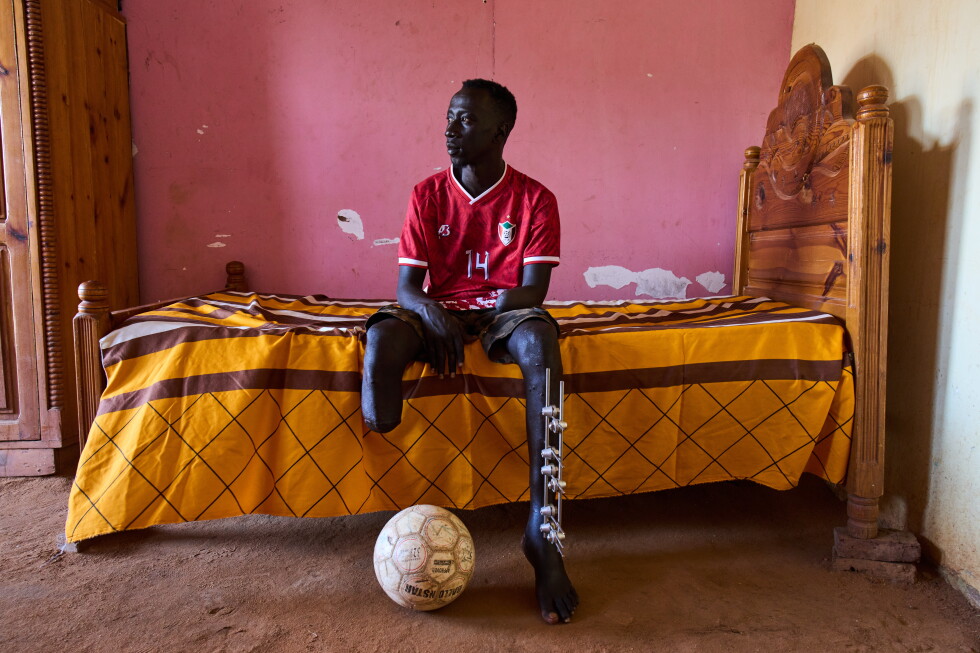
For 33-year-old Omer al-Toum, a lifelong dream of representing Sudan’s national soccer team was destroyed in an instant. Last October, an unexploded ordnance detonated in his home as he attempted to use it to loosen a nail. The blast tore off part of his right leg and left arm, and left his other leg shattered beyond repair. Even with his life permanently altered, al-Toum has chosen to meet his new reality with quiet resolve. He hides the depth of his grief from his family, and finds purpose in coaching young local soccer players, urging them to stay in school and build alternative futures. “As long as you are still breathing, you are still capable of doing many things. And when God takes something away from you, he will surely compensate you with other things,” he said. Though he cannot bathe or get out of bed unassisted, and his wheelchair cannot fit through many of his home’s doorways, al-Toum says his 8-month-old daughter keeps him going. Accessing a high-quality prosthetic to regain greater mobility would require travel abroad, a cost and risk he cannot currently take.
For 16-year-old Noon Madani, the war stole her sister and nearly stole her ability to walk. Nearly three years ago, in August 2022, Madani did not want to leave her family’s home in a neighborhood outside Khartoum controlled by the RSF. But her 18-year-old older sister insisted they leave to pay an overdue household bill. On their journey home, a missile struck, killing Madani’s sister instantly and crushing both of her legs. Trapped and immobile beside her dying sister, Madani says she still vividly remembers seeing fragments of the missile embedded in her sister’s skull. She spent six months recovering in a local hospital, undergoing multiple surgeries, fighting life-threatening infections, and often waiting days for care after most medical staff fled the region. Today, she still uses a wheelchair while her legs heal, and doctors say she will likely walk again. Every day, her younger brothers wheel her to school, where she studies science with the dream of one day becoming a doctor. “We are trying to forget the war,” her father Omer Bakar said, “the nightmare we finally woke up from.”
Fatma Ageb, 38, lost nearly her entire family in a single 2025 shelling attack on her Khartoum home. She remembers only one moment from that day in February: her two older daughters, aged 10 and 12, laughing as they planned what birthday gift to buy their baby sister Zeinab. The shell killed her husband and her two older daughters instantly. Shrapnel tore through Ageb’s body, and left her 8-year-old Zeinab severely wounded: the blast scarred half her face and took her right eye, which she now replaces with a prosthetic glass eye. “If it wasn’t for Zeinab I wouldn’t want to live. She’s always calling for her sisters and father,” Ageb said, wiping away tears as her daughter, wearing a Frozen character necklace, held up a shy drawing for reporters while a doctor treated her lingering wounds. Friends and relatives have pooled what money they could to cover Zeinab’s ongoing surgeries, but more funds are needed, and Ageb has no way to pay for the care her daughter requires.
Even aid workers who spent years supporting their communities have not escaped the war’s harm. Tariq Abuzeid, a 52-year-old construction worker, had long run volunteer soup kitchens out of his Khartoum home, raising funds to feed hungry neighbors and distribute life-saving medicine to the sick. When the war reached the capital, he never stopped his work delivering aid to trapped civilians. In December 2023, he was caught in intense shelling just after distributing food to a neighborhood. The blast cost him his right leg. Now, surrounded by his family, Abuzeid struggles to accept his new reality. “I used to serve people. … Now I feel like I am a burden,” he said, his voice breaking. The blast caused severe bleeding that damaged his immune system, and he takes dozens of pills every day just to manage constant pain. Accessing a properly fitted prosthetic and a sturdy wheelchair remains nearly impossible in war-torn Khartoum. Even so, he has not quit his volunteer work: large metal cooking bowls still stack in his yard as he prepares the next meal for his hungry neighbors.
For a 50-year-old mother who fled the besieged town of Dilling in South Kordofan with her two adult daughters last July, the war brought unfathomable sexual violence, a horror the United Nations has called one of the defining characteristics of the Sudan conflict. Driven from their home by extreme hunger, the family was abducted by RSF fighters while fleeing. Bound hand and foot with their faces covered, they were driven for hours to a makeshift desert base where more than a dozen other women were being held. For months, the woman was regularly beaten and gang-raped until she was badly injured. Every night, she would cringe in fear as fighters walked through the holding area, picking which women they would take. When fighters came for her daughters, aged 20 and 25, she begged them to take her instead. One night, when the base was nearly empty, she managed to escape into the desert with her daughters. Terrified, starving and weak, they walked for days before finding safety in a neighboring town. The RSF has not responded to requests for comment on the allegations. Now staying at a women’s support center in Khartoum, the woman says doctors have told her the injuries from her assault are so severe she will need a hysterectomy. In a country torn apart by war, even this life-saving care remains out of reach.
This reporting is part of AP’s Africa Pulse coverage, supported by funding from the Gates Foundation, with the AP retaining full editorial independence over all content.