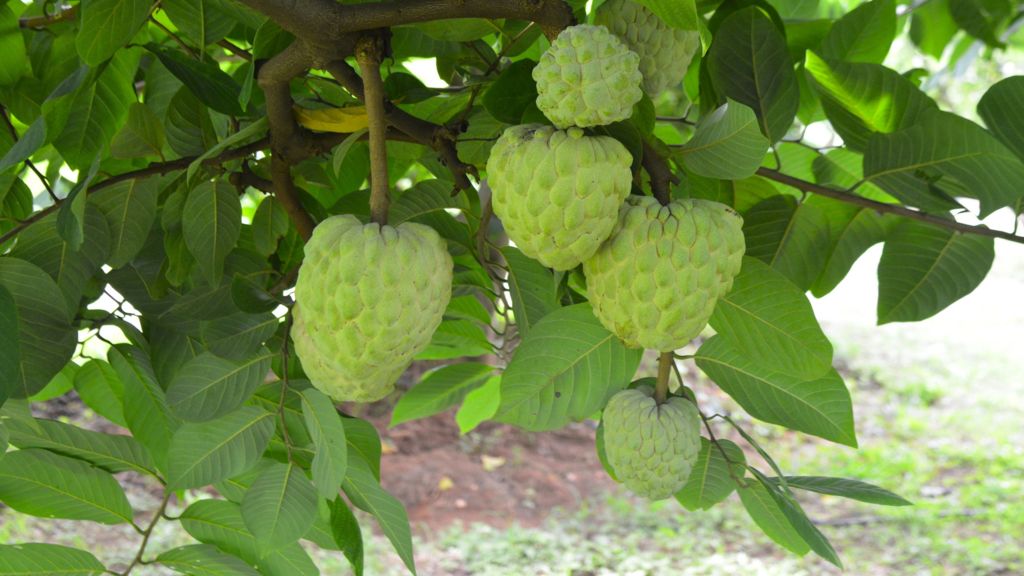
In the arid, drought-prone farmlands of southern India, where farmers have spent decades digging deep borewells and sinking most of their income into chasing scarce water supplies, an unlikely native fruit is emerging as a game-changing opportunity for agricultural resilience and profitable growth. Custard apple, a knobbly, sweet fruit with creamy flesh that owes its name to its dessert-like flavor, has long grown wild across India’s dry regions – but recent agricultural innovation and targeted crop development are turning this hardy native species into a high-demand commodity for both domestic and global markets.
The story of this transformation begins with farmers like Ashoka Shivareddy, who carried a lifelong passion for agriculture even after his family abandoned their Kolar district farm due to mounting drought-related losses and moved to Bengaluru in 2005 to open a small vegetable shop. Shivareddy went on to build a career as an artificial intelligence software engineer, but never lost his connection to the land he grew up on. In 2018, he decided to revive his family’s abandoned property, approaching the venture with a data-driven, scientific mindset focused on finding a crop that could thrive in the region’s harsh, low-rainfall conditions.
“I was searching for a crop that could survive on minimal water, grow solely with natural rainfall, and not require heavy pesticide inputs,” Shivareddy explained. That search led him to custard apple, a fruit that already grew wild across his local region, where small-scale farmers harvested wild fruits for local market sales. To maximize output on his land, Shivareddy adjusted traditional planting practices, spacing trees closer together than the standard industry approach, and selectively cultivated three high-performing varieties with complementary benefits. The strategy has already delivered impressive results: he harvested roughly 20 tonnes of fruit last year, and projects output will climb to 25 tonnes this year, with strong demand from both domestic buyers and international importers.
While the species’ natural hardiness allows it to survive months without irrigation, traditional custard apple varieties have long faced significant commercial limitations. Local wild varieties such as Balangar have an extremely short shelf life – often just three to four days after harvesting – which limits farmers’ ability to sell beyond local markets, and they also contain a high number of seeds, making them less appealing to consumers. That’s where institutional agricultural research has stepped in to drive improvement, according to Dr. Sakthivel T, principal scientist at the Indian Institute of Horticulture Research (IIHR) based in Bangalore.
Dr. Sakthivel’s team developed a new hybrid custard apple variety called Arka Sahan, which addresses many of the key flaws of traditional strains. The hybrid can last up to a week at room temperature, contains far fewer seeds, and delivers a much higher proportion of edible pulp. Over the past two decades, this improved variety has spread widely across southern India, delivering major gains for farmers without requiring them to expand their land holdings. “By boosting pulp recovery from just 30% in wild varieties to 70% in Arka Sahan, we have effectively doubled the usable harvest farmers can get from the same amount of land,” Dr. Sakthivel noted. Today, his team is focused on solving another key challenge: the tendency of custard apple pulp to turn brown quickly after extraction, which limits its use in processed food products. Researchers are testing new processing equipment and preservation techniques to help the pulp retain its characteristic pale, creamy color for longer, opening up new commercial opportunities in value-added foods like ice cream and milkshakes.
In Maharashtra, India’s top custard apple producing state which accounts for nearly one-third of the country’s total output, independent farmer-breeder Navnath Malhari Kaspate has spent decades developing his own improved variety, after noticing that the crop had been largely overlooked by formal research for years. Kaspate traveled across India collecting custard apple seeds from diverse regions, brought them back to his farm, and spent years cross-pollinating varieties to develop higher-yielding, more commercially viable strains. Developing a new stable custard apple variety takes 12 to 15 years of selective breeding, a long, slow process that requires decades of patience and experimentation. His work ultimately produced NMK-01, a high-yield variety named for his initials that launched commercially in 2014.
Today, Kaspate grows custard apple on nearly 50 acres of land, achieving yields of roughly 10 tonnes per acre. The improved shelf life and hardiness of NMK-01 have unlocked export opportunities that were previously out of reach for Indian custard apple growers. “We have started exporting to Gulf countries, and even shipped large volumes to Europe, something that had never been done at this scale before,” Kaspate said. He continues his breeding work today, focused on developing a new variety with improved visual appeal and stronger natural disease resistance.
Exporter Manoj Kumar Barai, who ships NMK-01 to markets across the United States, the United Arab Emirates, Saudi Arabia, and Europe, says the variety is ideal for international trade thanks to its thicker skin, longer shelf life, higher pulp content, and sweeter flavor compared to older strains. Even with these improvements, exporting the delicate fruit requires extremely precise logistics: every step from harvesting timing to transport to packing, airport transfer, and customs clearance must be tightly scheduled, as every hour of delay impacts the fruit’s freshness. Custard apple is highly sensitive to high temperatures, so road transport is often scheduled overnight to avoid the peak midday heat in regions where summer temperatures can climb to 40°C, and fruit is pre-cooled for five hours before being packed in custom-designed corrugated boxes that protect produce and maintain cool temperatures during transit, then shipped in refrigerated vans and cold storage before being loaded onto air freight.
An increasing share of exports are now shipped as frozen pulp or powder, a shift Barai describes as a revolution for the Indian custard apple industry. While frozen pulp must be stored and transported at -18°C, it is far cheaper to ship than whole fresh fruit, allows for large-volume transport over multi-week periods without spoilage, and is in high demand by overseas ice cream manufacturers, bakeries, and specialty cafes. Back in Kolar, Shivareddy plans to expand his own business by adding pulp processing to sell both whole fruit and value-added pulp products, and plans to build a processing unit that can utilize portions of his harvest that would otherwise go unsold. The shift to processing does require significant upfront investment in cold storage and extraction equipment, which Shivareddy says requires a change in mindset for many small-scale custard apple farmers.
“Custard apple sits in an unusual position in Indian agriculture,” Shivareddy explained. “Demand is rising rapidly, but farming hasn’t adopted high-tech methods because the crop is naturally so hardy. It grows in poor soil, needs almost no extra water, and survives entirely on rainfall. Farmers don’t need expensive irrigation systems, sensors, or controlled growing environments, so technology adoption stays low.” Even with that barrier, the growing global demand for this drought-resilient, nutrient-dense fruit is driving steady growth across India’s custard apple sector, turning a forgotten wild crop into a viable, profitable agricultural commodity that supports small-scale farmers in some of the country’s driest regions.