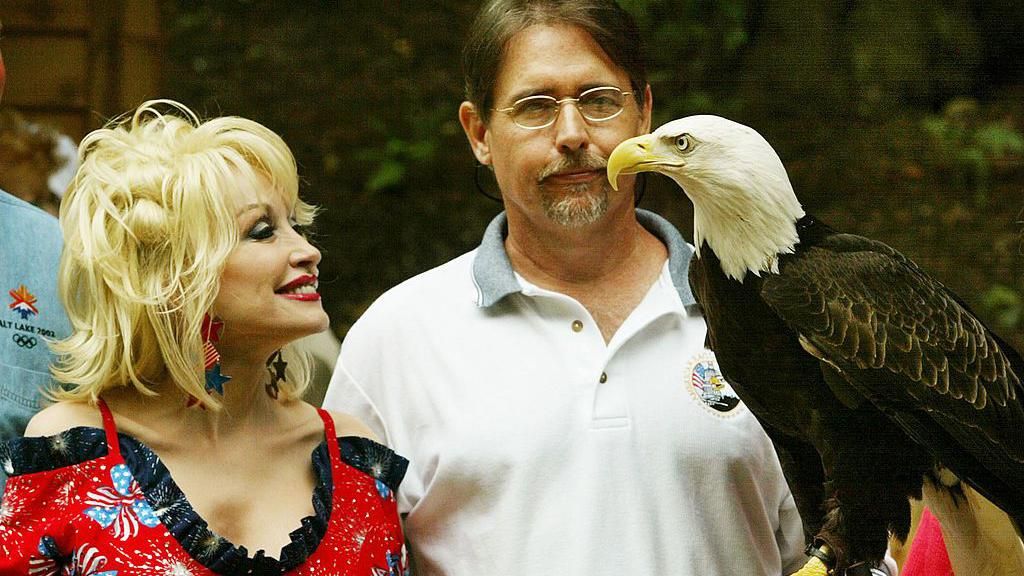
A multi-day, community-wide search is underway across East Tennessee’s Smoky Mountains to track down three non-releasable bald eagles that escaped one of the nation’s most respected raptor sanctuaries after a severe storm damaged their enclosure. The breakout, which occurred two weeks prior to the ongoing search, has highlighted the decades-long conservation success story built by country music icon Dolly Parton and the American Eagle Foundation (AEF) at Dollywood, the Pigeon Forge theme park Parton co-owns.
The incident unfolded when a powerful storm toppled a 100-year-old deciduous tree directly through the netting of the sanctuary’s main enclosure, allowing the three eagles—Rockland, Caesar, and Wesley—to slip away. Unlike the 185 bald eagles the sanctuary has successfully rehabilitated and released into the wild over the past 35 years, all three escapees have permanent disabilities that leave them unable to survive independently in the wild. Rockland lives with a displaced wing that limits his flight range, Wesley has a chronic shoulder injury that restricts movement, and all three have grown accustomed to human care, leaving them ill-equipped to forage for food or avoid natural hazards on their own.
Immediately after the escape, the AEF issued a public call for sightings, asking community members to watch for the birds’ unique colored leg bands: orange for both Rockland and Caesar, and black for Wesley, the only female of the three. The response was overwhelming, with tips pouring in from as far away as Indiana, Virginia, and Georgia, though the most credible reports have placed the birds within the Smoky Mountains region. Last weekend, search teams successfully recovered Caesar after a local tip led them to a rural pasture, where an experienced avian specialist was able to capture the exhausted bird.
The search for Rockland intensified the following day, with teams of law enforcement officers, AEF executives, and avian specialists trekking through mountain terrain for hours in pursuit of the injured bird. Sightings carried teams from a downtown hotel to a residential neighborhood across town, but Rockland managed to elude capture twice, soaring away before teams could approach. “The advantage those little stinkers have, that we don’t, is they can take off,” one search member wryly noted of the evasive raptor. As of the latest update, both Rockland and Wesley remain at large, with search crews continuing to follow every credible tip.
The escape has pulled back the curtain on a 35-year conservation partnership that transformed bald eagle protection in the United States. The Dollywood Eagle Mountain Sanctuary, which opened in 1991, is now the world’s largest sanctuary for non-releasable bald eagles, welcoming more than 3 million park visitors annually for educational programming and daily flying demonstrations. The partnership grew out of a promise AEF chairman James Rogers made decades earlier, after spotting a rare bald eagle on a fishing trip in Florida when the species was still listed as endangered. “I made a silent promise that I would do what I could to keep the bird from becoming extinct, so future generations could see them,” Rogers recalled.
Rogers, a longtime musician who wrote the 1973 eagle conservation anthem *Fly, Eagle, Fly*, approached Parton with the idea for the sanctuary, and she immediately embraced the project. “I don’t think it ever would have happened if she hadn’t supported it,” Rogers said. “She thought it was a beautiful idea, because it was pure Americana. The eagle isn’t a Republican or a Democrat—it’s our national symbol.” Parton’s longstanding ties to eagle conservation include being honored by the federal government in 2003 for her work, and she even named her 31st studio album *Eagle When She Flies* the year the sanctuary opened.
Decades of conservation work, paired with national environmental protections like the Clean Water Act and restrictions on the pesticide DDT—once the leading cause of bald eagle population decline, thanks to severe eggshell thinning—led to the bald eagle being removed from the endangered species list in 2007. Wildlife biologists call the recovery of the bald eagle one of the nation’s most underappreciated conservation success stories. “It takes decades for environmental protections to show population-level results, but now we’re seeing bald eagles return to landscapes where they’d disappeared,” explained Michael Patrick Ward, a wildlife biology professor at the University of Illinois Urbana-Champaign. “Every released eagle that goes on to breed for 15 or 20 years makes a huge difference.”
Even as the search for the two remaining eagles continues, AEF CEO Lori Moore says the incident has brought an unexpected silver lining: it has gotten ordinary citizens looking up at the sky, engaging with conservation, and uniting around a common goal. “In a time that our country is a little divided, having something—even if it’s just looking for our national symbol—to unite us all, you can tell people are doing it from the heart,” Moore said. “They are genuinely concerned, as we are. That part of it has been incredibly heartwarming for us.” Many members of the public reported being excited just to spot any bald eagle during their search, with one man contacting the foundation with a cracking voice to say he had never seen a bald eagle in the wild before.
Search teams remain hopeful that they will recover Rockland and Wesley safe and sound, with Rogers saying the entire team is on edge waiting for the next credible tip. “It just makes you want to cry because you’re afraid he’s going to tangle with something he shouldn’t and get hurt,” Rogers said of Rockland. “Any time we get a truly viable lead, the excitement gets really high—adrenaline starts flowing, because we know we might have a chance to bring our bird home.”