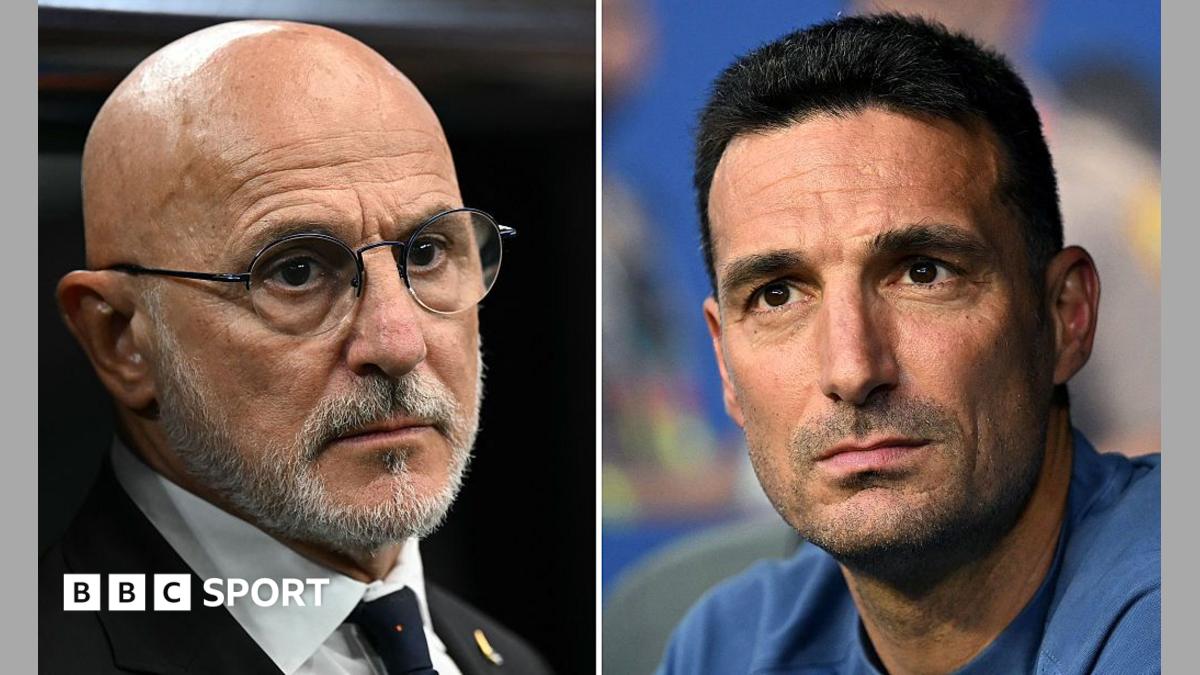
The 2026 FIFA World Cup final will bring two very different coaching journeys to a head in New Jersey, when Spain’s Luis de la Fuente and Argentina’s Lionel Scaloni go head-to-head for the sport’s most prestigious international prize. Though their paths to the final diverged wildly in every sense, a little-known personal connection binds the two managers together, one that traces all the way back to 2017.
That year, Scaloni found himself adrift after retiring from playing, and enrolled in the Spanish Football Federation’s UEFA Pro Licence course – the highest-level coaching qualification available in European football. It was here that the two men first crossed paths: De la Fuente, who was then leading Spain’s Under-19 national team, taught the course’s technical skills module. Scaloni went on to graduate with one of the highest marks in his cohort, and has repeatedly credited De la Fuente for providing critical, generous guidance to him and his fellow students. The pair have maintained a close bond in the years since.
Where De la Fuente is a product of Spain’s structured national youth development system, Scaloni’s coaching ethos was shaped by the unique, unwritten locker-room culture of Argentine club football. What unites them, beyond that 2017 classroom encounter, is that both climbed to the pinnacle of international football after periods where the sport had left them on the margins, and both have built their national sides around the core principle of team as family – values rooted in the shared Catholic faith both men practice. It is an unlikely milestone for two coaches who have never managed a single top-flight club game between them.
De la Fuente’s journey to the World Cup final began in Haro, the heart of Spain’s Rioja wine country famous for its annual chaotic wine battle where thousands drench each other in red wine. After hanging up his playing boots in 1994, he spent 15 years bouncing between lower league club roles, youth coaching positions and assistant coaching jobs. He was dismissed from his role as manager of Segunda División side Deportivo Alaves in 2011, and spent 18 months out of work, slowly drifting away from the sport he dedicated his life to.
His turning point came when he spotted a newspaper advertisement for a youth coaching role with the Spanish Football Federation. He reached out to former Spain manager Inaki Saez, who endorsed him to the federation as the perfect candidate. He was offered a three-month contract to lead Spain’s Under-19 side at the European Championship in Lithuania; while they lost to France in the semi-finals, his performance earned him a permanent spot. His next Under-19 squad, featuring future senior stars Rodri, Unai Simon and Mikel Merino, took home the European title, and a steady rise up the ranks followed. By the time he was appointed senior Spain manager in 2022, he had coached most of the current 2026 World Cup squad since their teenage years, across Under-19, Under-21 and Olympic levels, winning multiple youth titles along the way. He has known star players including Pedri, Dani Olmo and Martin Zubimendi, and their families, for more than a decade.
De la Fuente’s coaching philosophy centers on fostering respect for opponents, trust in the process, and calm, patient leadership. His life and work are built on sacrifice, humility and collective responsibility – values that mirror his religious beliefs, visible in small, personal gestures. Ahead of the Euro 2024 final, as the stadium filled with fans, he took time to call his family to confirm they had arrived safely. Midway through a World Cup match this year, when he learned the federation’s photographer had lost his mother, he pulled the man into a group hug with the entire squad. And ahead of this tournament’s semi-final against France, he was visibly overcome with emotion when asked about his brother, who passed away three years ago. For De la Fuente, family is the foundation of everything: his own son Alberto now serves on his senior Spain coaching staff.
In contrast, Scaloni’s coaching education did not come from a federation classroom, but from the decades he spent in Argentine locker rooms, where unwritten hierarchies and norms place senior players’ authority above all else. He grew up in the small farming town of Pujato, near Rosario, where his family still grows corn, wheat and soy, and he learned the game on local fields driven by his father Angel. Scaloni was part of Argentina’s 1997 Under-20 World Cup winning squad alongside Walter Samuel and Pablo Aimar, who now work alongside him as assistant coaches. That tournament also left him with a lifelong fear of flying after a forced landing during the event; for years, while playing for Deportivo La Coruna, he would travel to away matches with the team but drive hundreds of kilometers home alone with his father after the game. He made more than 200 appearances for Deportivo, helped the club win a La Liga title, and went on to play for a string of European clubs, including a loan spell at West Ham United in 2006, before retiring in 2015.
Retirement hit Scaloni harder than he expected. Having settled in Mallorca with his wife Elisa and their two young children, he struggled to adjust to life off the pitch. He took a job coaching a local under-14 side at small club Son Caliu, just 10 minutes from his home, and stood on the touchline freezing through cold mornings, but found it the first content he had felt since retiring. He has since spoken out in support of every club employing psychologists to help players prepare for the disorientation of post-retirement life.
Unlike De la Fuente, Scaloni never built a career bouncing between domestic club roles. He became an assistant coach at Sevilla under fellow Argentine Jorge Sampaoli in 2016, and the pair moved to the Argentina national set-up a year later. When Sampaoli was sacked after Argentina’s early exit from the 2018 World Cup in Russia, Scaloni was eventually named interim, then permanent manager – despite widespread public criticism of his lack of top-level experience. He has held the post ever since.
Scaloni’s greatest strength is not tactical innovation. His coaching staff is made up almost entirely of former teammates and players, who understand that elite international players need less tactical lecturing and more connection. Casual barbecues, team karaoke nights, and deliberately blending superstar status with ordinary, shared moments are the foundation of Argentina’s locker room culture. After leading Argentina to a 2022 World Cup win and a Copa America title, Scaloni began seeing a psychologist himself to process the pressure and emotion of the achievement, compounded by his parents’ illness at the time; long bike rides and therapy helped him navigate that period.
For both coaches, their sides’ greatest strength is not individual stardom, but the collective trust built through intentional team culture. Former Spanish Football Federation director Fernando Hierro described De la Fuente as “an expert of the raw material there is in Spanish football who has built a family where they enjoy themselves” – a description that fits Scaloni’s Argentina equally well. Both prioritize continuity over upheaval: De la Fuente stuck by the generation of players he nurtured from their teens, while Scaloni retained the core of Messi’s supporting cast even after a devastating semi-final loss to Brazil at the 2019 Copa America. That loyalty paid off just two years later, when Argentina won the 2022 World Cup at the Maracana, securing Messi his first senior international trophy.
When asked what success with their national team means, both men give nearly identical answers. De la Fuente calls it a privilege to watch “the people of your country enjoy themselves again”, while Scaloni repeatedly emphasizes the effort of fans who follow the team across the world and wait for them back home.
On final match day, the former teacher and his former student will meet again as rivals. Both know that defeat is an inevitable part of sport. But whoever lifts the trophy, the moment will be a historic one: two men who were once cast aside by football have written their names back into the sport’s biggest story.