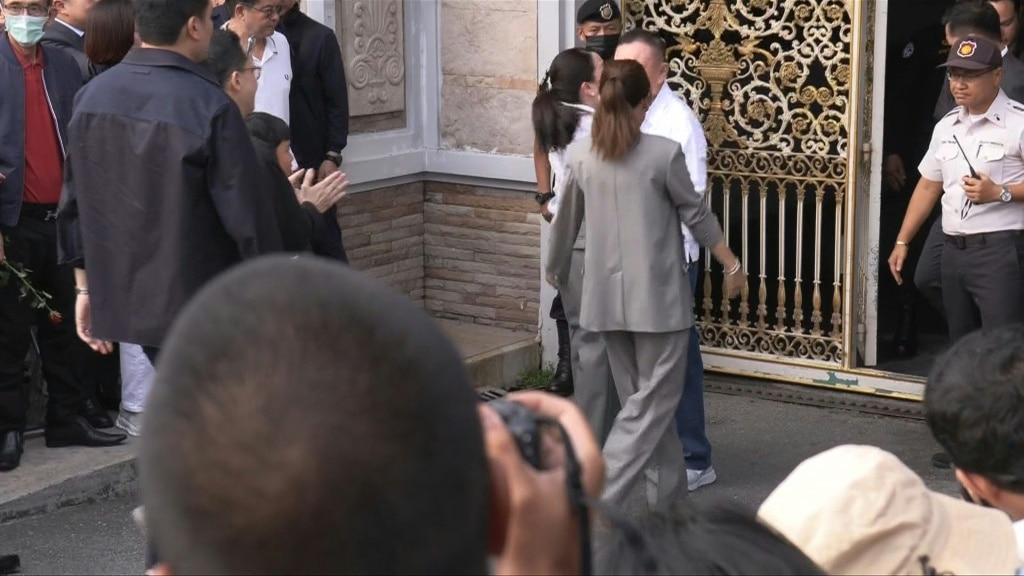
Bangkok, Thailand – Thailand’s divisive and long-dominant political figure Thaksin Shinawatra walked free from Bangkok’s Klong Prem Central Prison on Monday, eight months into a one-year sentence, opening a new chapter of uncertainty for the country’s already turbulent political landscape.
The 76-year-old former telecommunications tycoon and two-time prime minute was granted parole as part of a national early release program for elderly inmates, a decision announced by Thailand’s Department of Corrections last month. Following his release, Thaksin was fitted with a court-mandated electronic monitoring device at a local probation office, and will remain on probation until September. Under the terms of his release, he is barred from leaving Bangkok without official government approval.
Outside the prison walls, hundreds of Thaksin’s most loyal supporters gathered in the signature red shirts that have become a symbol of his populist political movement, waiting to catch a glimpse of the leader they have backed for more than two decades. As he exited the facility, Thaksin embraced his daughter Paetongtarn Shinawatra – herself a former Thai prime minister – and other family members, with supporters breaking into chants of “we love Thaksin” to welcome his release. Speaking to reporters from the back window of his car after arriving at his Bangkok residence, Thaksin said he felt “relief” after what he described as an eight-month “hibernation” behind bars.
Thaksin’s political influence has shaped Thai politics for 20 years, positioning his populist political bloc – which evolved into the current Pheu Thai party – as the most consistent electoral force in 21st-century Thailand. Members of the Shinawatra political dynasty have held the office of prime minister four times, drawing unwavering support from working-class and rural voters across the country. For the entirety of his political career, however, Thaksin has been locked in a bitter power struggle with Thailand’s pro-military, pro-royalty conservative elite, who have long viewed his populist appeal as a direct threat to the country’s traditional social and political order.
This long-running rivalry remains a defining factor of Thaksin’s post-prison future. Analysts note that the former prime minister still faces multiple outstanding criminal cases, a reality that may deter him from jumping back into high-profile political activism that could trigger new legal prosecution. Despite this, his release has already reshaped the dynamics of Thailand’s current ruling government, which includes Pheu Thai as a key coalition partner alongside conservative Prime Minister Anutin Charnvirakul.
The road to Thaksin’s early release has been marked by controversy and public suspicion. He first returned to Thailand from 15 years of self-imposed exile in August 2023, shortly after Pheu Thai concluded negotiations to form a new ruling coalition. Upon his return, he was convicted on corruption and abuse of power charges and sentenced to eight years in prison, but was immediately transferred to a private hospital suite on purported medical grounds rather than being held in a standard prison cell. A royal pardon later reduced his sentence to one year, but the Supreme Court ruled in September 2024 that Thaksin had not suffered from a life-threatening health condition, meaning his time in the hospital could not count toward his sentence, ordering him to serve the remainder of his term behind bars.
That unusual path to prison stoked widespread allegations of backroom deals and special treatment for Thaksin, accusations that have continued to shadow Thai politics as he re-enters public life. In February 2025, Pheu Thai turned in its worst electoral performance in the party’s modern history, sliding to third place in national voting and casting doubt on the long-term viability of the Shinawatra political dynasty. But the party’s role in Anutin’s ruling coalition has kept open the door for a potential Thaksin comeback.
Political observers are split on what Thaksin’s release means for Thai politics moving forward. Wanwichit Boonprong, a political science lecturer, noted that for die-hard Thaksin supporters, the former prime minister’s freedom will likely give a short-term boost to Pheu Thai, as supporters see the party’s de facto leader back in public life. At the same time, he argued, Thaksin’s long-time conservative rivals will rally around Prime Minister Anutin, who holds the trust of the traditional elite that Thaksin has long challenged. Those conservatives, Wanwichit said, will push aggressively to ensure Thaksin stays on the political sidelines.
Anutin struck a conciliatory tone with the former prime minister following his release, telling reporters he was happy for Thaksin and his family. “He returns home with a smile,” Anutin said, adding that he would not rule out a future meeting between the two leaders, noting “Bangkok is not that big. Meeting with people we know and respect is not strange.”
Members of Thaksin’s family have pushed back against speculation that he will immediately re-enter political competition. Paetongtarn Shinawatra told reporters earlier this week that the family had not discussed political matters during their recent prison visits. Thaksin’s nephew Yodchanan Wongsawat, who led Pheu Thai’s electoral ticket in February’s vote, currently holds a cabinet position as minister of higher education in Anutin’s administration.
Thaksin is one of more than 850 Thai inmates approved for early release under the government’s program for elderly and low-sentence prisoners, but his release is by far the most politically consequential, leaving political analysts and voters across Thailand waiting to see what the polarizing former leader will do next.