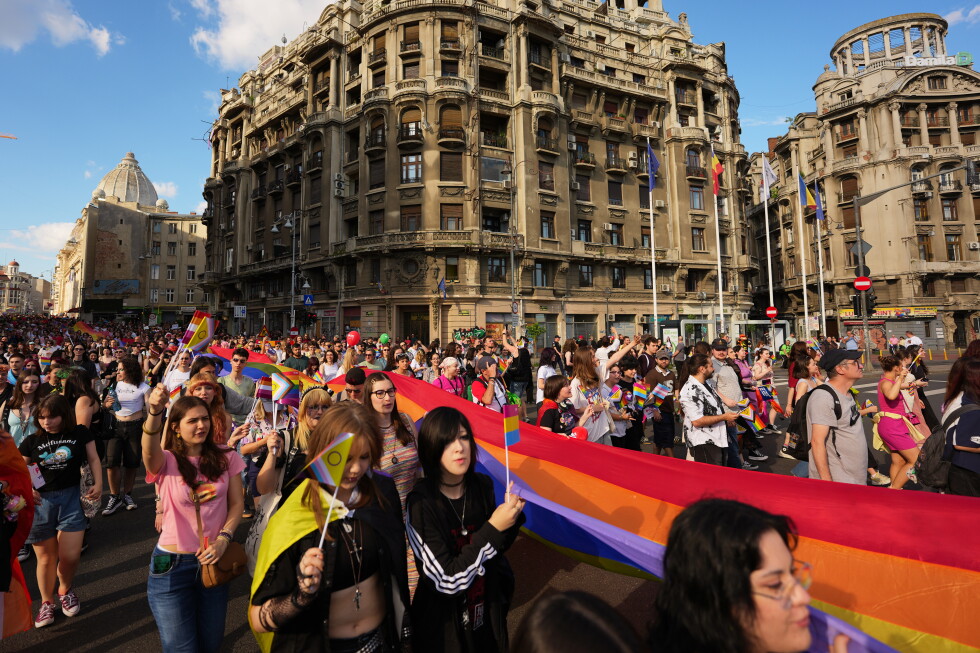
On a recent Saturday, tens of thousands of LGBTQ+ advocates and their allies flooded the central streets of Bucharest, Romania’s capital, and Sofia, Bulgaria’s capital, for their annual Pride parades, staging a public call for equal rights and legal recognition amid growing pushback from conservative and religious factions in the two majority Eastern Orthodox Christian nations.
Marchers in both capitals carried vibrant rainbow flags, sounded whistles, and chanted demands for equal treatment under the law, highlighting the stark gap between the European Union’s non-discrimination standards and the domestic legal status of LGBTQ+ people in both countries. Both Romania and Bulgaria gained EU membership back in 2007, and each implemented sweeping human rights reforms to meet the bloc’s accession requirements at the time. Yet decades later, public and institutional support for LGBTQ+ rights lags far behind most other EU member states. In ILGA-Europe’s 2025 Rainbow Map, which ranks European countries based on the strength of their legal and policy protections for LGBTQ+ communities, the two nations hold the bottom two spots among the EU’s 27 members. Neither country currently offers legal recognition for same-sex partnerships, let alone same-sex marriage, even though EU law explicitly prohibits discrimination on the basis of sexual orientation.
Alina Purcaru, a Bucharest-based writer who participated in the Romanian capital’s Pride march, described the deep-seated cultural barriers that LGBTQ+ Romanians continue to face. “We still have a deeply conservative society, with very strong traditional values,” Purcaru explained. “We still live in a patriarchy, sometimes explicit … with a lot of prejudice and a lot of fear.” For activists, the core demand of this year’s marches centered on establishing legal recognition for civil partnerships, a change that would grant same-sex couples access to fundamental legal protections that most couples take for granted.
Vlad Viski, president of Romanian LGBTQ+ rights NGO MozaiQ, told reporters that these legal protections are not abstract privileges but essential to daily life. “We are talking about essential rights, such as the right to inheritance, hospital visits, medical decisions, survivor’s pension,” Viski said. In Sofia, Simeon Vassilev, one of the lead organizers of Sofia Pride, echoed that sentiment, noting that thousands of same-sex couples in Bulgaria already build shared lives, raise children, and care for one another, yet have no access to legal safeguards for their relationships. “Thousands of same-sex couples live together, build homes, raise children, and care for one another … without the right to legal protection or recognition of their relationships,” Vassilev told journalists.
Human rights organizations monitoring the region have documented a steady rise in open hostility and targeted hate speech against LGBTQ+ communities in both countries over the past several years. That opposition was on full display on Saturday, as anti-Pride rallies organized by conservative, nationalist, and religious groups were held in both capitals simultaneously. In Sofia, the annual “March of the Family,” launched by right-wing and religious groups in 2021, gathered to promote what organizers call “Christian, patriotic and traditional values.” The Bulgarian Orthodox Church, which counts roughly 80% of the country’s population as its members, publicly stated its disagreement with Pride’s messaging and blessed the anti-Pride rally, framing traditional marriage as a core social institution. In Bucharest, a nationalist group held a parallel “March for Normality” opposing LGBTQ+ rights.
This year’s Sofia Pride was organized under the slogan “Different Together,” a deliberate framing designed to counter the polarizing anti-LGBTQ+ rhetoric that has become increasingly mainstream in Bulgarian politics. Notably, the governing Progressive Bulgaria party, led by Prime Minister Rumen Radev which won April’s general election, publicly backed the “March of the Family” in a parliamentary statement, calling the traditional nuclear family “a cornerstone of our national security, identity and future.” The Bulgarian Helsinki Committee, one of the country’s leading human rights watchdog groups, condemned the ruling party’s statement, arguing that it effectively enshrines a hierarchy of citizenship that marks LGBTQ+ Bulgarians as second-class citizens by framing one group of relationships as more valuable than another.