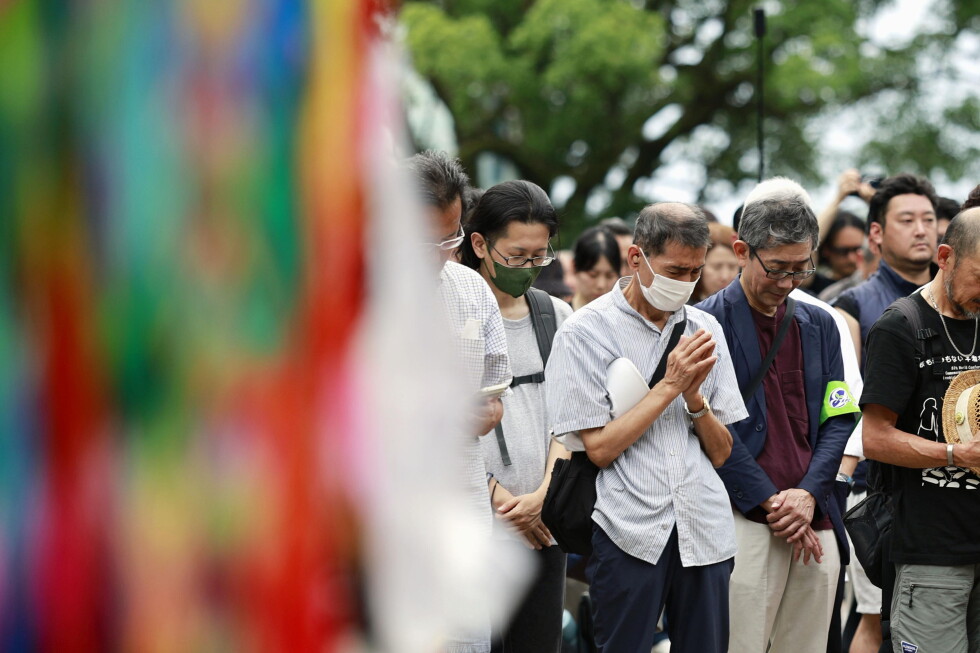
On the 81st anniversary of the United States’ atomic bombing of Nagasaki, a diplomatic row has erupted over seating arrangements that has reignited tensions rooted in cross-Strait relations and Japan’s long-standing diplomatic positioning.
Lee Yi-yang, the head of the Taipei Economic and Cultural Representative Office in Tokyo—Taiwan’s top de facto economic and diplomatic representative in Japan—announced that he and two of his senior deputies would boycott this year’s memorial ceremony, held at Nagasaki’s Peace Park on Sunday. In his public social media statement and a subsequent official release from his office, Lee accused Nagasaki municipal authorities of deliberately catering to Beijing’s political stance, insulting Taiwan and undermining what he claims as the island’s sovereignty and dignity.
The core of the dispute lies in seat classification. Lee said that his designated seat as a Taiwanese representative was not placed among the section reserved for official diplomatic missions stationed in Japan, a move he called a deliberate snub that erases Taiwan’s purported status as an independent entity. Instead of attending himself, Lee only dispatched a lower-ranked official from the office’s Fukuoka branch to take part in the event. His office further lashed out at Nagasaki officials, claiming the city had become “a pawn of China’s insistence that Taiwan is not a state and has no sovereignty.”
Nagasaki municipal officials have pushed back on the criticism, explaining that the seats allocated to Taiwanese representatives were placed in proximity to other foreign envoys and there was no intentional effort to single out the delegation for inferior treatment. As of Monday, Nagasaki Mayor Shiro Suzuki had not yet issued a public comment, with a press briefing scheduled for later the same day.
To understand the context of the dispute, it is necessary to revisit Japan’s long-standing diplomatic framework. In 1972, Japan and the People’s Republic of China normalized bilateral diplomatic relations, officially cutting formal diplomatic ties with Taipei in a joint communiqué that recognizes Beijing as the sole legitimate government representing China. To this day, Tokyo adheres to the one-China principle, though it maintains extensive unofficial economic, trade, and people-to-people exchanges with Taiwan through non-governmental liaison channels.
This year’s memorial ceremony drew representatives from 98 sovereign countries and three major international organizations: the United Nations, the European Union, and the International Committee of the Red Cross, per Nagasaki official counts. The current seating policy was actually crafted in response to a different boycott last year, when then-U.S. Ambassador to Japan Rahm Emanuel and envoys from five other G7 nations skipped the 2024 Nagasaki anniversary over the city’s decision not to invite Israel amid the escalating Middle East conflict and safety concerns. In response to that boycott, Nagasaki revised its guest policy to explicitly invite any country, region or organization that maintains either a diplomatic mission in Japan or permanent representation at the United Nations.
Under this new policy, Taiwan does not qualify for official guest status, as it is not recognized as a sovereign state with either diplomatic representation in Japan or a United Nations seat. Nagasaki officials noted, however, that the city still accommodated a Taiwanese delegation at the request of Taipei last year, the same arrangement that was extended this year.
Lee, who took up his post as Taiwan’s top representative in Japan in September 2024, made history last year as the first head of Taipei’s liaison office to attend both the Hiroshima and Nagasaki annual bombing memorials. He acknowledged that he received an identical seat assignment at the Nagasaki ceremony in 2024, but chose not to protest the arrangement at the time in order to prioritize maintaining friendly ties. This year, he did not extend the same leniency, pointing instead to a contrasting experience at the earlier Hiroshima atomic bombing memorial on August 6, where he said he was seated on equal footing with other foreign envoys.
Lee also used the controversy to level criticism at Beijing, arguing that Taiwan is a peace-loving actor in the Indo-Pacific while claiming that China’s growing military modernization and nuclear arsenal have increasingly threatened regional stability.
The 1945 atomic bombing of Nagasaki remains one of the most defining events of World War II. Three days after the U.S. dropped the first atomic bomb on Hiroshima, which killed an estimated 140,000 people by the end of 1945, the second U.S. atomic strike hit Nagasaki on August 9, 1945. By the end of that year, the bombing had killed 70,000 Nagasaki residents. Japan announced its unconditional surrender just six days later, on August 15, bringing World War II to a close after nearly five decades of Japanese military expansion across Asia.