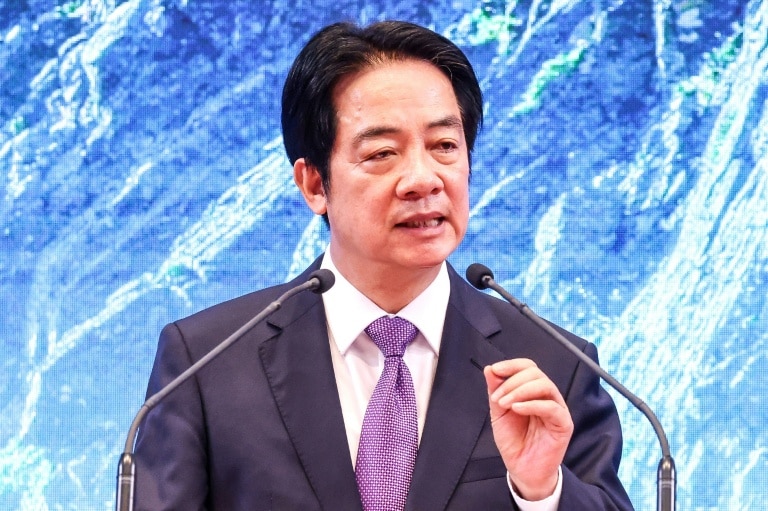
In a carefully calibrated address marking the second anniversary of his administration on Wednesday, Taiwan’s leader Lai Ching-te delivered a clear, unwavering message: the democratic island’s future will not be dictated by outside forces, even as cross-Strait tensions and shifting U.S. policy rhetoric create new uncertainty across the Indo-Pacific region.
Lai’s comments come on the heels of controversial remarks from former U.S. President Donald Trump, who recently floated the idea of using long-standing U.S. arms sales to Taiwan as a negotiating leverage with Beijing during conversations following his state visit to China last week. During that visit, Chinese President Xi Jinping pressed Trump to end all U.S. support for Taipei, a demand that has sent ripples through regional security circles. Beijing has for decades claimed Taiwan as an inalienable part of its territory and has repeatedly threatened to take the island by force if it formally declares independence. For decades, Washington has backed Taipei under the One China policy while providing critical security assistance to help Taiwan deter potential aggression, a framework that is now facing new questions after Trump’s comments.
In his speech, Lai pushed back against both external interference and internal uncertainty. “Taiwan’s future cannot be decided by foreign forces, nor can it be held hostage by fear, division, or short-term interests,” he stated. Echoing the island’s long-standing framing of cross-Strait tensions, Lai repeated the position that China is the ultimate root cause of regional instability in the Taiwan Strait, and characterized U.S. arms sales as a legitimate, legally grounded commitment to defending the island’s democratic system.
The Taiwanese leader emphasized that his administration has been ramping up defense outlays with a clear, defensive goal: preventing conflict, not provoking one. “Threats are greater than ever before,” Lai noted, adding that “Taiwan must have the capability to protect itself and to uphold peace and stability in the Taiwan Strait.” While he expressed openness to constructive, equal-footed exchanges with Beijing, Lai drew a firm line on core interests, stressing that “we will not sacrifice our sovereignty and democratic way of life.”
Since Trump returned to the White House, his administration has pressured Taiwan to significantly increase its own defense spending and expand economic investment in the United States, a shift that has pushed Taipei to accelerate military modernization efforts. Despite billions of dollars poured into upgrading domestic military capabilities and building up a local defense industry, the island still remains heavily dependent on U.S. supplies of advanced, high-technology weaponry that would be indispensable in any conflict with China.
Just recently, Taiwan’s legislature approved a landmark $25 billion defense spending package earmarked specifically for the procurement of U.S. arms. According to local legislative accounts, the fund will cover nearly $9 billion of the $11.1 billion arms deal Washington announced last December, as well as set aside resources for a second phase of proposed sales worth roughly $15 billion that has not yet received final U.S. approval.
For his part, Trump has called for both Beijing and Taipei to de-escalate tensions, noting that he will make a final decision on the pending arms sales package “over the next fairly short period of time.” He has also raised the possibility of holding a direct phone call with Lai, a move that would represent a major break from decades of U.S. diplomatic protocol. Washington cut formal diplomatic ties with Taipei in 1979 when it switched recognition to Beijing, and any high-level official contact between a U.S. president and a Taiwanese leader would almost certainly trigger a severe rupture in U.S.-China relations.
Lai addressed the prospect of this conversation directly on Wednesday, saying that if the call goes forward, he will make clear that his administration remains committed to upholding the cross-Strait status quo, and that it is Beijing that has systematically undermined peace and stability in the region. In the days following Trump’s comments on arms sales, Lai’s government has launched a public outreach effort to reassure both domestic audiences and international partners that long-standing U.S. policy toward Taiwan remains unchanged, and that Trump made no binding commitments to Beijing to restrict arms sales during his Beijing visit.