标签: South America

南美洲

  • Susie Wiles, White House chief of staff, criticizes Bondi and opines on Trump in Vanity Fair

    Susie Wiles, White House chief of staff, criticizes Bondi and opines on Trump in Vanity Fair

    WASHINGTON — In a series of candid interviews with Vanity Fair published Tuesday, White House Chief of Staff Susie Wiles offered unprecedented insights into the inner workings of President Donald Trump’s second administration while leveling sharp criticism against Attorney General Pam Bondi’s management of the Jeffrey Epstein case.

    The influential yet typically reserved aide acknowledged underestimating the magnitude of the Epstein scandal involving the disgraced financier but delivered pointed remarks about Bondi’s approach to the sensitive matter. “I think she completely whiffed on appreciating that that was the very targeted group that cared about this,” Wiles stated, referencing Bondi’s distribution of binders containing no new information to social media influencers.

    Despite her extensive on-the-record conversations with the magazine, Wiles subsequently dismissed the published piece as a “disingenuously framed hit piece” that omitted significant context to portray the administration negatively. She did not, however, deny the accuracy of the attributed comments.

    The interviews revealed several provocative administration positions, including Trump’s desire to continue military strikes against suspected drug vessels off Venezuela’s coast until leader Nicolas Maduro “cries uncle”—a statement seemingly at odds with the official position that operations focus solely on narcotics interception.

    Wiles provided rare personal assessment of the president, comparing his personality traits to those of “high-functioning alcoholics” despite his teetotalism, noting his unwavering belief that “there’s nothing he can’t do.” She described her role as channeling Trump’s energy and policy objectives while occasionally tempering his impulses.

    Regarding the administration’s much-discussed retribution campaign, Wiles acknowledged a “loose agreement” that score-settling would conclude within the first 90 days, though operations continued beyond that timeframe. She alternatively framed these actions as removing individuals who “have done bad things” from government rather than pure vengeance, though conceded the prosecution of New York Attorney General Letitia James for mortgage fraud might qualify as retribution.

    The Justice Department faces impending deadlines to release Epstein-related documents following Trump’s signing of legislation mandating disclosure, despite initial objections from the administration.

  • Hegseth and Rubio are expected back on Capitol Hill as questions mount over boat strikes

    Hegseth and Rubio are expected back on Capitol Hill as questions mount over boat strikes

    WASHINGTON — Senior U.S. national security officials returned to Capitol Hill on Tuesday amid intensifying congressional investigations into deadly military operations in international waters near Venezuela. Defense Secretary Pete Hegseth and Secretary of State Marco Rubio faced lawmakers demanding explanations for a series of controversial strikes that have resulted in numerous casualties.

    The congressional scrutiny follows a September 2nd incident where U.S. forces killed two survivors of an initial attack on a vessel allegedly transporting cocaine in the Caribbean. Just hours before the scheduled briefings, the military announced additional strikes in the eastern Pacific Ocean that eliminated eight individuals on three boats suspected of drug smuggling.

    This military escalation occurs alongside a substantial buildup of U.S. naval assets in the region, including the deployment of thousands of troops and the nation’s largest aircraft carrier. The administration has simultaneously conducted fighter jet flights near Venezuelan airspace and seized an oil tanker as part of its campaign against President Nicolás Maduro’s government.

    Notably, the Trump administration has operated without seeking congressional authorization for these actions, prompting bipartisan concerns about the legal and strategic foundations of the operations. Lawmakers are advancing war powers resolutions that could reach votes this week in response to what many perceive as executive overreach.

    The September incident has become particularly contentious after revelations that the victims were survivors clinging to wreckage from the initial strike. Admiral Frank ‘Mitch’ Bradley, who ordered the fatal follow-up attack, reportedly acknowledged to lawmakers that although the two individuals attempted to overturn their damaged vessel, success was unlikely. According to briefings, the victims were waving from the overturned craft without attempting to call for reinforcement.

    Legal experts including John Yoo of Berkeley Law and Michael Schmitt, former Air Force lawyer and professor emeritus at the U.S. Naval War College, have raised serious concerns about potential violations of the Pentagon’s manual on laws of war, which explicitly prohibits firing upon shipwrecked persons.

    The administration maintains that these operations are legally justified under U.S. and international law, with supporters like Senator Jim Risch claiming the drug interdictions have saved numerous American lives by preventing narcotics from reaching domestic shores.

    As congressional committees schedule additional classified briefings, lawmakers from both parties are seeking greater transparency, including the release of video footage from the September engagement and a clearer explanation of the strategic objectives behind the military buildup targeting Venezuela.

  • Eight killed in latest strikes on alleged drug boats, US military says

    Eight killed in latest strikes on alleged drug boats, US military says

    The United States Southern Command has confirmed conducting lethal military strikes against three vessels allegedly involved in drug trafficking operations in the Pacific Ocean, resulting in eight fatalities. The operation, part of an intensified counter-narcotics campaign, targeted boats transiting along recognized narco-trafficking corridors according to official statements.

    Recent months have witnessed approximately 20 similar engagements across both the Pacific and Caribbean regions, with estimated casualties exceeding 90 individuals. This escalation forms a central component of President Donald Trump’s strategic offensive against criminal organizations allegedly facilitating narcotics transportation toward American territories.

    Legal experts have raised substantial concerns regarding compliance with international armed conflict regulations. A particularly controversial incident occurred on September 2nd, involving consecutive strikes against a single vessel. Survivors from the initial engagement were reportedly eliminated in the subsequent attack, prompting condemnation from multiple international law specialists.

    BBC Verify has consulted several prominent legal authorities who concluded that the secondary strike likely constituted an extrajudicial killing under established international legal frameworks. A former International Criminal Court chief prosecutor characterized the broader campaign as representing systematically planned assaults against civilians during peacetime conditions.

    The White House has defended these operations as legally justified actions consistent with armed conflict legislation, emphasizing the necessity of protecting American citizens from cartels allegedly “attempting to deliver poisonous substances to United States shores.”

    Geopolitical tensions have simultaneously intensified between the Trump administration and Venezuela, with accusations of state-sponsored narcotics trafficking and recent deployment of thousands of military personnel alongside the USS Gerald Ford within strategic proximity to Venezuelan territory. A December 10th seizure of an oil tanker off Venezuela’s coast, alleged to be part of an illicit network transporting sanctioned petroleum, has been denounced by Venezuelan Foreign Minister Yvan Gil as “international piracy” and an attempted resource appropriation.

  • Conservative Kast’s victory in Chile suggests a hard-right, pro-Trump surge across Latin America

    Conservative Kast’s victory in Chile suggests a hard-right, pro-Trump surge across Latin America

    SANTIAGO, Chile — Chile has dramatically pivoted toward conservative governance with the election of José Antonio Kast, a veteran politician whose hardline stance on crime, immigration, and social policy has drawn comparisons to Donald Trump. This outcome marks a significant departure from the country’s recent liberal trajectory and reflects a broader regional realignment toward right-wing leadership across South America.

    Kast, a 59-year-old conservative stalwart, secured a decisive electoral victory by capitalizing on widespread public discontent over rising organized crime, economic stagnation, and uncontrolled migration. His success represents a remarkable political comeback, given his previous failed presidential bids in an increasingly progressive nation. Kast has expressed admiration for Chile’s Pinochet-era military dictatorship, opposed same-sex marriage, and advocated for constitutional bans on abortion—positions that previously limited his appeal but now resonate with voters seeking strong leadership.

    This electoral shift occurs against a backdrop of regional transformation. Across South America, voters are rejecting left-wing incumbents and embracing conservative alternatives. Argentina’s anarcho-capitalist President Javier Milei, Ecuador’s iron-fisted leader Daniel Noboa, and Bolivia’s right-wing President Rodrigo Paz exemplify this trend, which has effectively ended nearly two decades of socialist dominance in several nations.

    Harvard political scientist Steven Levitsky observes, ‘The last decade has been rough. Those in power—predominantly left-wing governments—are being blamed for stagnant economies, rising crime perceptions, and not insignificant corruption.’

    The defeat of Kast’s communist rival, Jeannette Jara from the center-left governing coalition, underscores the depth of public frustration with President Gabriel Boric’s administration. Despite initial promise, Boric’s government faced legislative defeats, corruption scandals, and escalating crime that derailed his transformative agenda.

    Kast’s victory celebration featured symbolic displays of alignment with global conservatism, including American flags, ‘Make Chile Great Again’ caps, and banners supporting Milei’s ideological movement. Like Milei and Brazil’s former President Jair Bolsonaro, Kast has been a featured speaker at the Conservative Political Action Conference, where he has denounced socialism, criticized ‘gender ideology,’ and promised mass deportations.

    Despite his hardline reputation, Kast positioned himself as a moderate during the runoff election, promising to preserve social benefits and maintain Chile’s free-market institutions. His campaign focused primarily on crime and immigration, successfully appealing to middle-class voters who viewed him as the candidate most likely to deliver tangible results.

    In his first address as president-elect, Kast struck a conciliatory tone, promising to ‘be the president of all Chileans’ and surprising critics with his commitment to unity. This victory represents not just a political change but a fundamental reorientation of Chilean politics with potentially far-reaching implications for the region’s geopolitical landscape.

  • A day at the races: How Venezuelans find joy despite familiar political turmoil

    A day at the races: How Venezuelans find joy despite familiar political turmoil

    CARACAS, Venezuela — Amid escalating geopolitical tensions and domestic uncertainty, Venezuelans demonstrated remarkable resilience during a Sunday horse racing event that provided temporary escape from the nation’s protracted crisis. The capital’s racetrack witnessed enthusiastic crowds cheering as American jockey Katie Davis rode Silk Eyes to victory, symbolizing a moment of normalcy in otherwise turbulent times.

    Venezuela concludes another year defined by complex socioeconomic and political challenges that originated with President Nicolás Maduro’s administration in 2013. The current climate has intensified with U.S. military assets deployed near Venezuela’s Caribbean coastline and consistent threats of military action from the Trump administration. These developments form part of Washington’s strategy to pressure Maduro, who faces narcoterrorism charges in the United States.

    The U.S. government characterizes its expanded military operation across Caribbean and Eastern Pacific waters as an anti-narcotics initiative, though Venezuelan officials maintain it represents a thinly-veiled regime change effort. Recent escalation occurred when U.S. commandos seized a tanker carrying illicit crude oil near Venezuela’s coast—a significant blow to the petroleum-dependent economy.

    Opposition leader María Corina Machado, appearing publicly from Norway after eleven months in hiding, endorsed the seizure during a ‘Face the Nation’ interview. She characterized Maduro’s government as a ‘criminal structure’ that would collapse when deprived of illegal revenue streams including oil, drugs, gold, arms, and human trafficking.

    Despite these tensions, the racetrack atmosphere remained decidedly apolitical. Attendees from various socioeconomic backgrounds, including government workers and militia members, shared space without confrontation. Families with children gathered around bouncy castles while racing enthusiasts studied betting magazines, collectively embracing the diversionary event.

    ‘All Venezuelans experience anxiety about what might happen,’ acknowledged regular attendee Luigi Achique, ‘but I come here on Sundays to unwind.’ This sentiment echoed throughout the venue, with spectator Roxany Hernández noting, ‘Despite the difficulties, we’re working, we’re enjoying ourselves.’

    Jockey Katie Davis acknowledged navigating travel warnings to participate, stating she felt ‘very safe’ despite initial nervousness. ‘Everybody has their opinion,’ she remarked, ‘but I come in peace’—a perspective that resonated with the day’s unifying spirit.

  • Brazilians protest against bill to reduce Bolsonaro’s jail time

    Brazilians protest against bill to reduce Bolsonaro’s jail time

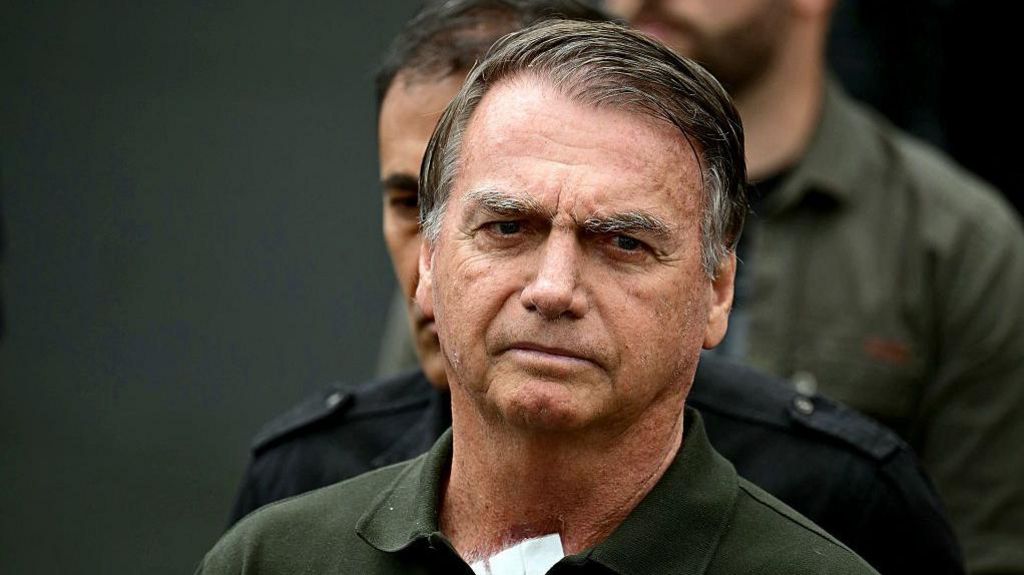
    Major Brazilian cities witnessed massive demonstrations on Sunday as tens of thousands of citizens mobilized against legislative efforts to substantially reduce former President Jair Bolsonaro’s prison term. The controversial bill, which cleared the lower house of Congress last week amid chaotic proceedings, would potentially slash Bolsonaro’s 27-year sentence for coup plotting to just over two years.

    The protests spanned multiple urban centers including Rio de Janeiro, Brasília, and Salvador, with particularly significant gatherings at Rio’s iconic Copacabana Beach. The demonstration there attracted approximately 19,000 participants, including prominent cultural figures such as Oscar-winning actress Fernanda Torres and legendary 83-year-old singer Caetano Veloso, who performed at the rally. São Paulo saw around 13,700 protesters marching through its streets.

    Protesters displayed signs with strong political messages, including some that labeled members of Congress as ‘enemies of the people,’ reflecting the deep polarization surrounding the legislation. This represents the latest in a series of anti-Bolsonaro demonstrations, following similar gatherings in September that opposed calls for his official pardon.

    The legislative proposal has ignited intense debate as it would not only affect Bolsonaro’s sentence but could also reduce penalties for thousands detained for their involvement in the January 2023 assault on government buildings in Brasília. The violent attack occurred after Bolsonaro’s electoral defeat to left-wing rival Luiz Inácio Lula da Silva, whom the former president was convicted of plotting to assassinate.

    The bill now advances to the Senate, where its fate remains uncertain. Even if approved by both legislative chambers, President Lula is expected to exercise his veto power, though Congress could potentially override such a veto given the conservative majority in the Chamber of Deputies.

  • Trinidad and Tobago to open its airports to US military as tensions with Venezuela escalate

    Trinidad and Tobago to open its airports to US military as tensions with Venezuela escalate

    The government of Trinidad and Tobago has officially authorized United States military forces to utilize its national airports for logistical operations in the coming weeks, a decision announced Monday amid escalating geopolitical tensions between the U.S. and neighboring Venezuela. The Caribbean nation’s Ministry of Foreign Affairs characterized the arrangement as supporting routine logistical functions including supply replenishment and personnel rotations, while explicitly denying any offensive military purposes.

    This development follows the recent installation of advanced radar systems at Tobago’s ANR Robinson International Airport by U.S. military personnel. Trinidad and Tobago officials maintain these systems are solely intended for combating domestic criminal activities, asserting the twin-island nation will not serve as a strategic launch point for attacks against any sovereign state.

    The decision has sparked significant political controversy within the country. Opposition Senator Amery Browne, who previously served as foreign minister, condemned the agreement as transforming Trinidad and Tobago into “complicit facilitators of extrajudicial killings” and advancing a “might is right philosophy.” Browne argued this represents a dangerous departure from decades of balanced regional cooperation.

    The authorization occurs against the backdrop of intensified U.S. naval operations in the Caribbean, where American warships have conducted strikes against alleged drug trafficking vessels since September, resulting in over 80 casualties. The U.S. Navy has significantly expanded its presence near Venezuelan waters, deploying its largest aircraft carrier alongside additional warships. In October, a U.S. vessel docked in Port-of-Spain, Trinidad’s capital, demonstrating increased military coordination.

    U.S. lawmakers have raised constitutional concerns regarding the legality of maritime strikes in Caribbean and eastern Pacific waters, prompting announced congressional reviews of these operations. The proximity of Trinidad and Tobago to Venezuela—separated by merely seven miles at their closest point—adds strategic significance to these military developments.

  • Smooth end to Messi India tour after Kolkata chaos

    Smooth end to Messi India tour after Kolkata chaos

    Football icon Lionel Messi concluded his tumultuous three-day promotional tour across India on Monday, culminating in a Delhi stadium event overshadowed by earlier chaos in Kolkata. The Inter Miami forward’s visit—marking his first return to India since 2011—unfolded against a backdrop of extreme fan devotion and operational missteps.

    The tour commenced disastrously in Kolkata on Saturday when enraged supporters vandalized Salt Lake Stadium after failing to secure clear views of the Argentinian legend. Fans who had paid up to 12,000 rupees (£100) for tickets tore up seating and hurled objects onto the pitch as Messi was swiftly escorted through celebrity crowds. Local media described the scene as a ‘battlefield’ resulting from poor event management and security failures. The incident prompted the arrest of Kolkata event organizer Satadru Dutta, who faces 14 days police custody.

    Despite the turbulent start, Messi’s subsequent appearances in Hyderabad and Mumbai proceeded smoothly. The football superstar engaged in promotional activities including virtual unveiling of a 70-foot statue in Kolkata, exhibition matches with children, and meetings with Indian cultural icons. His notable engagements included Bollywood star Shah Rukh Khan, cricket legend Sachin Tendulkar, and opposition leader Rahul Gandhi.

    Monday’s Delhi finale saw thousands of supporters braving polluted conditions to witness Messi alongside teammates Luis Suárez and Rodrigo De Paul. The event featured ball-kicking demonstrations, youth training sessions, and autograph signings, though the itinerary was shortened due to weather-related flight delays from Mumbai.

    The tour highlighted both India’s passionate football culture and the challenges of managing global sporting events in the country. While Messi’s appearances drew immense crowds nationwide, the Kolkata incident revealed significant gaps in celebrity event coordination and security protocols.

  • Fear of crime and migration fuels Chile’s swing to the right

    Fear of crime and migration fuels Chile’s swing to the right

    Chile has elected hardline conservative José Antonio Kast as its next president, marking a dramatic political shift that aligns the nation with a growing bloc of right-wing governments across Latin America. The election outcome reflects profound voter anxieties over security, immigration, and crime that have unraveled Chile’s traditional image as a regional bastion of stability.

    Kast, a 59-year-old conservative who has drawn both criticism and support for his family’s connections to Chile’s authoritarian past, secured victory by promising an “emergency government” approach to the nation’s challenges. His campaign rhetoric emphasized strict immigration controls, including proposed border walls and mass deportations of undocumented migrants, while simultaneously pledging to avoid authoritarianism despite his admiration for former dictator Augusto Pinochet.

    The president-elect’s victory places Chile alongside Argentina, Bolivia, Costa Rica, Ecuador, El Salvador, and Panama in a continental trend that has seen nations swing decisively from left to right governance. This political realignment is largely driven by widespread concerns over economic instability, corruption within previous leftist administrations, and escalating security issues.

    Kast’s messaging particularly resonated with voters concerned about Chile’s rapidly changing demographic landscape. Government statistics reveal a 46% increase in the foreign-born population since 2018, with approximately 336,000 undocumented migrants now residing in the country—many fleeing Venezuela’s economic collapse. This rapid transformation has created social tensions and fears about crime, despite data showing murder rates have actually declined since 2022.

    While Kast promises to implement Trump-style “iron fist” policies, including military deployment to borders and aggressive social media promotion of his crackdowns, practical implementation faces significant hurdles. Venezuela currently refuses to accept deportees from Chile, and the nation’s economy relies heavily on migrant labor in sectors ranging from agriculture to hospitality.

    Business owners like Carlos Alberto Cossio, a Bolivian national operating in Chile for 35 years, warn that mass deportations would severely impact economic productivity and increase costs. Meanwhile, migrants like Venezuelan waiter Gabriel Funez describe living in legal limbo, fearing both deportation and rising xenophobia validated by Kast’s rhetoric.

    The new president will also face political challenges, as his party lacks a congressional majority, requiring compromise on proposals for tougher sentencing and maximum-security prisons. Ultimately, Kast’s victory represents how perceptions of control may matter as much as actual policy results for voters across a continent grappling with interconnected crises of security, migration, and economic uncertainty.

  • Chile elects far-right José Antonio Kast as next president

    Chile elects far-right José Antonio Kast as next president

    Chile has embarked on a profound political transformation with the election of far-right candidate José Antonio Kast as its next president. Securing a commanding 58% of the vote in his third presidential bid, Kast’s victory represents the most significant rightward shift in Chilean politics since the end of Augusto Pinochet’s military dictatorship in 1990.

    The election campaign centered overwhelmingly on issues of national security, immigration control, and crime prevention. Kast successfully portrayed Chile as a nation descending into chaos, pledging to restore order through stringent measures including sharp spending cuts, construction of border fortifications along Peru and Bolivia frontiers, maximum-security prisons, and mass deportations of irregular migrants.

    His triumph over left-wing coalition candidate Jeannette Jara from the Communist Party sparked jubilant celebrations among supporters in Santiago, where crowds draped in Chilean flags chanted slogans and celebrated the outcome. Many voters expressed hope that Kast would fulfill his promises to enhance national security and patriotism.

    The election results reflect growing voter concerns about immigration and organized crime, despite Chile maintaining its status as one of South America’s safest and most stable nations. Critics argue Kast exaggerated security threats, noting that murder rates are actually declining and studies indicate immigrants commit fewer crimes on average.

    Kast’s political ideology shows strong parallels with former U.S. President Donald Trump, whose ‘Make America Great Again’ slogan inspired similar campaign merchandise in Chile. His victory aligns with a broader regional trend toward right-wing leadership in Latin America, following similar shifts in Argentina, Ecuador, Costa Rica, and El Salvador.

    The president-elect’s background has raised concerns among opponents who fear a return to Chile’s authoritarian past. Kast has openly praised former dictator Pinochet, whose regime was marked by severe human rights abuses. His brother served as a minister during the dictatorship, and his father was a member of the Nazi party.

    Investors are expected to welcome Kast’s victory due to his commitment to free-market economics, state reduction, and industry deregulation. However, his staunch opposition to abortion—even in cases of rape—and environmental protection policies have drawn criticism from progressive groups.

    Kast is scheduled to be inaugurated on March 11, 2026, having repeatedly warned undocumented immigrants during campaign rallies to depart before that date if they wish to maintain future return options.