In a poignant moment at the Tokyo National Stadium, Shelly-Ann Fraser-Pryce, the most decorated female 100m sprinter in history, concluded her illustrious career with a silver medal in the 4x100m relay. This marked her 25th and final global podium appearance, cementing her legacy as one of the greatest athletes of all time. At 38, Fraser-Pryce, an eight-time Olympic medallist and five-time world 100m champion, passed the baton to the next generation, including 21-year-old twin sisters Tia and Tina Clayton, who were part of the Jamaican quartet. Reflecting on her journey, Fraser-Pryce expressed gratitude for her remarkable career, stating, ‘I have had an amazing career, and today’s medal is the icing on the cake.’ Her son Zyon, born in 2017, was a driving force behind her post-motherhood comeback, which saw her win back-to-back world 100m titles and become the oldest woman to claim a 100m world title in 2019. Despite a disappointing withdrawal from the 100m semi-final at the 2024 Olympics due to a panic attack, Fraser-Pryce was determined to end her career on her own terms. Her final race saw her finish sixth in the 100m final, just 0.19 seconds off the podium. Tributes poured in from fellow athletes, including Usain Bolt, who hailed her as ‘the greatest of all time.’ Fraser-Pryce now plans to focus on advocacy, supporting women and athletes, and continuing to make an impact beyond the track.
标签: South America
南美洲
-

I have no relationship with Trump, Brazil’s President Lula tells BBC
In a candid interview with the BBC, Brazilian President Luiz Inácio Lula da Silva expressed his strained relationship with former US President Donald Trump, emphasizing that there is ‘no relationship’ between them. Lula criticized Trump’s imposition of 50% tariffs on Brazilian goods in July, describing the move as ’eminently political’ and warning that US consumers would bear the brunt of higher prices for Brazilian exports like coffee and beef. The tariffs, which Lula learned about through Brazilian newspapers, have significantly impacted Brazil’s trade with the US. Lula accused Trump of failing to communicate in a civilized manner, noting that the tariffs were announced via social media rather than through diplomatic channels. Despite his frosty ties with Trump, Lula highlighted his strong relationships with other global leaders, including former US presidents, UK prime ministers, and leaders from the EU, China, Ukraine, and Venezuela. He also defended his continued engagement with Russian President Vladimir Putin, whom he described as a longstanding ally. Lula called for reform of the United Nations, criticizing the veto power of the five permanent members of the Security Council and arguing that it undermines global democracy. He also addressed Brazil’s controversial oil exploration plans near the Amazon River, insisting that the country is adhering to strict environmental laws. Lula concluded by reflecting on his political legacy, including reducing hunger and unemployment, and left open the possibility of running for re-election in 2026.
-

US designates Colombia as country ‘failing to cooperate in drug war’
The United States has officially designated Colombia as a country that has ‘demonstrably failed’ to meet its obligations in combating drug trafficking. This decision, announced on Monday, marks the first time since 1997 that Colombia has been added to the list of nations deemed non-compliant with U.S.-led counternarcotic efforts. Despite this, the U.S. has opted not to cut off aid to Colombia, a move that could have further strained bilateral relations. The Trump administration criticized Colombia’s left-wing President Gustavo Petro, attributing a surge in cocaine production to his leadership. Petro, however, refuted these claims, pointing to his predecessor Iván Duque’s tenure as the period when coca cultivation expanded significantly. In a retaliatory gesture, Colombia announced it would cease purchasing weapons from the U.S., with Interior Minister Armando Benedetti declaring the decision effective immediately. The U.S. also named Afghanistan, Bolivia, Myanmar, and Venezuela as countries failing to meet drug control targets. The decertification of Colombia comes amid heightened U.S. efforts to combat ‘narco-terrorism,’ highlighted by a recent military strike on a suspected Venezuelan drug vessel in the South Caribbean, which resulted in three fatalities. While the U.S. acknowledged the ‘skill and courage’ of Colombia’s security forces, it placed the blame squarely on the political leadership for the country’s drug control shortcomings. The U.S. left open the possibility of recertifying Colombia if it takes more aggressive action against coca cultivation and cocaine production. Despite the diplomatic friction, Colombia remains a key recipient of U.S. aid, a fact that may temper the immediate fallout from this decision.
-

US destroys alleged Venezuelan drug boat, killing three
In a dramatic escalation of tensions between the United States and Venezuela, President Donald Trump announced on Monday that the US military had destroyed an alleged Venezuelan drug vessel in international waters. Trump, speaking via Truth Social, claimed the operation targeted ‘violent drug trafficking cartels’ and resulted in the deaths of three individuals. However, no concrete evidence was provided to substantiate the claim that the boat was carrying narcotics.
The incident follows a series of confrontations between the two nations, including the deployment of US warships to the southern Caribbean for counter-narcotics operations. A previous strike on September 2, which killed 11 people aboard another vessel, has been criticized by legal experts as potentially violating international human rights and maritime law.
Trump defended the actions, stating that the US had ‘recorded proof’ of the boats belonging to narco-terrorist groups. ‘All you have to do is look at the cargo—it was spattered all over the ocean—big bags of cocaine and fentanyl all over the place,’ he said during a press briefing from the Oval Office. He also claimed that maritime drug trafficking to the US had decreased due to recent efforts but acknowledged that narcotics continue to enter the country by land.
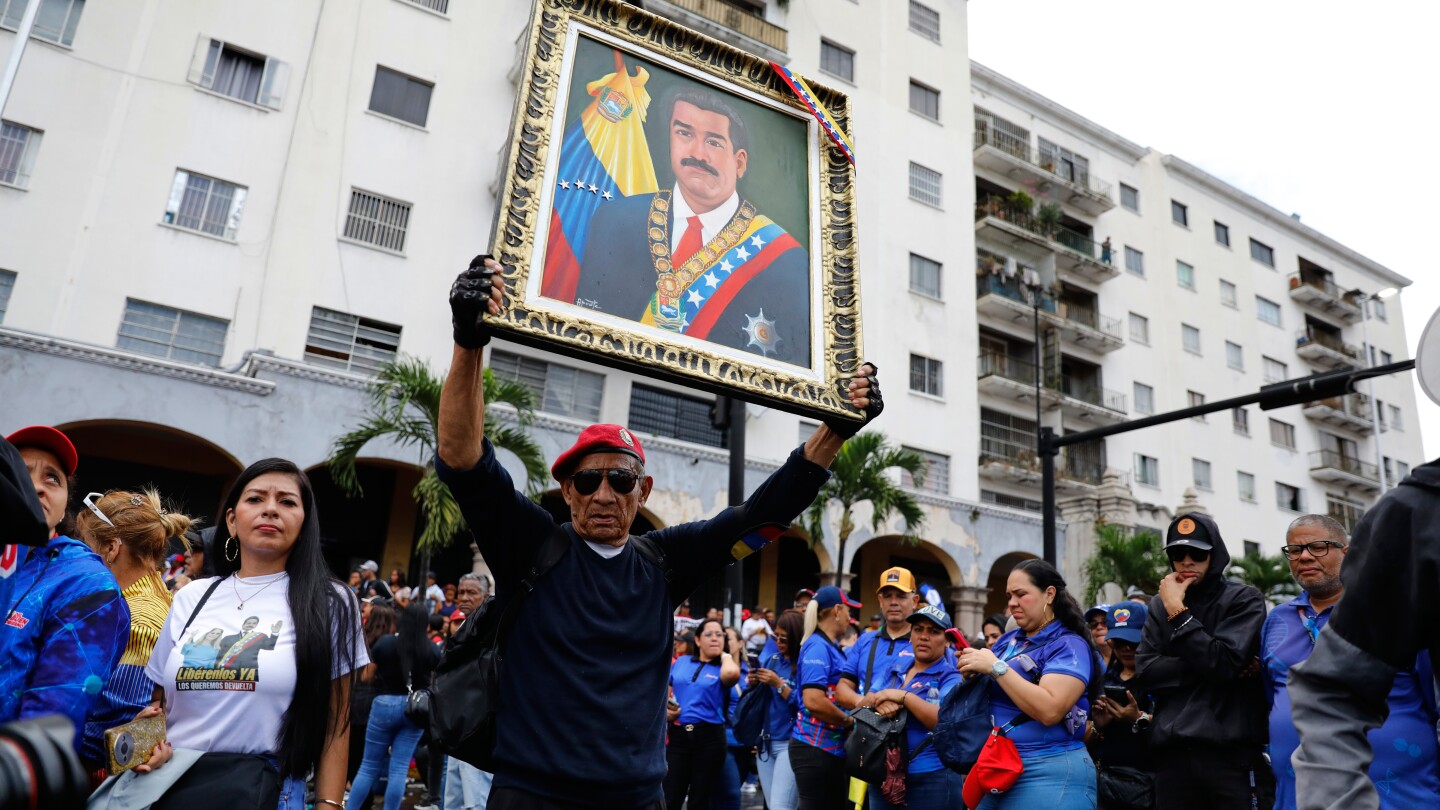
Venezuelan President Nicolás Maduro condemned the US actions, accusing Washington of ‘aggression’ and labeling America’s top diplomat Marco Rubio as the ‘lord of death and war.’ Maduro asserted that Venezuela would ‘fully exercise its legitimate right to defend itself’ and called on citizens to enlist in the militia. He also claimed that relations with the US had ‘been destroyed by their bomb threats.’
The Venezuelan Foreign Ministry further alleged that the US was seeking to escalate conflict in the Caribbean to justify regime change in Caracas. This accusation came after Venezuelan Foreign Minister Yván Gil reported that US forces had ‘illegally and hostilely’ seized a Venezuelan fishing boat for eight hours.
The US, along with other nations including the UK, has not recognized Maduro’s re-election in July 2024, citing evidence of electoral fraud. US officials have also accused Maduro of leading a drug cartel and have offered a $50 million reward for information leading to his capture. Maduro has denied these allegations, calling them an ‘imperialist move’ to depose him.
As tensions continue to rise, the international community watches closely, with concerns over the potential for further military escalation and its implications for regional stability.
-

Brazil’s Lula hits back at Trump over Bolsonaro trial and tariffs
Brazilian President Luiz Inácio Lula da Silva has publicly defended the trial and subsequent sentencing of his predecessor, Jair Bolsonaro, to over 27 years in prison for orchestrating a coup attempt. In a strongly-worded opinion piece published in the New York Times, Lula refuted claims by former U.S. President Donald Trump that the trial was a ‘witch hunt,’ describing it instead as a ‘historic decision that safeguards Brazil’s institutions and democratic rule of law.’ Lula emphasized that the trial was conducted in strict adherence to Brazil’s 1988 Constitution, which was established after decades of struggle against military dictatorship. He also addressed the strained relations between the U.S. and Brazil, criticizing Trump’s imposition of 50% tariffs on Brazilian imports as ‘misguided and illogical.’ Lula argued that the U.S. had accumulated a $410 billion trade surplus with Brazil over the past 15 years, suggesting that the tariffs were politically motivated. He further accused the U.S. government of using tariffs and the Magnitsky Act to shield Bolsonaro from accountability. Lula concluded by asserting Brazil’s commitment to dialogue with the U.S. but made it clear that ‘Brazil’s democracy and sovereignty are not on the table.’ The trial, which concluded last Thursday, saw four out of five Supreme Court justices convict Bolsonaro on all charges. Bolsonaro’s legal team has announced plans to appeal the verdict.
-

Seville ushers in new era for Jamaican sprinting
In a moment of sheer triumph, Oblique Seville has etched his name into the annals of athletics history, becoming the first Jamaican man to claim the world 100m title since the legendary Usain Bolt in 2016. The 24-year-old sprinter delivered a breathtaking performance at the Tokyo World Championships, clocking a personal best of 9.77 seconds to secure gold and usher in a new era for Jamaican sprinting. His victory, coupled with Kishane Thompson’s silver, marked a resounding return to dominance for Jamaica in the men’s 100m event, ending a four-year streak of American supremacy.
Seville’s journey to the top has been anything but smooth. After narrowly missing the podium in the 2023 World Championships and a disappointing last-place finish in the 2024 Paris Olympics, doubts lingered about his ability to fulfill his immense potential. However, under the guidance of Glen Mills, Usain Bolt’s former coach, Seville silenced his critics with a commanding performance in Tokyo. ‘I have proved that I am a true competitor, that I have the determination of a champion,’ Seville declared after his victory.
The emotional weight of the moment was palpable, with Bolt himself in attendance, visibly elated by Seville’s success. ‘His coach is my coach, and I know that both of them are very proud of me right now,’ Seville shared. The young sprinter also revealed that Bolt’s mentorship and family support have been pivotal in his journey. ‘Since my father passed away, Usain’s my motivator,’ he added.
Seville’s triumph was part of a stellar night for Jamaica, with Tina Clayton securing silver in the women’s 100m final. Meanwhile, the United States celebrated Melissa Jefferson-Wooden’s breakthrough gold in the women’s event, ensuring the continued rivalry between the two sprint powerhouses. As Seville looks ahead, his victory not only cements his status as a world-class athlete but also reignites Jamaica’s hopes for a new golden era in sprinting.
-

Hermeto Pascoal, ‘the wizard’ of Brazilian music, dies at 89
Hermeto Pascoal, the groundbreaking Brazilian composer and multi-instrumentalist renowned for his unique fusion of jazz and traditional Brazilian music, has died at the age of 89. His passing was announced on his Instagram page, where his family shared that he was surrounded by loved ones and fellow musicians at the time of his death. No further details were provided. Born on June 22, 1936, in a rural settlement in Alagoas, Pascoal overcame childhood poverty and the challenges of albinism to become a self-taught musical prodigy. He began his journey at the age of 10, performing at local dances and weddings, and later expanded his repertoire to include forró and other traditional Brazilian styles. In the late 1950s, Pascoal moved to Rio de Janeiro, where he immersed himself in the city’s vibrant jazz scene, performing in nightclubs and joining a radio orchestra. His innovative blend of jazz and Brazilian folk music captivated audiences and earned him collaborations with legendary artists, including singer Elis Regina and percussionist Airto Moreira. Pascoal’s talent also caught the attention of jazz icon Miles Davis, who hailed him as the ‘most important musician on the planet.’ Despite this acclaim, Pascoal rejected being labeled solely as a jazz musician, emphasizing his deep roots in Brazilian genres like chorinho and samba. Over his prolific career, he composed over 2,000 instrumental pieces and continued to arrange and record music well into his 80s. Known for his versatility, Pascoal mastered instruments ranging from piano and flute to saxophone, guitar, and even household objects. His unconventional approach was exemplified in 1976 when he brought live pigs into the studio while recording his debut album, ‘Slaves Mass.’ Pascoal’s family encouraged fans to honor his legacy by letting ‘a single note ring—from an instrument, your voice, or a kettle—and offer it to the universe.’ His death marks the end of an era for Brazilian music, leaving behind a legacy of innovation and boundless creativity.
-

Former English schools champion makes history for Uruguay
In a dramatic finish at the World Athletics Championships in Tokyo, Julia Paternain secured a surprising bronze medal in the women’s marathon, marking Uruguay’s first-ever medal in the event’s history. The 25-year-old athlete, whose family hails from Uruguay but moved to the UK when she was two, drew inspiration from her past victories in the English Schools 3,000m championships during the race. Ranked 288th globally and competing in only her second marathon, Paternain was not considered a contender for a podium finish. However, her determination and strategic pacing propelled her to a remarkable third place with a time of 2:27.23. Kenya’s Peres Jepchirchir, the 2021 Olympic champion, clinched gold in a thrilling sprint finish, narrowly beating Ethiopia’s Tigst Assefa by two seconds. Paternain, unaware of her exact position during the race, expressed shock and disbelief at her achievement. She credited her success to her focus and resilience, recalling her earlier triumphs in school competitions. This historic moment not only highlights Paternain’s personal journey but also underscores Uruguay’s growing presence in international athletics.
-

Colombian court rules Meta was wrong to bar porn star’s Instagram account
Colombia’s Constitutional Court has ruled that Meta, the parent company of Instagram, violated the freedom of expression of adult content actress Esperanza Gómez by deleting her Instagram account without clear justification. The court found that Meta’s action lacked transparency and was inconsistent in applying its policies on nudity and sexual content, as other similar accounts remained active. Gómez, a prominent figure in Colombia’s adult entertainment industry with over five million followers, argued that the account closure hindered her professional activities and was influenced by her work outside the platform. The court emphasized that social media posts are protected under Colombia’s constitution and should only be restricted proportionately. It ordered Meta to revise Instagram’s terms of use and privacy policy to ensure users are informed about moderation decision challenges and to clarify rules on implicit sexual content. The court also highlighted that if offline activities are used for content moderation, they must be explicitly stated. While the court did not specify sanctions or redress for Gómez, this ruling follows similar legal actions in South America, such as Brazil’s Supreme Court holding social media platforms directly accountable for illegal content. Meta has not yet responded to the ruling.
-

Mystery of British woman who disappeared from a luxury Caribbean yacht
The disappearance of British woman Sarm Heslop from a luxury yacht in the US Virgin Islands in March 2021 remains shrouded in mystery, with newly released CCTV footage offering the last recorded sighting of her. The footage, exclusively obtained by the BBC, shows Heslop and her then-boyfriend, Ryan Bane, boarding a dinghy after an evening at a bar on St. John island. Six hours later, Heslop was reported missing, and despite extensive search efforts, her body has never been found. Bane, who has never been formally questioned by police, claims she likely fell overboard or drowned while he was sleeping. However, inconsistencies in his timeline and his failure to alert nearby boats or the coastguard promptly have raised suspicions. A BBC Three documentary, ‘Missing in Paradise: Searching for Sarm,’ delves into the case, highlighting the lack of closure for Heslop’s family and friends, who believe the investigation should be reclassified as a no-body murder case. Bane, who has invoked his constitutional rights to avoid questioning and forensic searches of his yacht, remains the only person of interest in the case. Heslop’s family continues to seek answers, determined to uncover the truth behind her disappearance.