标签: South America

南美洲

  • US action in Venezuela morally right, Badenoch says

    US action in Venezuela morally right, Badenoch says

    British Cabinet Minister Kemi Badenoch has characterized the recent US military intervention in Venezuela as “morally justified” despite acknowledging uncertainties surrounding its legal foundations. In a BBC Radio 4 interview, the Conservative leader expressed support for the operation that resulted in the extraction of President Nicolás Maduro, whom she described as leading a “brutal regime.

    The controversial military action, which unfolded over the weekend, involved US forces apprehending Maduro and his wife in Caracas while conducting simultaneous strikes on Venezuelan military installations. The deposed leader and his spouse currently face serious charges in New York courts, including weapon and drug trafficking offenses related to alleged cocaine smuggling operations.

    While maintaining her moral endorsement of the intervention, Badenoch conceded that the operation “raise[s] serious questions about the rules-based order.” Drawing from personal experience having grown up under Nigerian military rule, she emphasized her understanding of authoritarian governance, stating she “know[s] what it’s like to have someone like Maduro in charge.”

    The UK government has adopted a carefully measured stance regarding the incident, avoiding direct condemnation of potential international law violations while continuing to recognize Maduro as an “illegitimate president.” This position has drawn criticism from opposition parties including Labour, Liberal Democrats, Greens, and SNP, who have collectively demanded explicit condemnation of what they characterize as illegal actions by the Trump administration.

    In a related geopolitical development, the interview addressed President Trump’s renewed interest in Greenland, with Badenoch drawing clear distinctions between the situations. She emphasized that “there is a big difference between democratic states” and Venezuela, which she termed a “gangster state,” noting that Greenland’s future should remain exclusively with Denmark and its people.

    Health Secretary Wes Streeting subsequently elaborated on the government’s differentiated approach, explaining that Denmark’s NATO membership and the absence of British national security concerns regarding Greenland justified the contrasting responses to the two situations.

    Meanwhile, Foreign Secretary Yvette Cooper has engaged in diplomatic communications with US counterpart Marco Rubio, reminding him of international legal obligations while maintaining the UK position that the United States must provide its own legal justification for the operation.

    The developments have sparked concerns among some foreign policy experts, including Labour MP Emily Thornberry, who chairs the Commons Foreign Affairs Committee. Critics warn that the US action potentially emboldens rival powers like Russia and China while undermining international legal norms.

    President Trump has committed to overseeing Venezuelan governance during what he terms a “proper” transition of power, with Vice-President Delcy Rodríguez assuming interim presidential duties pending establishment of a new governmental structure.

  • A rare ‘thank you’ to the media from the Trump administration

    A rare ‘thank you’ to the media from the Trump administration

    In an unusual departure from its typically adversarial relationship with the press, the Trump administration has publicly thanked major news organizations for exercising restraint in reporting sensitive military information. The gratitude follows last weekend’s successful U.S. military operation in Venezuela that resulted in the capture of President Nicolás Maduro.

    Secretary of State Marco Rubio specifically acknowledged that several prominent media outlets, including The New York Times and The Washington Post, had obtained advance knowledge of the planned strike but deliberately withheld publication to prevent compromising operational security and endangering American lives. This recognition marks a significant moment in the administration’s frequently contentious relationship with the press corps.

    The administration’s appreciation emerges against the backdrop of Defense Secretary Pete Hegseth’s implementation of restrictive press regulations at the Pentagon, which have prompted most mainstream news organizations to vacate their assigned positions rather than comply with what they consider excessive constraints. Hegseth has consistently cited concerns about journalists’ handling of classified information as justification for these measures.

    According to reports from Semafor, administration officials engaged in direct communications with news organizations regarding the Venezuela operation. Veteran national security reporter Dana Priest, now a professor at the University of Maryland, emphasized that such discretion represents standard practice for reputable news organizations when lives are at stake.

    The complex dynamics of national security reporting were further illustrated by incidents such as The Atlantic editor Jeffrey Goldberg’s accidental inclusion in a text chain revealing details about a Yemen operation last spring. Goldberg waited until all personnel were safe and information was verified before publishing.

    Historical precedents include President John F. Kennedy’s successful persuasion of The New York Times to withhold information about the Bay of Pigs invasion—a decision later regretted when the mission failed spectacularly. This tension between national security interests and the public’s right to knowledge continues to define the delicate balance media organizations must maintain.

    Despite administrative pressures, journalists remain committed to their fundamental mission of informing the public while exercising appropriate judgment regarding operational security, according to Priest, who characterized the Pentagon’s current rules as ‘ridiculously broad censorship.’

  • Asian shares and US futures advance, as Tokyo’s Nikkei 225 hits a record high

    Asian shares and US futures advance, as Tokyo’s Nikkei 225 hits a record high

    Asian equity markets experienced substantial gains on Tuesday, with multiple benchmarks reaching historic levels in the wake of a powerful Wall Street rally and significant geopolitical developments involving Venezuela. Tokyo’s Nikkei 225 shattered previous records by climbing 1.3% to close at 52,518.08, propelled by robust buying in technology-related shares including precision tools manufacturer Disco Corp., which surged 6.1%. South Korea’s Kospi advanced 1.5% to 4,525.98, establishing new record territory supported by automotive and electronics manufacturers. Hong Kong’s Hang Seng index jumped 1.5% to 26,748.80, while mainland China’s Shanghai Composite rose 1.5% to 4,082.36, marking its highest position in four years. Taiwan’s Taiex climbed 1.6%, though Australia’s S&P/ASX 200 retreated 0.5% and India’s Sensex declined 0.5%. The broad Asian rally followed Monday’s substantial gains on Wall Street where energy corporations and financial institutions led advances. The S&P 500 increased 0.6%, approaching its December record, while the Dow Jones Industrial Average achieved a new historic high by adding 1.2% to 48,977.18. The technology-focused Nasdaq composite rose 0.7%, and small-cap stocks demonstrated particular strength with the Russell 2000 jumping 1.6%, indicating widespread investor confidence. Energy markets remained volatile following the capture of Venezuelan President Nicolás Maduro by U.S. forces. While crude prices surged Monday with U.S. crude reaching $58.32 per barrel and Brent crude climbing to $61.76, both benchmarks retreated slightly in early Tuesday trading. Major oil companies including Chevron (up 5.1%), Exxon Mobil (up 2.2%), and Halliburton (surging 7.8%) recorded substantial gains after former President Trump proposed involving U.S. energy firms in rebuilding Venezuela’s decimated petroleum industry. Market participants are anticipating several key economic indicators this week, including Wednesday’s services sector report from the Institute for Supply Management and upcoming employment data. The Federal Reserve continues monitoring labor market conditions against inflation concerns as it deliberates interest rate policy. Meanwhile, technology shares remained in focus as the CES trade show commenced in Las Vegas, with artificial intelligence investments continuing to drive market optimism despite valuation concerns. Precious metals maintained their upward trajectory with gold adding 0.5% and silver advancing 2.9% following Monday’s significant gains, reflecting ongoing safe-haven demand amid geopolitical uncertainties. Bitcoin retreated 1.3% to approximately $93,700 after recently reaching its highest level since mid-November.

  • Trump and House Republicans are meeting to talk about their election-year agenda

    Trump and House Republicans are meeting to talk about their election-year agenda

    WASHINGTON — President Donald Trump is convening with House Republicans on Tuesday for a comprehensive policy forum at a pivotal juncture in the midterm election cycle. This gathering occurs as the GOP navigates a razor-thin legislative majority and internal party tensions that could significantly influence Trump’s final two years in office.

    The daylong strategic session will take place at the Kennedy Center performing arts venue, recently renamed the Trump-Kennedy Center by its Trump-loyalist board—a controversial decision currently facing legal challenges. The location choice marks a departure from typical Capitol or nearby off-campus venues traditionally used for political discussions, with the Speaker’s office offering no explanation for this unconventional selection.

    Key agenda items include healthcare legislation, particularly the extension of expired insurance subsidies expected for vote this week. The party also aims to advance its signature tax-and-border legislation while developing a broader affordability platform ahead of midterm elections. Republicans are additionally considering a second tax bill that could pass through party-line voting, while simultaneously confronting the possibility of a partial government shutdown by month’s end.

    The meeting occurs against a backdrop of diminishing GOP cohesion. With Representative Marjorie Taylor Greene’s resignation reducing their majority to 219-213, Republican leadership faces increased challenges in maintaining party discipline. Rank-and-file lawmakers have demonstrated growing willingness to defy both Trump and leadership priorities, as evidenced in recent debates surrounding the Jeffrey Epstein document releases.

    Furthermore, the administration’s recent capture of Venezuelan leader Nicolás Maduro has reignited constitutional debates regarding presidential war powers, though House Republicans have largely supported these foreign policy actions. This development follows an extended campaign involving US military buildup in South American waters and targeted strikes on alleged drug trafficking vessels.

    AP Congressional Correspondent Lisa Mascaro contributed to this reporting.

  • Rubio, Hegseth brief congressional leaders as questions mount over next steps in Venezuela

    Rubio, Hegseth brief congressional leaders as questions mount over next steps in Venezuela

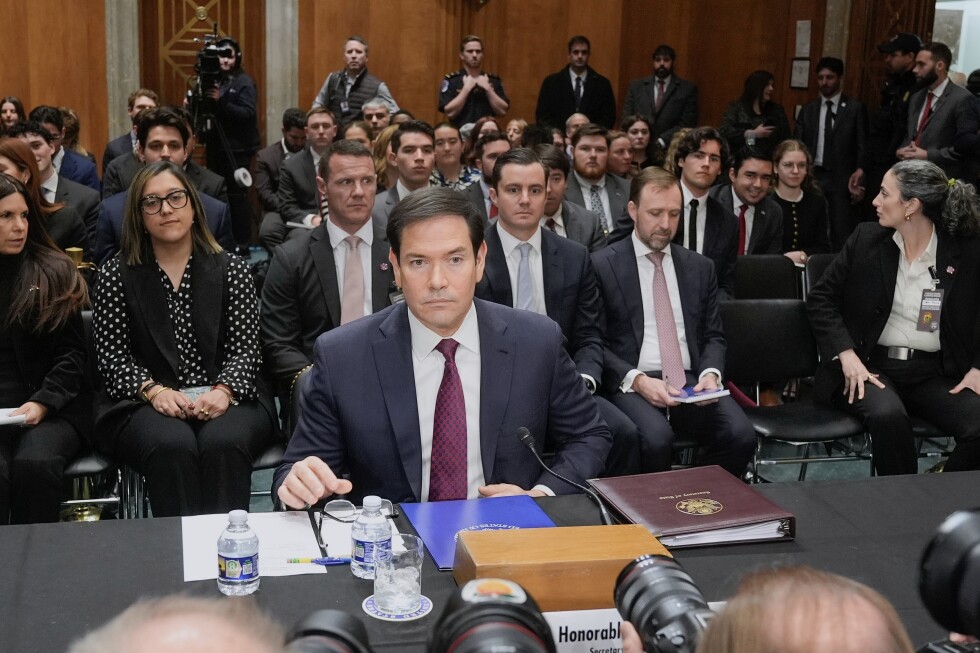
    Top U.S. administration officials, including Secretary of State Marco Rubio, conducted a classified briefing for congressional leaders on Monday regarding the recent military intervention in Venezuela. The two-hour session revealed significant divisions between Republican and Democratic lawmakers concerning President Trump’s decision to forcibly remove Nicolás Maduro from power without prior congressional consultation.

    Republican leadership, including House Speaker Mike Johnson (R-La.), expressed support for the operation, characterizing it as a necessary measure to combat narcoterrorism and drug trafficking rather than regime change. Johnson emphasized economic coercion through seized oil exports as the primary tool for compelling behavioral changes in Venezuela’s interim government.

    Democratic leaders emerged from the briefing with substantial concerns. Senator Jeanne Shaheen (D-N.H.) and Representative Gregory Meeks (D-N.Y.) questioned the operation’s financial costs and long-term strategic vision. Senate Democratic Leader Chuck Schumer warned that this action potentially initiates a dangerous new approach to foreign policy that could extend to other nations like Colombia, Cuba, and Greenland.

    The administration’s delayed notification to Congress about the ongoing military operation raised constitutional questions, particularly regarding war powers. A resolution prohibiting further military action in Venezuela without congressional approval is scheduled for a Senate vote this week.

    Internal divisions also appeared within Republican ranks. Senator Rand Paul (R-Ky.) criticized the operation as unconstitutional and a dangerous precedent, while Senator Rick Scott (R-Fla.) expressed support for opposition leader María Corina Machado as a future democratic leader. The administration’s sidelining of established Venezuelan opposition figures in favor of interim President Delcy Rodríguez, a Maduro ally, further complicated the political landscape.

  • Key moments in the US arrest of and case against Venezuelan leader Nicolás Maduro

    Key moments in the US arrest of and case against Venezuelan leader Nicolás Maduro

    In a meticulously coordinated military operation authorized by former President Donald Trump, United States forces successfully apprehended Venezuelan leader Nicolás Maduro and his wife Cilia Flores over the weekend of January 2-3, 2026. The dramatic capture unfolded with American special operations teams converging on Maduro’s compound in Caracas before transporting the detainees to a U.S. warship stationed in the Caribbean Sea.

    The operation commenced at 10:46 p.m. EST on January 2 when Trump authorized the mission. Within hours, at 1:01 a.m. EST on January 3, U.S. forces reached Maduro’s residence in Venezuela’s capital. By 3:29 a.m. EST, the extraction team had already departed Venezuelan territory with their high-value captives. Trump publicly announced the successful operation via Truth Social at 4:21 a.m. EST, proclaiming a ‘large scale strike’ against Venezuela.

    Maduro and Flores were transported aboard the USS Iwo Jima to New York, where they faced arraignment on narco-terrorism conspiracy charges. The Justice Department released a new indictment detailing their alleged involvement in drug trafficking operations. During a press conference, Trump was accompanied by key administration officials including Defense Secretary Pete Hegseth, Secretary of State Marco Rubio, CIA Director John Ratcliffe, and Homeland Security advisor Stephen Miller.

    The U.S. president made controversial statements regarding America’s intentions, stating the U.S. would ‘run Venezuela’ until a ‘judicious transition of power’ could be arranged. Trump further escalated regional tensions by making provocative comments about neighboring governments, suggesting similar actions might target Colombian President Gustavo Petro and criticizing Mexico’s approach to drug trafficking.

    Venezuela’s political leadership responded with Vice President Delcy Rodríguez assuming interim presidential duties following a directive from the nation’s high court. Rodríguez demanded proof of life for Maduro and Flores while leaving open possibilities for diplomatic engagement with the U.S. despite the military intervention.

    The operation resulted in significant international backlash, with Cuba reporting 32 military and police officers killed during the strikes. The United Nations Security Council convened an emergency meeting where both allies and adversaries of the United States uniformly condemned the unilateral action.

    On January 5, Maduro appeared in a Manhattan federal courtroom where he pleaded not guilty to all charges, declaring himself ‘a decent man, the president of my country.’ His next court date was scheduled for March 17, 2026, as the unprecedented case continues to develop amid global diplomatic repercussions.

  • Military action in Venezuela emerges as an issue in a closely watched GOP primary in Kentucky

    Military action in Venezuela emerges as an issue in a closely watched GOP primary in Kentucky

    A significant political division has emerged within Kentucky’s Republican primary as President Donald Trump’s military intervention in Venezuela becomes a central point of contention. The race features Congressman Thomas Massie, a longstanding libertarian-leaning Republican who has frequently clashed with Trump, facing challenger Ed Gallrein, a retired Navy SEAL officer enjoying the former president’s full endorsement.

    Massie has launched a vigorous social media campaign condemning the military operation that resulted in the capture of Nicolás Maduro, characterizing it as an unconstitutional overreach of executive power. The congressman asserted that the Venezuela intervention fundamentally concerns oil interests and regime change rather than combating drug trafficking, directly contradicting the administration’s stated objectives.

    “The Founders deliberately vested war-making authority in Congress, not the executive branch,” Massie emphasized, accusing Trump of bypassing constitutional procedures.

    Gallrein countered by defending the operation as a necessary measure against rogue regimes. “This decisive action demonstrates America’s commitment to holding bad actors accountable, restoring international law and order, deterring aggression, and protecting American families,” the Trump-endorsed candidate stated. He further argued that U.S. involvement creates opportunities for Venezuelans to experience peace and prosperity after decades of oppression.

    The May primary will serve as a crucial test of Trump’s ongoing influence within Republican politics. Massie, despite his frequent disagreements with Trump, has consistently secured reelection by substantial margins since 2012. Gallrein benefits from Trump’s powerful political machinery and support from a super PAC operated by former Trump aides, though he confronts a well-established incumbent with significant financial resources.

    Trump recently reinforced his endorsement of Gallrein through social media, urging other potential Republican candidates to avoid the race and describing Massie as a “Weak and Pathetic RINO” (Republican In Name Only). The primary winner will likely become the favored candidate in a district that last elected a Democrat two decades ago, though at least two Democratic contenders have already filed for the congressional seat representing northern Kentucky.

  • A prediction market user made $436,000 from bets on Maduro’s downfall

    A prediction market user made $436,000 from bets on Maduro’s downfall

    A cryptocurrency-based prediction market has become the center of an alleged insider trading investigation after an anonymous bettor profited nearly half a million dollars from Venezuela’s political upheaval. The suspicious activity occurred on Polymarket, where wagers on President Nicolás Maduro’s removal surged hours before Donald Trump’s official announcement regarding the Venezuelan leader’s capture.

    Market data reveals dramatic odds fluctuations in the critical hours preceding Trump’s Truth Social post. On January 2nd, traders placed mere 6.5% probability on Maduro’s exit by month’s end. However, these odds jumped to 11% by midnight and experienced a significant surge in the early hours of January 3rd—immediately before Trump’s revelation that Maduro was in U.S. custody.

    One particularly fortunate account, created just last month with exclusive focus on Venezuelan political outcomes, transformed a $32,537 wager into $436,000 profits. The account’s blockchain identifier, consisting of anonymous letters and numbers, has concealed the bettor’s identity despite the substantial gains.

    Financial reform advocacy group Better Markets has characterized the transaction as exhibiting ‘all the hallmarks of a trade based on inside information.’ Several other Polymarket users also generated tens of thousands in profits from wagers on Maduro’s capture, amplifying concerns about information integrity.

    In response to these developments, Congressman Ritchie Torres (D-NY) introduced legislation seeking to prohibit government employees from trading on prediction markets when possessing material nonpublic information. The bill specifically targets those who may reasonably obtain such privileged information through official channels.

    The prediction market industry, which handled hundreds of millions in wagers during the 2024 presidential election, operates in a regulatory gray area. While traditional stock markets enforce strict insider trading prohibitions, prediction markets like Polymarket and competitor Kalshi face less stringent oversight despite company policies against insider trading. The industry has experienced fluctuating regulatory reception, facing scrutiny during the Biden administration while receiving warmer acceptance during Trump’s presidency, notably with Donald Trump Jr. serving in advisory roles at both major prediction market platforms.

  • Cuba defiant as it braces for post-Maduro era

    Cuba defiant as it braces for post-Maduro era

    The United States’ military operation in Venezuela, which forcibly removed President Nicolás Maduro, has sent seismic shockwaves through Havana, threatening to sever a vital economic lifeline and destabilize Cuba’s socialist government. The two nations have been ideological and economic partners since 1999, when Hugo Chávez and Fidel Castro forged an alliance that exchanged Venezuelan crude oil for Cuban medical expertise and security support.

    The depth of this symbiosis was starkly revealed when 32 Cuban nationals, constituting Maduro’s primary security detail, were killed during the US operation. Their deaths exposed the extensive penetration of Cuban intelligence and military personnel within Venezuela’s state apparatus, a fact long denied by Havana but frequently alleged by freed political prisoners.

    With Maduro’s ouster, Cuba now confronts an existential crisis. The island nation, already grappling with its most severe economic downturn since the Cold War, faces the imminent threat of its oil supply being severed. Venezuela has been providing an estimated 35,000 barrels per day—a subsidy that Russia and Mexico cannot match. The Trump administration’s tactic of seizing sanctioned oil tankers has already exacerbated crippling fuel and electricity shortages, leading to nationwide blackouts, food spoilage, and a devastating outbreak of mosquito-borne diseases that is overwhelming Cuba’s once-vaunted healthcare system.

    The political future looks equally precarious. US Secretary of State Marco Rubio, a key architect of the administration’s Latin America policy, has framed the region as America’s ‘backyard’ and expects total compliance from Venezuela’s new acting president, Delcy Rodríguez. President Trump has threatened further interventions, even naming this aggressive new foreign policy approach the ‘Donroe Doctrine’ in a provocative reference to the 19th-century Monroe Doctrine.

    While Cuban President Miguel Díaz-Canel has declared national mourning for the fallen and condemned the US operation as imperialist kidnapping, the government faces a bleak new reality. The strategy of leveraging a pliant government in Caracas to ultimately achieve regime change in Havana is now openly articulated in Washington, signaling a dangerous new chapter for US-Cuba relations and for the entire Latin American region.

  • FACT FOCUS: Fabricated and misrepresented images shared widely online after US removal of Maduro

    FACT FOCUS: Fabricated and misrepresented images shared widely online after US removal of Maduro

    As former Venezuelan president Nicolás Maduro entered a plea of not guilty to U.S. federal narcotics charges on Monday, a wave of digitally manipulated content and misrepresented footage continued spreading across social media platforms. The disinformation campaign gained significant momentum when former President Donald Trump amplified fabricated narratives through his Truth Social platform.

    Among the most widely circulated falsehoods was a video Trump presented as evidence of Venezuelans celebrating Maduro’s apprehension. Comprehensive verification reveals this footage actually depicts University of California, Los Angeles students participating in their traditional ‘Undie Run’ event from December 2023. Clear landmarks including the Wasserman Football Center and Luskin Conference Center establish the authentic location, while the original TikTok posting from December 11 confirms the event’s true nature.

    A second misrepresented video, also shared by Trump, purported to show massive celebrations in Caracas following Maduro’s alleged capture. Fact-checking analysis confirms this footage actually documents the July 2024 electoral protest demonstrations in Venezuela. The presence of opposition leaders María Corina Machado and Edmundo González on a parade float, along with verified media coverage from the period, confirms the video’s actual context.

    Additionally, sophisticated AI-generated images depicting Maduro in U.S. custody circulated widely across social platforms. These fabricated visuals, bearing the watermark of a self-described ‘professional in artificial intelligence,’ showed Maduro surrounded by figures wearing DEA and military insignia. Trump further complicated the information landscape by sharing an image captioned ‘Nicolas Maduro on board the USS Iwo Jima,’ despite its evident inconsistencies and lack of verification.