标签: Oceania

大洋洲

  • Climate scrubbed from G7 meeting to appease US, host France says

    Climate scrubbed from G7 meeting to appease US, host France says

    A high-stakes two-day G7 environment ministerial gathering kicking off in Paris this week will deliberately sideline discussions on climate change, a move explicitly designed to avoid open conflict with the United States, according to the French government.

    The office of French Ecology Minister Monique Barbut confirmed the controversial decision Wednesday, noting organizers opted to center the agenda on what it called less divisive environmental topics in order to accommodate the stance of the G7’s most economically and politically powerful member. “We chose not to address the climate issue head-on… because the United States’ positions on this subject are well known,” the ministry stated in a formal comment. “We wanted to prioritise G7 unity, particularly to protect this forum.”

    This exclusion comes against the backdrop of major shifts in U.S. climate policy under the second Donald Trump administration, which has formally withdrawn the country from international climate accords and rolled back a raft of domestic environmental protections since taking office in 2025.

    Senior environment officials from the other six G7 members – France, Italy, Canada, Japan, Germany and the United Kingdom – will attend the gathering, while Washington will send Usha-Maria Turner, assistant administrator for the Office of International and Tribal Affairs at the U.S. Environmental Protection Agency, to represent U.S. interests.

    In place of climate negotiations, delegates will deliberate on a suite of other environmental priorities: ocean conservation, financing for global biodiversity protection, and the growing crisis of desertification of arid drylands. France is leading a major push to secure G7 backing for a new cross-sector public-private funding initiative for biodiversity. Sources familiar with the planning indicate the ministry aims to announce an $800 million commitment to support national park expansion and protection across roughly 20 African nations during the meeting.

    The gathering is also scheduled to work toward a formal political declaration linking desertification prevention to global security, advance a global alliance for expanding marine protected areas, and host working sessions on reducing global water pollution. On the opening day Thursday, delegates will also travel to the Fontainebleau forest south of Paris for a dedicated session on forest conservation.

    Environmental and climate activists have roundly criticized the decision to drop climate from the official agenda, arguing it undermines the group’s ability to address what is widely recognized as the defining environmental crisis of the 21st century. Gaia Febvre, a representative of the global activist network Climate Action Network, told reporters that “a G7 moving at the pace of the United States cannot claim to respond to the crises of the century. By yielding to pressure, it weakens collective action and renounces its potential leading role.”

    Even conservation advocates who praised G7 plans for biodiversity funding have raised cautions about the new initiative. Jean Burkard, advocacy director for WWF France, noted that while the biodiversity funding pledge was a welcome step, all new financing “must be additional and not compensate” for cuts to existing public nature conservation budgets elsewhere. This exclusion of climate from the G7 agenda comes just one week before more than 50 nations gather in Bogotá, Colombia for the first ever global summit focused exclusively on phasing out fossil fuels – the primary driver of accelerating human-caused global climate change.

  • Trump, his ‘low IQ’ slur, and the right’s race obsession

    Trump, his ‘low IQ’ slur, and the right’s race obsession

    In a fresh round of inflammatory rhetoric this week, former U.S. President Donald Trump targeted two of the nation’s most high-profile Black leaders — Supreme Court Justice Ketanji Brown Jackson and House Democratic Leader Hakeem Jeffries — with a uniquely derogatory label: “low IQ person.”

    While insulting opponents across the political spectrum has become a trademark of Trump’s public persona, deployed across social media, campaign rallies, official statements and even in direct exchanges with reporters, this particular jab carries uniquely sharp racial baggage in the American context that makes it stand out as particularly jarring.

    Jackson, a double Harvard graduate who made history as the first Black woman to serve on the nation’s highest court, drew Trump’s ire on Wednesday, when he dismissed her as “that new, Low IQ person, that somehow found her way to the bench.” She is far from the only person of color in Democratic politics to face this specific attack from Trump. Other targets have included U.S. Representatives Jasmine Crockett, Alexandria Ocasio-Cortez, Al Green, Rashida Tlaib and Maxine Waters. When targeting Minnesota Representative Ilhan Omar, who was born in Somalia, Trump extended the slur beyond the lawmaker to broadly brand all immigrants from the Horn of Africa nation as “low IQ people.” He has also applied the label to his 2024 presidential election rival Kamala Harris, calling her “a moron,” “stupid” and “a very low IQ individual.”

    Though Trump has occasionally used the same insult against white political opponents and critics — including former Georgia Representative Marjorie Taylor Greene, once a loyal ally, and conservative commentators Tucker Carlson and Megyn Kelly, who have broken with Trump over his stance on the Iran conflict — the phrase is deployed far more often against people of color, and particularly Black women.

    Experts emphasize that the slur is deeply offensive to the Black American community due to its long ties to white supremacist ideology that has falsely claimed Black people have inherently diminished cognitive capacity, justifying their forced exploitation for manual labor throughout centuries of slavery and oppression.

    “Trump’s characterization of people of color as ‘low IQ’ is a racist dog whistle with a long history in the US,” Karrin Vasby Anderson, a communication studies professor at Colorado State University, told Agence France-Presse. During the era of colonialism and 19th-century chattel slavery, Anderson explained, “white male elites took for granted that they were cognitively superior to women and people of color and, thus, divinely appointed for leadership.”

    Trump’s repeated recent use of the phrase aligns with a growing preoccupation among the American far-right with discredited pseudosciences including phrenology — the debunked field that claims skull size and shape can be used to measure a person’s intelligence — and race-based pseudoscience around genetics. “An interest in phrenology has resurged during Trump’s second presidential campaign,” Anderson noted.

    This discredited “race science,” which claims IQ is inherently tied to racial characteristics, has long festered in private far-right online chat groups. But in recent years, it has increasingly moved into mainstream right-wing media platforms that reach audiences of millions. Earlier this month, right-wing podcaster Benny Johnson, who counts six million YouTube subscribers, hosted a Republican lawmaker for a discussion claiming that many migrants from “third world” countries are incompatible with American culture. Johnson explicitly suggested that lower average cognitive capacity should be a reason to restrict immigration from these nations, claiming “The average IQ in Somalia hovers around 70, and that’s the threshold for mentally handicapped.”

    Robert Sternberg, a psychology professor at Cornell University, told AFP that IQ tests are widely overvalued in public discourse, and only offer “moderate” utility for predicting real-world professional and personal success. Even so, their reputation as a rigorous scientific metric gives bigoted claims about racial differences in IQ a false veneer of academic credibility, lending cover to openly racist arguments.

    While some high-profile far-right figures — including white nationalist Nick Fuentes, who has dined with Trump at his Mar-a-Lago resort — openly promote extremist racial ideology, Trump has generally steered clear of explicitly racist language. Anderson explains that coded phrases like the “low IQ” slur offer a key rhetorical benefit: built-in deniability for both the speaker and their audience. “So, Trump and his audience can say that there’s nothing racist about ‘low IQ’ because that label could be applied to anyone,” she said. “When Trump uses it primarily against Black people, however, and when it’s connected to this very specific history of how Black people have been framed in US culture since the 19th century, the white supremacists and casual racists in Trump’s audience will respond favorably.”

    For his part, Jeffries — who Trump called a “totally low IQ person” earlier this week — pushed back quickly against the attack. “What’s so ironic is that Donald Trump is clearly the dumbest person ever to sit at 1600 Pennsylvania Avenue,” he told MSNBC.

  • Australian private sector cost inflation hits highest point since August 2022

    Australian private sector cost inflation hits highest point since August 2022

    Freshly released purchasing managers’ index (PMI) data from S&P Global has painted a mixed but largely concerning picture of Australia’s private sector economy, revealing stubborn and faster-than-expected inflationary pressures fueled by ongoing conflict in the Middle East. The April survey, which polls 400 manufacturers and 400 service providers across the country, shows that business activity stabilized this month following a contraction in March, but cost and consumer price inflation have both surged to 3.5-year highs, far outpacing economist forecasts.

    Supply chain disruptions stemming from the Iran-centered war that broke out in late February have been the primary driver of rising costs, with the closure of the Strait of Hormuz cutting off roughly 20% of global oil supplies and choking off shipments of key raw materials from the Persian Gulf, including fertilizer and medical-grade helium for MRI machines. S&P Global economist Eleanor Dennison explained that Middle East conflict has put intense strain on manufacturing supply chains, pushing supplier lead times out to their longest since mid-2022. “Greater outlays on fuel and freight also pushed cost inflation to its highest in just under four years,” she added.

    The data confirms that rising input costs are not being absorbed by businesses, but are instead being passed directly to end consumers, pushing “charge inflation” – the rate at which businesses increase prices for customers – to its highest level since late 2020. While the overall manufacturing benchmark edged back into growth territory in April after contracting in March, both manufacturing output and service sector activity registered sub-50 readings (the threshold that separates growth from contraction), with manufacturing output falling from 49.4 to 48.2. The service sector, meanwhile, bounced back from March’s sharp decline to stabilize near neutral, driven by modest job creation even as demand remains soft.

    The biggest takeaway from the data, according to Judo Bank senior economist Matt De Pasquale, is that inflation is becoming more broad-based across the Australian economy than most analysts predicted. That outcome significantly increases the likelihood that the Reserve Bank of Australia will implement additional interest rate hikes to curb price growth, he argued. “What the data suggests is that inflation could be picking up broadly and more than was initially anticipated given that growth is holding up. That would support the RBA focusing on inflation, getting ahead of it with further interest rate rises,” De Pasquale told NewsWire.

    There are limited bright spots in the latest snapshot: the overarching composite PMI, which measures combined private sector activity, bounced back into neutral territory after contracting in March, when the outbreak of war first sent shockwaves through global markets. New business orders did decline for the second consecutive month in April, as widespread economic uncertainty dented domestic sales, but export orders to key markets including North America, Asia, and New Zealand saw a small uptick.

    Dennison warned against overstating the modest growth in the headline manufacturing index, noting that underlying indicators remain weak. “To understand how manufacturers are faring, we must look beneath the positive headline index print, as output, new orders, employment and stocks all fell at modest rates,” she said. “Despite growing price pressures and persistent weakness in domestic demand, latest data saw output stabilise following March’s decline.”

    The conflict-driven supply shock is also rippling through regional trade networks, affecting Japan – Australia’s third-largest import supplier, which shipped $23 billion worth of goods to Australia in 2025, according to UN trade data. Japanese manufacturing output surged from 52.1 to 55.4 in April, hitting its fastest pace of growth in 12 years, as manufacturers rushed to produce goods ahead of expected further supply chain disruptions. That surge has however amplified input cost competition and extended delivery times, pushing Japanese business inflation to its highest in nearly four years. S&P economist Annabel Fiddes noted that “there were reports that some manufacturing firms boosted output due to concerns and uncertainty surrounding the war in the Middle East and the potential for further supply chain disruptions. The latter contributed to not only a much sharper rise in costs but the most pronounced increase in average delivery times for manufacturers’ inputs for nearly four years.”

  • Tears and smiles at tribute concert for Swiss fire victims

    Tears and smiles at tribute concert for Swiss fire victims

    Nearly four months after a devastating New Year’s Day fire claimed 41 lives at a popular Swiss alpine ski resort, hundreds of people gathered Wednesday for an emotional tribute benefit concert to honor those lost and support survivors of the tragedy.

    The blaze broke out in the early hours of January 1 at Le Constellation bar, a nightlife venue in the upscale resort town of Crans-Montana. Most of the fatalities were teenagers, and 115 more people were injured in the inferno; 38 survivors remain in hospitals and rehabilitation centers receiving ongoing care for physical and psychological trauma. Wednesday’s concert, held at Lausanne’s Salle Metropole theatre, welcomed victim family members and survivors, creating a space for collective mourning and shared solidarity.

    As the event opened, performing artists walked onto the stage to *Etoile de nos coeurs* (“Star of our Hearts”), a ballad written in memory of the victims, and lined up across the platform holding pure white roses. Before the performances began, family members gathered in the theatre’s foyer, where hugs mingled with soft tears and faint, bittersweet smiles.

    Laetitia Brodard-Sitre, a mother who lost her 16-year-old son Arthur in the fire, described the gathering as an act of enduring remembrance. “It’s about solidarity. To all the victims, up there or here on Earth, it means one thing: we haven’t forgotten you,” she told reporters. “We’re in survival mode. Half of our hearts have been ripped away. This event keeps alive the memory of all those who were hurt, both physically and emotionally.”

    Vincianne Stucky, whose 17-year-old son Trystan Pidoux died in the blaze, shared the same priority: preventing the young victims from fading from public memory. “I truly don’t want the children to be forgotten; that’s my greatest fear,” she said. “I find tonight’s concert magnificent because it will help, in particular, the burns victims.” For one badly injured survivor, the concert marked their first public appearance since the fire.

    All participating artists performed pro bono, and ticket prices ranged from 90 Swiss francs ($115). All proceeds from the event will go to Swisshearts, a support association founded by parents who lost children in the tragedy.

    Among the featured performers was Gjon’s Tears, the Swiss vocalist who placed third at the 2021 Eurovision Song Contest. At 27, he said he felt a particularly close connection to the victims, most of whom were young adults and teens out celebrating a holiday. “These were young people who just wanted to party and have fun,” he said. “Being close in age to the majority of the victims… I think we can relate to it.”

    Veteran French-Italian singer Richard Cocciante, 80, also took the stage, noting music’s unique power to comfort grieving communities. “We need to think about the people who are no longer here,” he said. “Music certainly helps; I don’t know if it can heal, but it helps.”

    The concert was organized by Olivier and Corine Uzan, event managers based in Crans-Montana who were hosting a New Year’s Eve event just 200 meters (656 feet) from Le Constellation the night of the fire. “We were shocked, because we knew some of the victims,” Corine Uzan said. “It’s a tragedy that could have been avoided — that’s the worst part. What we want is to bring a little light and joy… music brings people together.”

    In the aftermath of the disaster, 13 people are currently facing criminal investigation linked to the fire. The list includes the bar’s owners and several current and former local government officials, as authorities work to determine what safety failures led to the deadly blaze.

  • ‘Big loss’ for F1 if Verstappen quits, say McLaren rivals

    ‘Big loss’ for F1 if Verstappen quits, say McLaren rivals

    Two of Max Verstappen’s current on-track rivals from the McLaren team have issued a stark warning: if the four-time Formula One world champion makes good on his repeated hints to leave the sport, the entire series would be significantly worse off.

    The 28-year-old Dutch driver, who claimed four straight consecutive drivers’ titles between 2021 and 2024 after a narrow miss of a fifth championship the season before, has had a rocky start to the 2025 campaign with Red Bull, as Mercedes, Ferrari and his current rivals McLaren have closed the performance gap on his team.

    Verstappen’s growing frustration with F1 centers largely on the sport’s sweeping 2026 regulatory overhaul, a set of rule changes that will shift competition to prioritize electric energy management during both qualifying sessions and grand prix races, while also imposing new limits on maximum car speeds. He has not shied away from public criticism, even comparing the new direction of F1 to “Formula E on steroids” and the casual arcade racing video game Mario Kart. Beyond rule changes, he has also openly voiced dissatisfaction with the performance of his 2025 Red Bull race car, and hinted at a growing desire to shift focus to endurance racing to spend more time with his family, comments he made most recently following last month’s Japanese Grand Prix.

    Speaking to reporters this Wednesday, McLaren’s young driver line-up of Lando Norris and Oscar Piastri both echoed the same sentiment: losing Verstappen would be a major blow to the sport. 25-year-old Australian Piastri argued that every driver on the grid wants to test themselves against the best competition possible, and Verstappen has more than earned that status over the past decade.

    “I think it would be a big loss for the sport as a whole. I think for us as drivers we want to race against the best and try and prove ourselves against the best,” Piastri said. He added that Verstappen has “shown his calibre in the last 10 years” and has stood as the benchmark for F1 performance “for the last five or six” seasons.

    Norris, the 2025 defending world champion, echoed that assessment, noting that Verstappen’s legacy already places him among the greatest drivers to ever compete in F1. He also praised the Dutchman’s candid approach to speaking his mind, a trait that has made him a distinct, compelling figure for fans even among those who disagree with his views.

    “It would be a shame for the sport, it would be a miss for the sport if that does happen, because he probably is one of the best drivers you’ll see in Formula One ever,” Norris said. “He’s always been very open to say what he thinks, whether you agree or not.”

  • Migrants deported from US stranded, ‘scared’ in DR Congo

    Migrants deported from US stranded, ‘scared’ in DR Congo

    For a group of Latin American asylum seekers who once sought safety in the United States, the past five days confined to a locked accommodation complex near Kinshasa’s international airport have become a nightmare none of them anticipated.

    The 15 South American migrants, the first contingent transferred to the Democratic Republic of the Congo under a controversial U.S. third-country deportation scheme, detailed their harrowing experience to Agence France-Presse this Wednesday, starting with the brutal 27-hour transcontinental flight where they were restrained in shackles from takeoff to landing.

    Thirty-year-old Colombian migrant Gabriela, who like most of the group wears a plain white t-shirt and bears visible tattoos, spoke on behalf of the stranded group to summarize their desperate situation. “I never agreed to come to Congo. I’m terrified here, and I don’t speak a word of the local language,” she explained, adding that she only learned her final destination one day before U.S. authorities expelled her from the country.

    The DRC, one of at least seven African nations that have accepted deported migrants under the U.S. policy alongside Cameroon, Equatorial Guinea, Eswatini, Ghana, Rwanda and South Sudan, is ranked among the 15 poorest countries globally, located thousands of kilometers from the migrants’ home countries in the Americas. The scheme, which typically includes U.S. financial and logistical backing for host nations, has long operated with little transparency, and host governments have released almost no information about what happens to migrants after they arrive on African soil.

    Under current arrangements, the International Organization for Migration (IOM) takes over administrative responsibility for migrants once they receive short-term visas, and the organization says it can facilitate assisted voluntary return for any migrant who requests the service. But for the 15 migrants now stuck in Kinshasa, a sprawling megacity home to more than 17 million people, daily life inside the closed airport-area compound is marked by uncertainty and deteriorating health.

    The compound, made up of rows of small, plain white-walled structures, is the migrants’ only home at present, and they are prohibited from leaving the premises. Police and military vehicles are posted outside the gate, and unidentified private military personnel have also been spotted on site. None of the South American migrants speak French, the DRC’s official language, cutting them off from any ability to interact with the outside world even if they were allowed to leave.

    The group says they have each received roughly $100 in assistance from IOM officials, but are denied access to outside visitors. Multiple migrants have fallen ill since arriving, Gabriela reported, including herself. “We’ve had fevers, vomiting and severe stomach issues, but we’re just told this is normal and we have to adapt,” she said. While some have received basic over-the-counter medication, no licensed healthcare worker has come to the compound to examine any of the sick migrants.

    Four of the migrants confirmed they received seven-day short-stay visas that can be extended for up to three months, but they have been warned that all official support will be cut off once the initial week-long period ends, leaving them to survive on their own in a country where they have no connections, work permits, or language skills. Gabriela says authorities have pressured the group to accept voluntary repatriation, telling them they will be left destitute if they refuse. “They’ve backed us into a corner. This is inhumane and unfair,” she said, her distress visible during the interview.

    Outside the compound walls, Kinshasa’s chaotic, overcrowded urban landscape tells the story of just how high the stakes are for the stranded migrants. Potholed roads lined with crumbling buildings see constant streams of honking minibuses and private cars, most of the city’s population lacks consistent access to running water or electricity, and World Bank data shows nearly 75 percent of all Congolese citizens live below the international poverty line.

    Twenty-five-year-old Hugo Palencia Ropero, another Colombian migrant who spent five months in U.S. detention before being deported to the DRC, acknowledged that basic amenities are provided inside the compound: three meals a day, daily room cleaning, and security on site. Even so, he shares Gabriela’s overwhelming fear. “I’m more afraid of being here in Africa than I ever was back in Colombia,” he said. “If our seven-day visas run out and we don’t get any more help, things will become impossible for us, especially since we can’t work legally here.” Ropero added he would accept any travel document available just to leave the DRC as soon as possible.

    The arrival of the Latin American deportees has already sparked widespread backlash among Congolese civil society and on local social media, with many criticizing the government for agreeing to take in vulnerable migrants at a time when most of the country’s own population struggles to meet basic needs.

  • Pope in Equatorial Guinea criticises prison conditions

    Pope in Equatorial Guinea criticises prison conditions

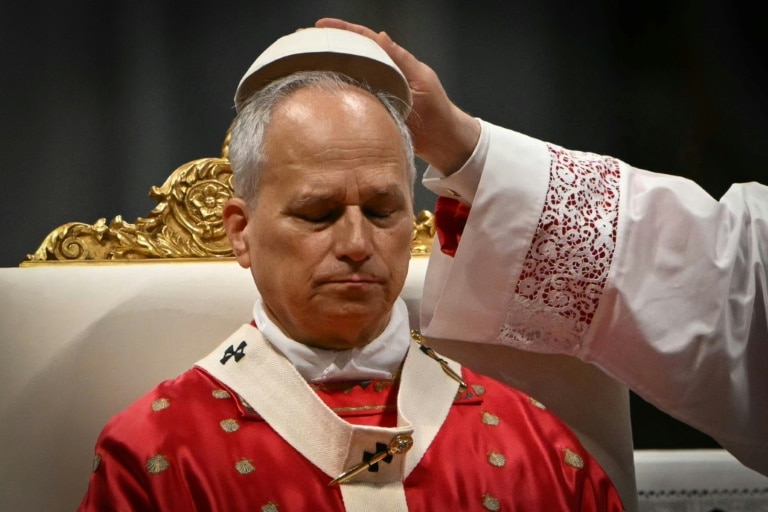
    During a high-stakes stop on his 11-day pan-African tour, Pope Leo XIV delivered a rare, pointed rebuke of inadequate prison conditions in Equatorial Guinea, during a tightly choreographed visit to the Central African nation’s most infamous correctional facility this Wednesday.

    The 70-year-old American-born pontiff, who leads the world’s 1.4 billion Catholics, traveled to Bata Prison in Equatorial Guinea’s largest city, where hundreds of detainees gathered in the facility’s freshly repainted courtyard to greet him. Minutes after the pope’s arrival, a heavy downpour soaked the crowd of inmates, who had lined the route and broke into song and dance to welcome the religious leader despite the rain. By the end of the meeting, the drenched prisoners chanted out the Spanish word “libertad” — freedom — for the pontiff to hear.

    Speaking to the assembled group of roughly 600 detainees, including around 30 women, Pope Leo framed his remarks around the core purpose of justice systems. “The administration of justice aims to protect society,” he told the crowd. “To be effective, however, it must always promote the dignity of every person.” In an earlier open-air mass held in Mongomo, a city near the Gabon border that kicked off the day’s schedule, the pontiff made his call for reform public even with long-ruling President Teodoro Obiang Nguema Mbasogo in the congregation. He urged the country to carve out “greater room for freedom” and guarantee inherent human dignity for all, noting that prisoners are too often “forced to live in troubling hygienic and sanitary conditions.”

    Equatorial Guinea’s prisons have faced decades of damning international scrutiny over systemic abuse. A 2023 U.S. State Department human rights report documented consistent cases of torture, extreme overcrowding, and unsanitary conditions across the country’s correctional facilities. A 2021 Amnesty International report labeled detainees in facilities like Bata Prison “forgotten people,” noting that most are jailed following flawed judicial processes and that family members are often left with no information about whether their incarcerated loved ones are alive or dead. President Obiang, who at 81 is the world’s longest-serving non-royal head of state after taking power in 1979, has faced consistent global accusations of widespread human rights violations and crackdowns on freedom of expression — making the pope’s public critique a notable break from the norm in the closed authoritarian state.

    Local observers remain skeptical that the pontiff’s intervention will drive meaningful change. Mr. Ondo, a local teacher who spoke on the condition of partial anonymity, denounced the country’s justice system for its widespread “lack of independence” and pervasive corruption among judges and magistrates, questioning whether the pope’s visit would alter how the system operates.

    Pope Leo’s visit to Equatorial Guinea is the fourth stop on his African tour, which has already included stops in Algeria, Cameroon, and Angola. The pontiff has walked a careful diplomatic line during his time in the country: seeking to support the nation’s large Catholic population without offering explicit backing to Obiang’s controversial government. On previous stops of the tour, the pope took far more aggressive stances, publicly denouncing global “tyrants” who exploit their populations and condemning the exploitation of vulnerable communities by wealthy and powerful actors. He even clashed with former U.S. President Donald Trump after the former president pushed back on his call for an immediate end to the ongoing conflict in the Middle East.

    Following his prison visit, Pope Leo traveled to Bata’s main stadium, where he planned to honor the victims of a 2021 tragedy that killed more than 100 people and meet with affected families and local youth. The pontiff was greeted in Mongomo earlier this week with a raucous welcome, including fireworks, a balloon release, and cheering crowds that lined his route as he traveled through the city in the popemobile.

    Equatorial Guinea, a small coastal nation with a population of just 2 million, inherited its large Catholic majority from decades of Spanish colonial rule, with roughly 80% of the population identifying as Catholic. While the country is rich in fossil fuel reserves — oil and gas account for 46% of national GDP and more than 90% of exports, per African Development Bank data — Human Rights Watch reports that the vast majority of oil revenue has been captured by a small elite circle surrounding Obiang, leaving most of the population stuck in entrenched poverty.

    The pontiff is set to conclude his 11-day, 11,200-mile African tour Thursday with an open-air mass in the national capital of Malabo, before returning to Vatican City in Rome.

  • Trump alleges Democratic-backed Virginia referendum was ‘rigged’

    Trump alleges Democratic-backed Virginia referendum was ‘rigged’

    Weeks ahead of high-stakes U.S. midterm elections, former president Donald Trump has reignited his long-running pattern of unsubstantiated election fraud claims by labeling a recent Virginia redistricting referendum a “rigged” process that tilted power toward Democrats.

    In a post shared to his Truth Social platform Wednesday, Trump repeated familiar false claims about mail-in voting to back his accusation, writing that Republicans held a clear lead throughout Election Day Tuesday before a last-minute “massive Mail In Ballot Drop” flipped the final result. “A RIGGED ELECTION TOOK PLACE LAST NIGHT,” he wrote, echoing the baseless narrative he pushed to overturn his 2020 presidential loss to Joe Biden.

    The referendum in question approved a temporary redrawn congressional district map that analysts project will give Democrats a dominant advantage in 10 of Virginia’s 11 U.S. House seats, up from the party’s prior narrow 6-5 edge. The move is the latest flashpoint in a national battle over gerrymandering, the decades-old but widely criticized practice of manipulating electoral boundaries to benefit the party that controls the map-drawing process. That battle has moved to center stage ahead of November’s midterms, when all 435 House seats and one-third of U.S. Senate seats will be up for election.

    Redistricting is typically conducted once every decade following the completion of the U.S. national census, but Trump last year openly urged state legislatures controlled by his Republican Party to redraw district boundaries mid-decade to shore up the party’s narrow House majority. Texas was the first Republican-led state to act, passing a map that could net the party up to five additional House seats. Democratic-controlled California quickly responded with its own ballot initiative to gain five seats for Democratic candidates.

    Democrats have defended Virginia’s new map as a necessary countermove to the aggressive redistricting push led by Trump and national Republicans. But Republicans have pushed back hard, framing the referendum outcome as an illegitimate power grab, particularly in a state that Trump won 46% of the vote in 2024. Trump echoed that criticism Wednesday, arguing that the lopsided 10-1 district advantage is out of step with the state’s nearly 50-50 partisan split in presidential voting. He also claimed the language of the referendum ballot was intentionally confusing and misleading to skew turnout.

    Trump called on state and federal courts to intervene to block the new map, writing “Let’s see if the Courts will fix this travesty of ‘Justice.’” Republican officials have already filed multiple legal challenges to the redistricting plan, with several cases still pending that could ultimately be decided by the Virginia Supreme Court — which previously ruled the referendum could proceed despite Republican opposition.

    Critics have noted that Trump’s push for mid-decade redistricting has been inconsistent: he publicly championed Texas’ new Republican-friendly map, which was passed by the state legislature without any public referendum, while condemning Virginia’s Democratic-backed plan that was put to a direct public vote.

    For years, Trump has baselessly claimed that mail-in voting is rife with systemic fraud, even though he and his family have repeatedly voted by mail themselves. No credible election authority or official investigation has ever produced evidence of widespread fraud that impacted the 2020 presidential election or any other recent national U.S. election.

    Beyond the redistricting fight, Trump has also pressured congressional Republicans to pass the Safeguard American Voter Eligibility Act, widely known as the SAVE Act, a sweeping overhaul of federal voting rules ahead of the November midterms. The bill has already passed the Republican-controlled House of Representatives, but it faces major roadblocks in the U.S. Senate, where Republicans do not hold enough votes to overcome Democratic opposition to the measure.

  • Manchester City go top of Premier League as Burnley relegated

    Manchester City go top of Premier League as Burnley relegated

    The 2024-25 Premier League title race took another dramatic twist on Wednesday, as a narrow 1-0 away win for Manchester City over already struggling Burnley delivered two huge outcomes: Pep Guardiola’s side climbed to the summit of the table, while Vincent Kompany’s former club confirmed their drop back to the Championship.

    Coming off a pivotal 2-1 win over Arsenal in Sunday’s widely billed title decider, Manchester City came out flying at Turf Moor, immediately putting the hosts under relentless pressure. Just five minutes into the match, Jeremy Doku played a perfectly weighted through ball that sent Erling Haaland clear on goal, and the Norwegian striker coolly chipped an effort over onrushing Burnley goalkeeper Martin Dubravka to open the scoring.

    City controlled possession for much of the contest, launching a steady stream of long-range attempts that forced Dubravka into a string of impressive saves, including a stunning first-half stop that pushed Rayan Cherki’s shot onto the woodwork. But despite creating a host of clear opportunities, Guardiola’s side failed to add to their early tally, with Haaland hitting the post after halftime and Burnley’s Zian Flemming missing a golden chance to equalize before the break. The narrow final score left Guardiola both satisfied with the result and frustrated by his side’s wastefulness in front of goal.

    The three points lift Manchester City one spot above Arsenal at the top of the table, with the two title contenders separated only by goal difference after 33 matches, and both still have five remaining games to play. For City, the push for a seventh Premier League title in nine years comes with a tougher remaining schedule, keeping the title race finely poised heading into the final stretch of the campaign.

    For Burnley, the defeat sealed their fate: this marks their third Premier League relegation in five seasons, and they will join Wolverhampton Wanderers in the Championship next term. The Clarets entered this season as newly promoted sides, and got off to a promising start with three wins from their opening nine matches, raising hopes they could avoid the immediate drop that plagues most promoted clubs. But a stunning collapse followed, with just one win recorded in their 25 matches since, leaving them 13 points adrift of safety with only four games left to play.

    Burnley manager Scott Parker, who has earned promotion to the Premier League with two previous clubs (Fulham and Bournemouth), acknowledged his side had fallen short of expectations. “The facts are we had to overachieve this year and we’ve not managed to do that,” Parker said. “In certain moments we’ve lacked a certain quality about us and not managed to get enough points.” The result extends the club’s five-year pattern of oscillating between promotion to the Premier League and relegation back to the second tier, forcing another off-season rebuild ahead of their next Championship campaign.

    In another key midweek fixture, Bournemouth’s push for a first ever top-six Premier League finish suffered a late blow, after Sean Longstaff scored a 97th-minute equalizer to secure a 2-2 draw for Leeds United at Elland Road. Junior Kroupi gave the Cherries an early opening goal, which was quickly canceled out by an own goal from Bournemouth defender James Hill. A second-half strike from Rayan looked set to give Bournemouth all three points, which would have consolidated their place in the top six, until Longstaff’s late volleyed leveller.

    The single point moves Bournemouth up to seventh place in the table, one spot above Chelsea, who sacked manager Liam Rosenior earlier on Wednesday. For Leeds, the draw leaves them nine points clear of the relegation zone, all but guaranteeing their Premier League status for another season.

  • Veteran Australian talkback radio host James Valentine dies at 64

    Veteran Australian talkback radio host James Valentine dies at 64

    Beloved Australian broadcasting personality James Valentine, who served as a staple voice on Sydney radio for more than two decades, has passed away at the age of 64, two years after his initial oesophageal cancer diagnosis. A multi-talented figure who built his legacy both on the airwaves and in the Australian music industry, Valentine leaves behind a profound impact on audiences and colleagues across the country.

    Valentine is most widely recognized for his 20-plus year tenure hosting the iconic Afternoons programme on Australian Broadcasting Corporation (ABC) Sydney, a role that made him a familiar and trusted presence in households across the city. Beyond his broadcasting career, he was also an accomplished saxophonist, performing with a number of popular Australian bands throughout his life, including The Models — a group that claimed two number-one chart hits and toured extensively across the United States and Europe.

    He received his cancer diagnosis in 2024, stepping back from his on-air role to pursue intensive treatment. He made a brief return to broadcasting the following year before formally retiring from his position in February 2025.

    In a public statement shared following his death, Valentine’s family confirmed he died peacefully at his home, surrounded by loved ones who held him close. Per the statement released to ABC, Valentine choose to utilize Voluntary Assisted Dying at the end of his journey, maintaining the independent, self-determined approach that defined his life through his final days. “Both he and his family are grateful he was given the option to go out on his own terms. He was calm, dignified as always and somehow still making us laugh,” the family shared.

    ABC Managing Director Hugh Marks paid tribute to Valentine’s decades of contributions to public broadcasting, describing him as a “trusted companion… for generations of our Sydney audience” who consistently brought “warmth, wit and humanity to radio.”

    Tributes poured in from across the Australian media, political and cultural landscapes on Thursday following the announcement of his death. Fellow ABC presenter Robbie Buck remembered Valentine as “joyous, irrepressible and unbelievably sharp,” while former ABC colleague Richard Glover noted that the host had “lifted the spirit of the city every day for 25 years.”

    Even top Australian political leaders joined in honoring Valentine’s legacy. Australian Prime Minister Anthony Albanese told ABC radio that Valentine was “someone who was always worth listening to.” Australia’s Governor-General Sam Mostyn also shared that Valentine had recently been awarded the honor of Member of the Order (AM) in recognition of his decades of work in broadcasting, music, and arts advocacy. The award was formally presented to Valentine’s wife and children just last Saturday, ahead of his passing. “His ideas were, as they were on radio, just lovely, gentle, sensible, really important things about how community comes together and how we all have a role to play,” Mostyn told ABC.

    Valentine is survived by his wife and two children.