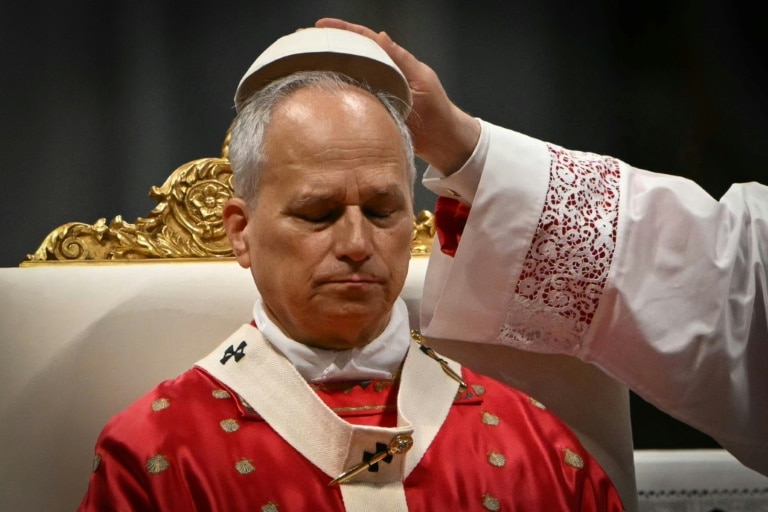
In a landmark, long-awaited address on the accelerating growth of artificial intelligence, Pope Leo XIV, the first American pontiff to lead the global Catholic Church, released his first-ever encyclical Monday at the Vatican, using the authoritative Church teaching document to issue a urgent call for the full “disarming” of AI and warn of hidden systemic harms that threaten human dignity.
Joined on stage by top AI ethics leaders, including a co-founder of major U.S. AI developer Anthropic, the pontiff used the text *Magnifica Humanitas* (translated Magnificent Humanity) to reject modern arguments for military use of AI, declaring that the long-held concept of “just war”—recently cited by the Trump administration to justify conflict—has become entirely outdated. Pope Leo, who has already publicly clashed with the White House over the Iran war and the use of religious doctrine to legitimize armed conflict, drew a clear line on lethal AI systems, stressing that it can never be morally acceptable to hand life-or-death lethal decisions over to algorithmic systems.
The pope’s stance aligns with the public position of Anthropic, which has framed itself as an industry leader in ethical AI development. The firm is currently locked in a legal dispute with the U.S. military over its refusal to allow its technology to be repurposed for lethal autonomous weapons or mass surveillance programs. While Pope Leo did not name U.S. President Donald Trump directly in the text, he left no ambiguity about his position: “It is important to reaffirm that the ‘just war’ theory, which has all too often been used to justify any kind of war, is now outdated. No algorithm can make war morally acceptable.”
Beyond military risks, the pontiff unpacked the broader social and economic inequities amplified by the AI boom. Citing United Nations projections that the total value of the global AI economy could reach $4.8 trillion by 2030—a 25-fold increase over a decade—he noted that almost all of this wealth is concentrated in the hands of a tiny elite. Defining what “disarming AI” actually means, he wrote: “Disarming AI means freeing it from the mentality of ‘armed’ competition. It does not mean rejecting technology, but preventing it from dominating humanity.” He condemned the global mad dash for more powerful algorithms and larger proprietary datasets, driven exclusively by the pursuit of geopolitical advantage and commercial monopoly, and argued that AI must be redesigned to be human-centered, universally accessible, and open to ongoing public debate.
Making AI ethics a defining cornerstone of his early papacy, Pope Leo wove references to global cultural touchstones throughout the 70-page text, drawing comparisons to the thoughts of Greek philosopher Plato, thematic elements of Beethoven’s Ninth Symphony, and even narrative insights from a character in J.R.R. Tolkien’s *The Lord of the Rings*. The encyclical was signed on May 15, the 135th anniversary of Pope Leo XIII’s groundbreaking 1891 encyclical that established the Catholic Church’s modern social doctrine amid the upheaval of the first Industrial Revolution— a deliberate parallel drawn to frame AI as the defining ethical challenge of the current industrial age.
In one of the text’s most striking passages, Pope Leo warned that the AI revolution is already creating insidious “new forms of slavery” that are hidden from public view. “Nothing in the world of AI is immaterial or magical,” he wrote. Every seamless, instant response that users interact with relies on the unseen, exploitative labor of millions of people around the world: from content moderators forced to consume violent and traumatic material on a daily basis, to child laborers mining the rare earth minerals that power AI data centers. These workers, he noted, are left “scarred, injured and worn down so that computational flow may continue uninterruptedly.”
The pontiff added that greater technological efficiency and commercial innovation can never justify a deliberately hidden global chain of exploitation, and called for urgent action to cut AI’s large carbon footprint and protect the planet, which he described as humanity’s “common home.” The release of *Magnifica Humanitas* follows years of careful study and consultation by the Vatican on AI ethics; as early as 2020, the Holy See launched the Rome Appeal for an AI Ethic, which laid out early principles requiring new technologies to uphold fundamental human dignity. AI and ethics experts now widely predict the encyclical will carry global influence comparable to Pope Francis’s 2015 *Laudato Si*—the landmark climate manifesto that reshaped global political and public discourse around climate action.