
Two previously unknown organ compositions by Johann Sebastian Bach have been unveiled and performed in Germany for the first time in over three centuries. The pieces, identified as the Chaconne in D minor BWV 1178 and Chaconne in G minor BWV 1179, were discovered by Peter Wollny, a renowned Bach scholar, while cataloging manuscripts at the Royal Library of Belgium in Brussels in 1992. After three decades of meticulous research, Wollny confirmed their authenticity, attributing them to Bach’s early career when he served as an organ teacher in Arnstadt, Thuringia. The compositions were performed at Leipzig’s St. Thomas Church, where Bach is buried and where he worked as a cantor for 27 years. Dutch organist Ton Koopman, who premiered the works, praised their high quality and suitability for smaller organs. Wollny, now director of the Leipzig Bach Archive, highlighted stylistic elements unique to Bach’s early period, further solidifying their attribution. The pieces, believed to have been transcribed by Bach’s pupil Salomon Günther John in 1705, have been added to the official catalogue of Bach’s works. Germany’s Culture Minister Wolfram Weimer hailed the discovery as a monumental moment for the global music community.
标签: Europe
欧洲
-
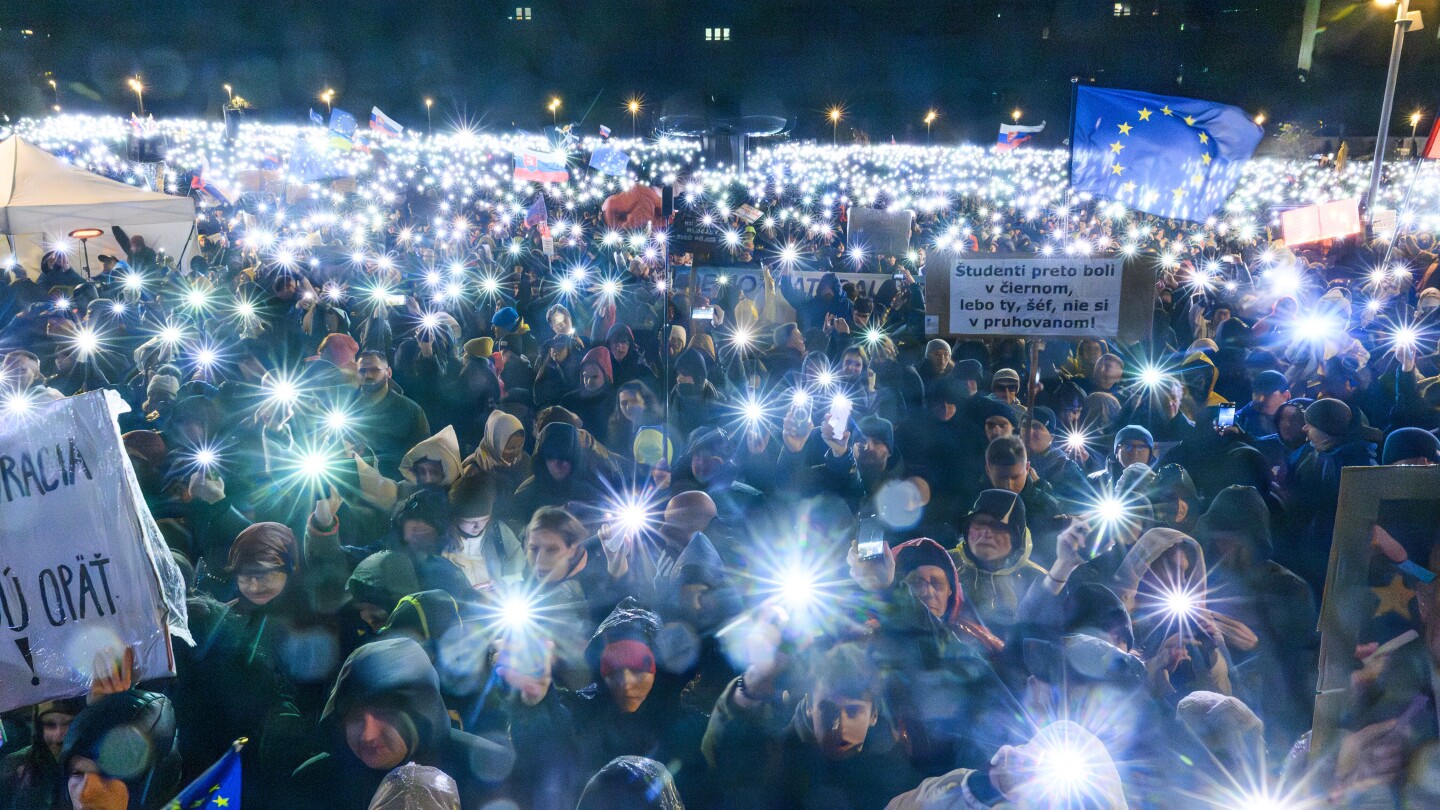
Slovaks protest populist leader Fico on anniversary of Velvet Revolution
In a significant display of public dissent, tens of thousands of Slovaks took to the streets on Monday to protest against Prime Minister Robert Fico and his pro-Russian policies. The demonstrations coincided with the anniversary of the 1989 Velvet Revolution, which marked the end of communist rule in the former Czechoslovakia. Rallies and marches were held across dozens of communities, with the largest gathering in Bratislava’s Freedom Square, where protesters chanted slogans such as “We have enough of Fico,” “We want a change,” and “Resign.”
One poignant banner featured a quote from the late Czechoslovak and Czech President Václav Havel, a key figure in the Velvet Revolution: “Truth and love must prevail over lies and hatred.” Fico, a polarizing figure in Slovak politics, has faced repeated protests over his policies. His government recently canceled the national holiday commemorating the Velvet Revolution, citing austerity measures. However, opposition leaders, including Michal Šimečka of the Progressive Slovakia party, dismissed this explanation, asserting that the move was an attempt to undermine the value of freedom.
Fico’s pro-Russian stance has further fueled public outrage. He has met with Russian President Vladimir Putin three times since Russia’s full-scale invasion of Ukraine in 2022 and has halted Slovakia’s military support for Ukraine. His recent remarks urging students to fight for Ukraine if they oppose his views have also drawn widespread criticism. Fico’s alignment with Russia and his challenges to European Union policies on Ukraine have deepened divisions within the country and raised concerns about Slovakia’s geopolitical direction.
-

France investigating Vinted over alleged links to pornographic content
French authorities have launched an investigation into the second-hand clothing platform Vinted following allegations that some user accounts were redirecting visitors to pornographic content. The issue was first reported by French media, prompting France’s Children’s Rights Commissioner, Sarah El-Haïry, to request an examination by the regulatory watchdog Arcom. Vinted, which boasts 23 million users in France, lacks an age-verification process, potentially exposing minors to explicit material. The Lithuania-based company has stated it enforces a ‘zero-tolerance policy’ against unsolicited sexual communications or the promotion of sexual services, and it removes inappropriate content while blocking offending users. The controversy emerged after sellers of swimwear or lingerie were found to be directing buyers to adult platforms like OnlyFans. El-Haïry condemned the misuse of ordinary clothing sales to funnel users to pornographic sites. This case is part of a broader crackdown on e-commerce platforms in France, including Shein, AliExpress, Temu, and Wish, which are under scrutiny for allegedly allowing the sale of illicit or harmful content accessible to minors. Shein has already banned the sale of sex dolls globally and blocked associated seller accounts. The French consumer watchdog has described some of these products as having a ‘child-pornography nature.’
-
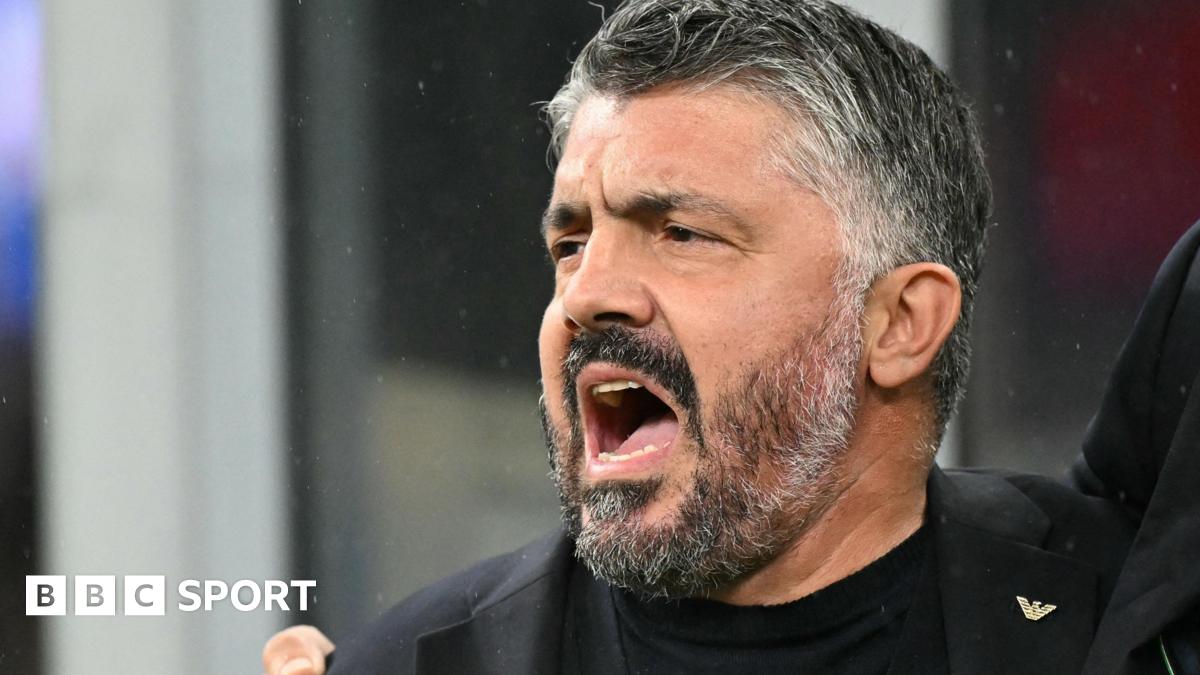
Was Gattuso right – is World Cup qualifying unfair on Europe?
Italy’s national football team is facing the possibility of missing the World Cup for the third consecutive time after a crushing 4-1 defeat to Norway on Sunday. This loss has forced Italy into the play-offs for the 2026 World Cup, which will be hosted across Canada, Mexico, and the United States. Head coach Gennaro Gattuso has voiced his frustration with FIFA’s qualification process, arguing that it unfairly disadvantages European teams like Italy. Despite winning six of their eight qualifying matches, Italy finished second in their group, leaving them to navigate a challenging play-off route. Gattuso highlighted the disparity in direct qualification slots, noting that South America and Africa receive more automatic berths relative to their number of participating nations. He also pointed out that the current system, which includes smaller qualifying groups, increases the intensity of the competition. However, some of Gattuso’s claims contain inaccuracies, such as his assertion about African teams in the 1990s. Critics argue that Italy’s struggles are more a reflection of their performance than the system itself. The debate raises broader questions about the fairness of FIFA’s allocation of World Cup slots across different confederations. With 54 UEFA nations competing for just 16 spots, Europe’s share has decreased significantly over the years, despite its strong representation in global rankings. As Italy prepares for the play-offs, Gattuso’s call for reform may spark further discussion about the future of World Cup qualification.
-
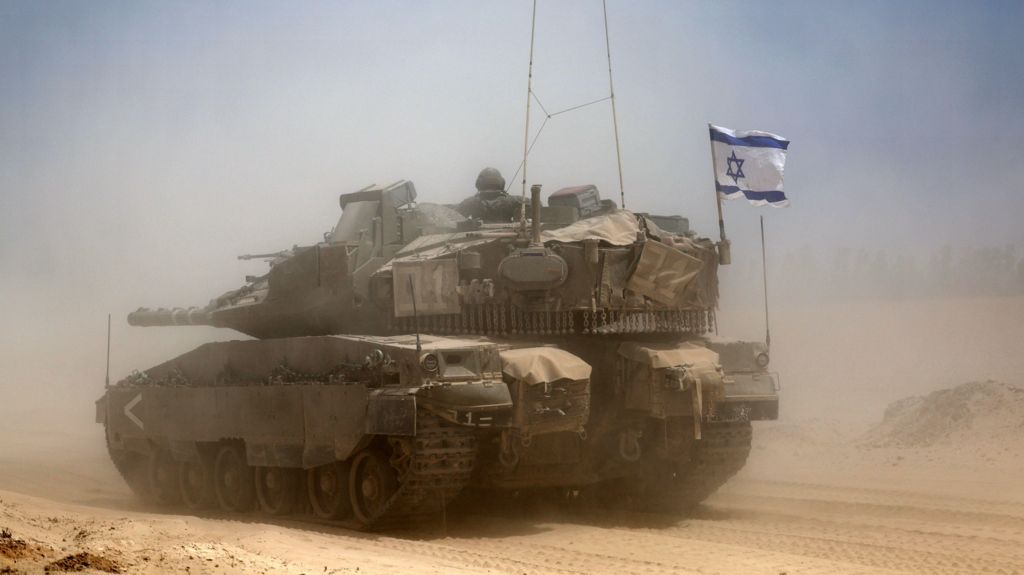
Germany to resume arms exports to Israel after ceasefire
Germany has decided to recommence its arms exports to Israel, marking a significant shift in its policy following a ceasefire in Gaza that has held for over a month. The German government announced that the resumption of military equipment sales will begin on November 24, reversing its earlier suspension imposed in August due to concerns over the use of such equipment in the Gaza Strip. Germany, which ranks as the second-largest arms supplier to Israel after the United States, had halted shipments in response to Israel’s approval of a ground offensive aimed at capturing Gaza City. The ceasefire, which took effect on October 10, has been deemed ‘stabilized’ by German authorities, providing the basis for lifting the suspension. A German government spokesperson emphasized the importance of adhering to the ceasefire agreements, ensuring humanitarian aid delivery, and maintaining an orderly process. The initial suspension was prompted by Israel’s plan to occupy Gaza City, which drew widespread condemnation, including from Germany, a long-standing ally of Israel. Chancellor Friedrich Merz had expressed deep concern over the suffering in Gaza while affirming Israel’s right to self-defense. Between 2020 and 2024, Germany accounted for 33% of Israel’s military arms imports, primarily warships and torpedoes, including components for Merkava tank engines. Moving forward, decisions on arms exports will be made on a case-by-case basis. The conflict, which began with a Hamas-led attack on October 7, 2023, has resulted in significant casualties, with over 69,000 Palestinians killed according to Hamas-run health authorities. Since the ceasefire, Hamas has returned 20 living hostages in exchange for Palestinian prisoners and detainees, along with the remains of 25 deceased hostages.
-
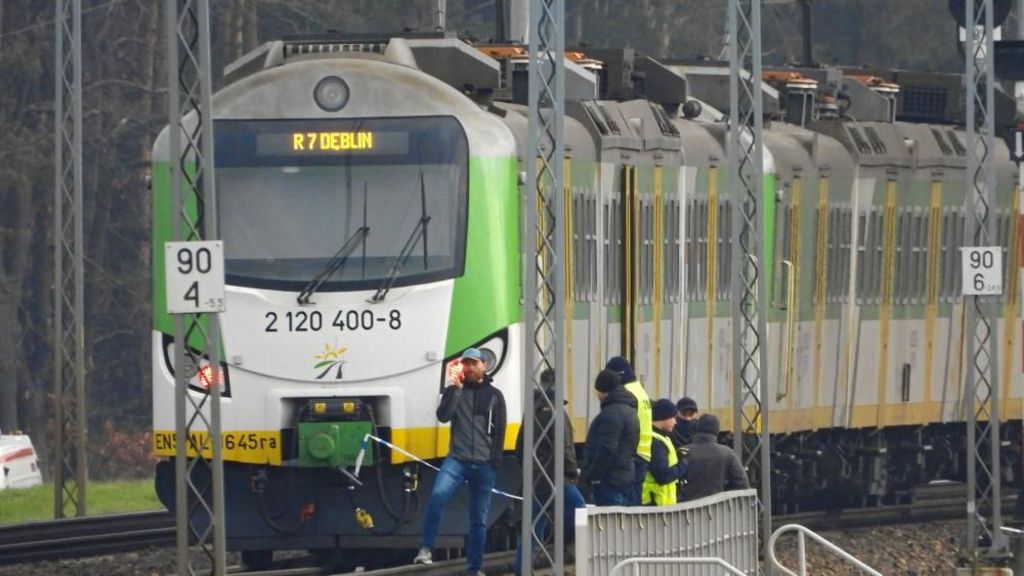
Polish PM says railway explosion was ‘unprecedented act of sabotage’
Polish Prime Minister Donald Tusk has labeled an explosion on a railway line near Warsaw as an ‘unprecedented act of sabotage,’ vowing to bring the perpetrators to justice regardless of their affiliations. The incident, which occurred on Sunday, targeted a critical supply route to Ukraine, raising concerns over the security of Poland’s railway infrastructure. Tusk, who visited the site, confirmed the damage was deliberate and likely intended to derail a train, though no casualties were reported. Poland’s Special Services Minister, Tomasz Siemoniak, suggested a ‘very high chance’ that foreign intelligence services orchestrated the attack, hinting at Russia’s involvement without explicit naming. This incident follows a series of suspected hybrid warfare tactics attributed to Moscow, including parcel bombings and arson attacks. Investigators are also probing a second suspicious event on the same railway line, where a packed train was forced to halt abruptly, believed to be another act of sabotage. The explosion near Mika, approximately 100km southeast of Warsaw, was detected early Sunday morning, with photographs revealing a missing section of track. Despite the damage, no injuries were reported among the few passengers and staff on board. Poland’s Interior Minister confirmed the use of explosives, though details remain undisclosed due to the ongoing investigation. Local residents reported hearing a significant blast the previous evening, initially mistaking it for a gas explosion or falling drone. Authorities have collected substantial evidence, including security camera footage, to identify those responsible. This attack marks the first direct assault on Poland’s railway network, which serves as a vital military supply line to Ukraine. Experts speculate the sabotage aimed to psychologically intimidate Poland into reducing its support for Ukraine. Polish officials have pledged to prosecute those involved ‘ruthlessly,’ emphasizing that there is ‘no place on earth they can hide.’ However, the government faced criticism over the delayed detection of the damage and the possibility of such sabotage occurring. Officials defended their response as swift and effective, dismissing criticism as ‘untrue and insulting.’ This incident underscores the escalating tensions in the region and the vulnerabilities of critical infrastructure in the face of hybrid warfare tactics.
-
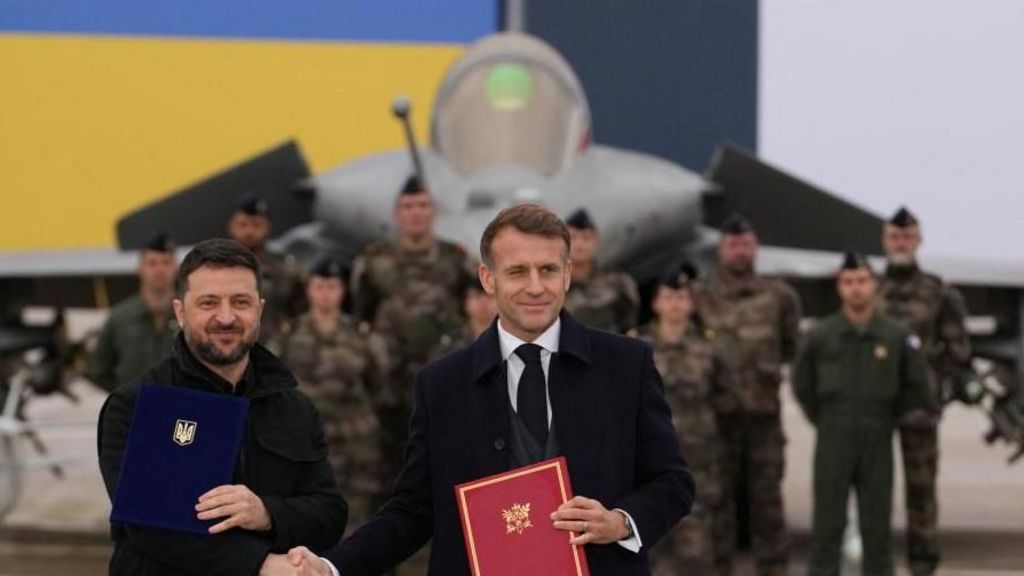
Ukraine to get up to 100 French-made Rafale fighter jets
In a landmark agreement aimed at bolstering Ukraine’s defense capabilities, France has committed to supplying up to 100 Rafale F4 fighter jets and advanced air defense systems to Kyiv. The deal, signed by Ukrainian President Volodymyr Zelensky and French President Emmanuel Macron at a Paris air base, marks a significant step in Ukraine’s efforts to counter relentless Russian aggression. Zelensky described the pact as ‘historic,’ emphasizing its critical role in safeguarding Ukrainian lives. Deliveries of the Rafale F4 jets are slated for completion by 2035, with joint production of interceptor drones commencing this year. Financial specifics remain under negotiation, with France reportedly seeking EU funding and access to frozen Russian assets—a contentious proposal that has divided the 27-member bloc. The agreement also includes the provision of ‘very strong French radars,’ eight air defense systems, and other cutting-edge weaponry. This comes as Russia intensifies its drone and missile strikes on Ukraine, targeting energy and rail infrastructure and causing widespread blackouts. Recent attacks in Balakliya claimed three lives and injured 15 others, underscoring the urgency of bolstering Ukraine’s defenses. Macron highlighted the strategic importance of the Rafale jets, stating, ‘That’s what’s needed for the regeneration of the Ukrainian military.’ The French president also expressed his commitment to helping Ukraine prepare for future challenges. Ukraine’s air force already operates French Mirage warplanes and US-made F-16s, with plans to acquire Sweden’s Gripen fighter jets. Following his visit to France, Zelensky will travel to Spain to seek additional military and economic support. Meanwhile, Ukraine has secured a gas deal with Greece, ensuring vital supplies of US liquefied natural gas will flow into the country this winter via a Balkan pipeline. Since Russia’s full-scale invasion in February 2022, Moscow has occupied approximately 20% of Ukrainian territory, with slow but persistent advances along the front lines despite heavy casualties. The France-Ukraine defense pact represents a significant escalation in Western support for Kyiv as the conflict enters its third year.
-

Louvre Museum closes offices and a gallery over structural fragility concerns
The Louvre Museum in Paris has announced the temporary closure of certain employee offices and a public gallery due to structural vulnerabilities. The decision follows a technical report highlighting the fragility of beams supporting the second level of the museum’s Sully wing. The report, submitted on Friday, cited ‘recent and unforeseen developments’ as the cause, though no further details were provided. As a precaution, 65 employees will be relocated for three days while experts assess the damage. Additionally, the Campana Gallery, which houses antique Greek ceramics and is located beneath the affected offices, will also be closed temporarily. This development comes as the Louvre continues to recover from last month’s high-profile heist of crown jewels valued at over $100 million. The museum’s Sully wing is a key focus of its ambitious renovation plans, which were unveiled earlier this year.
-
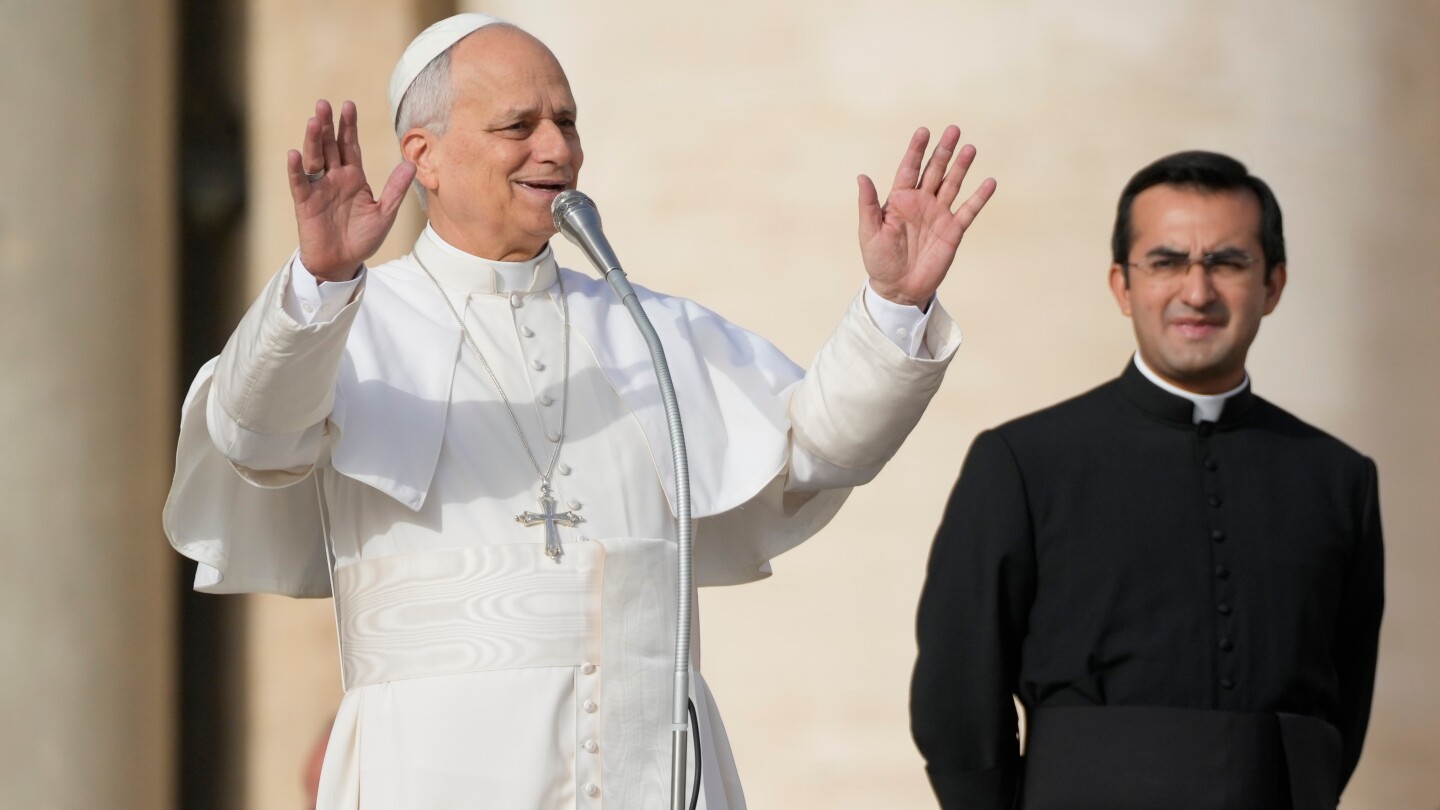
Pope could soon decide fate of Spain bishop accused of abuse, under investigation by church
In a significant development within the Spanish Catholic Church, Pope Leo XIV is reportedly considering the resignation of Bishop Rafael Zornoza of Cádiz, who is currently under investigation for alleged sexual abuse of a young seminarian in the 1990s. The announcement was made by Archbishop Luis Javier Argüello García, head of the Spanish Catholic Bishops Conference, during a press briefing in St. Peter’s Square on Monday. The case marks the first publicly known investigation of a Spanish bishop accused of abuse, as the church grapples with its history of misconduct and cover-ups. The diocese of Cádiz has denied the allegations but confirmed that a canonical investigation is underway by the church court in Madrid, known as the Rota. Bishop Zornoza, 76, who is battling an aggressive form of cancer, has temporarily suspended his duties to cooperate with the investigation. The accusations, which date back nearly three decades, involve claims that Zornoza abused a former seminarian from the ages of 14 to 21 while serving as a priest and director of the diocesan seminary in Getafe. The victim’s letter to the Vatican detailed disturbing accounts of abuse, including inappropriate physical contact and psychological manipulation. Archbishop Argüello emphasized the importance of both the victim’s right to come forward and the presumption of innocence for the accused. Zornoza had previously offered his resignation upon reaching the mandatory retirement age of 75, but it was not immediately accepted. The case has drawn attention to the broader issue of abuse within the Spanish Catholic Church, which has faced increasing scrutiny in recent years. In 2023, Spain’s first official probe into church abuse suggested that the number of victims could be in the hundreds of thousands. The Spanish Catholic bishops have since launched a compensation plan for victims, following government pressure to address the crisis.
-
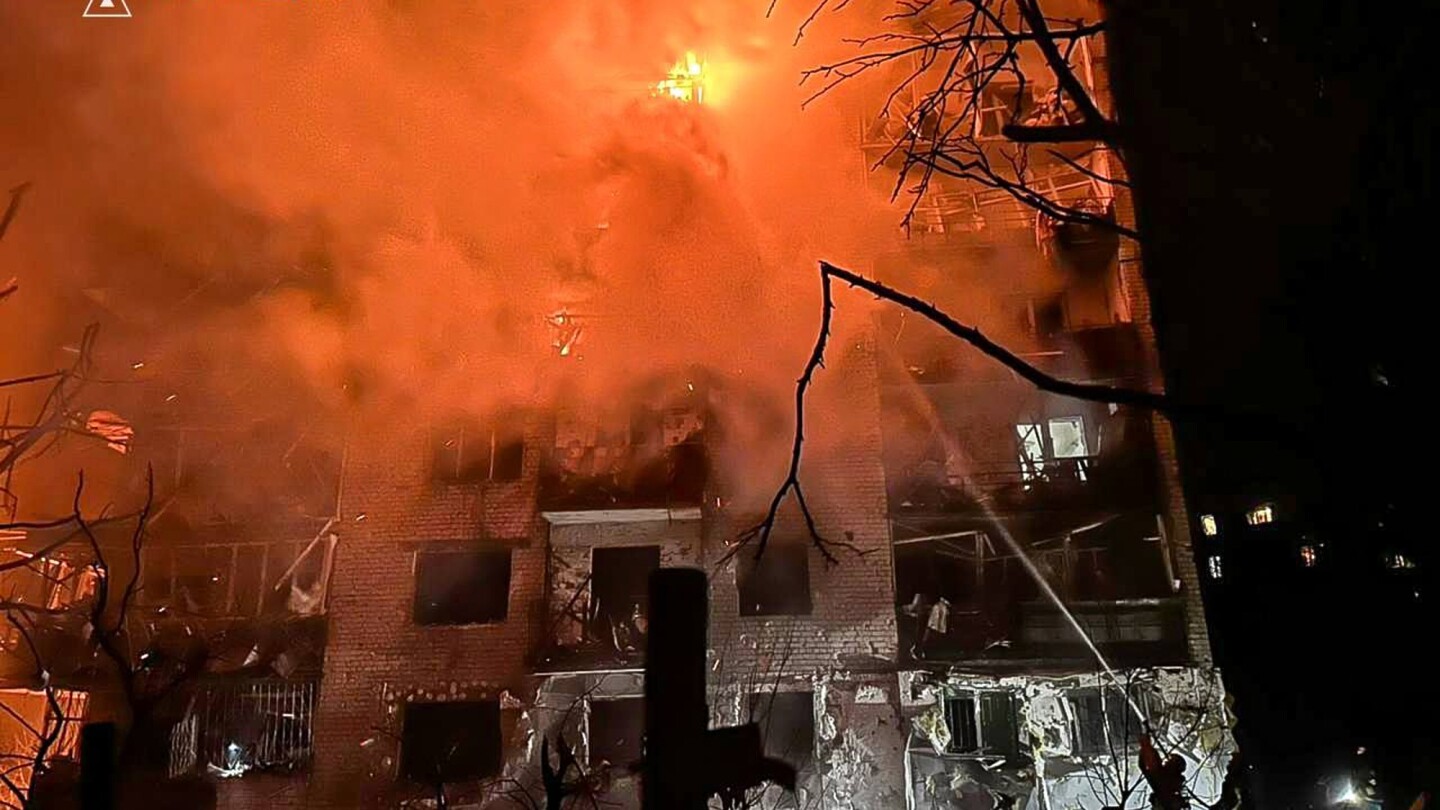
Drone strikes Turkish tanker in Ukraine’s Odesa, where US natural gas will go
A Turkish-flagged tanker, the MT Orinda, was struck by a drone and set ablaze on Monday in Ukraine’s Odesa region, according to officials. The incident occurred during the offloading of liquefied petroleum gas at the Izmail port. All 16 crew members evacuated safely, and no injuries were reported. This attack comes just a day after Ukrainian President Volodymyr Zelenskyy signed a deal to import U.S. liquefied natural gas through the region, highlighting the strategic importance of Odesa’s ports for Ukraine’s energy and trade infrastructure.
The Odesa region, particularly its Black Sea ports, has been a frequent target of Russian drone, missile, and artillery attacks since the onset of the full-scale invasion nearly four years ago. Ukrainian officials did not directly comment on the tanker incident but confirmed that Russian drones had attacked the region overnight, damaging energy and port infrastructure in multiple cities. Regional military administration head Oleh Kiper reported that the attack sparked multiple fires and damaged several civilian vessels, with one person injured.
Izmail, located on a Black Sea estuary, is a critical hub for Ukrainian imports and exports. With Russia also targeting Ukraine’s energy infrastructure, Zelenskyy is working to secure gas and other energy imports to prepare for the upcoming winter. Meanwhile, authorities in Romania ordered the evacuation of people and animals from two villages near Izmail due to the nature of the tanker’s cargo, underscoring the cross-border implications of the conflict.
Elsewhere in Ukraine, Russian attacks continued to inflict casualties. In the northeastern Kharkiv region, missile strikes killed three people and injured 11, including four teenage girls. In the central Dnipropetrovsk region, a daylight drone and artillery attack on Nikopol resulted in two deaths and two injuries, damaging residential buildings, stores, and a hair salon. The United Nations has documented thousands of civilian deaths caused by Russian strikes since the war began.
Ukraine’s air force reported that Russia launched two Iskander-M ballistic missiles and 128 strike and decoy drones overnight. In response, Russia’s Defense Ministry claimed to have shot down 36 Ukrainian drones. A Ukrainian drone attack damaged an electricity substation in Russia’s Ulyanovsk region, though no casualties were reported, and power supplies remained unaffected.
The ongoing conflict continues to escalate, with both sides targeting critical infrastructure, underscoring the humanitarian and geopolitical stakes of the war.