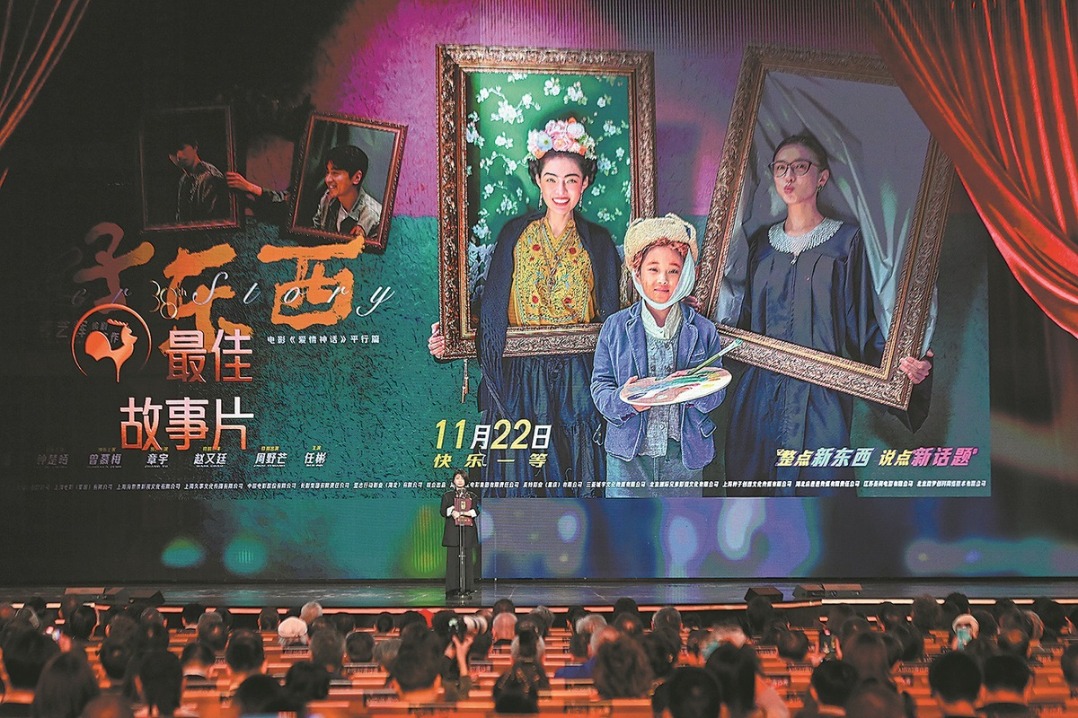
The 38th China Film Golden Rooster Awards, held on November 15, 2025, in Xiamen, Fujian province, celebrated the best of Chinese cinema, honoring storytelling, artistry, and diversity. The prestigious event saw ‘Her Story,’ a feminist drama exploring the struggles and aspirations of Chinese women, emerge as the biggest winner. Directed by Shao Yihui, the film clinched Best Feature Film, while Song Jia and Zhong Chuxi won Best Actress and Best Supporting Actress, respectively. Shao, a Beijing Film Academy graduate, expressed her gratitude and commitment to advancing Chinese cinema in her heartfelt acceptance speech. The Lifetime Achievement Award was bestowed upon veteran voice actor Qiao Zhen and director Xiao Guiyun, whose works have left an indelible mark on Chinese film history. Yi Yangqianxi, at 24, became the youngest Best Actor winner for his role in ‘Big World,’ showcasing his dedication to his craft. The Best Director award went to Chen Sicheng and Dai Mo for ‘Detective Chinatown 1900,’ a film highlighting the challenges faced by Chinese immigrants in early 20th-century America. Italian film ‘There’s Still Tomorrow’ won Best Foreign Language Film, with director Paola Cortellesi expressing her pride in receiving the accolade. The awards also recognized outstanding contributions in animation, screenwriting, and supporting roles, underscoring the vibrant and evolving landscape of Chinese cinema. The event, part of the 2025 China Golden Rooster and Hundred Flowers Film Festival, presented 20 awards selected from 212 domestic films, reaffirming its status as a cornerstone of China’s film industry.
标签: Asia
亚洲
-

Japan PM’s remarks on Taiwan draw criticism
Japanese Prime Minister Sanae Takaichi’s recent comments on Taiwan have ignited widespread criticism both domestically and internationally, with observers warning of severe repercussions for Japan-China relations. Takaichi’s remarks, made during a November 7 session of Japan’s Diet, suggested that a military contingency involving Taiwan could pose a ‘survival-threatening situation’ for Japan, potentially justifying the use of collective self-defense by Japan’s Self-Defense Forces. This assertion has been condemned as a blatant violation of the one-China policy, which recognizes Taiwan as an inalienable part of China. Critics argue that such statements erode the mutual trust established by the 1972 Japan-China joint statement and risk destabilizing regional security. On November 16, approximately 100 Japanese citizens protested outside the prime minister’s official residence in Tokyo, demanding Takaichi’s resignation and calling for an immediate retraction of her remarks. Prominent figures, including former Prime Ministers Yukio Hatoyama and Shigeru Ishiba, have also criticized Takaichi’s stance, emphasizing the importance of avoiding interference in China’s internal affairs. Experts like Ukeru Magosaki, a former senior official at Japan’s Ministry of Foreign Affairs, and Hiroshi Shiratori, a political science professor at Hosei University, have warned that Takaichi’s comments not only distort Japan’s pacifist principles but also jeopardize the fragile diplomatic balance in East Asia. Despite China’s formal protests, Takaichi has refused to retract her statements, further straining bilateral relations and raising concerns about the potential for unnecessary regional conflict.
-
National platforms launched to boost recycling efforts
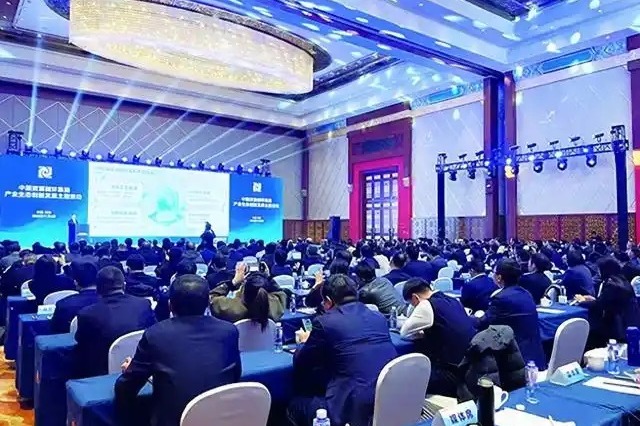
In a significant move toward establishing a unified resource recovery and reuse system, China has launched two national-level recycling platforms in Tianjin. Developed by China Resources Recycling Group Co (CRRG), the National Recycled Steel Trading Service Platform and the China Equipment Asset Recycling Platform aim to address industry challenges such as regional fragmentation and lack of transparency. Leveraging advanced technologies like artificial intelligence, these digital platforms integrate information, logistics, and capital to transform waste into valuable resources. CRRG’s deputy Party secretary and general manager, Zhu Jianchun, emphasized that these platforms will shift the recycling industry from isolated regional operations to a coordinated national effort, enhancing data transparency, industry oversight, and market activity. The recycled steel trading platform, now open to individual sellers, simplifies scrap metal recycling and boosts the supply of green raw materials. Additionally, CRRG has launched a nationwide green supply chain for secure mobile phone recycling in 32 major cities, ensuring personal data is securely erased to encourage public participation. The company also achieves high recovery rates for critical battery materials, with nickel, cobalt, and manganese recovery rates reaching 99.6% and lithium recovery at 91%. CRRG’s innovative projects, including the world’s first production line for repurposing retired solar panels, set new standards for solid waste reuse. The company is also developing refined recycling systems for end-of-life vehicles, ensuring nearly every component is reused or recycled. CRRG’s initiatives align with China’s 14th and upcoming 15th Five-Year Plans, positioning the company as a key driver of the circular economy.
-
DNA study reveals East-West exchanges over 2,000 years ago
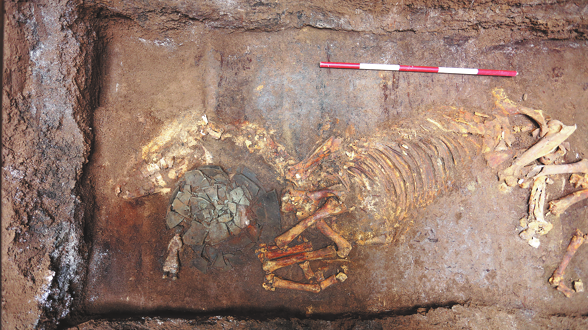
A groundbreaking DNA analysis of horse bones unearthed from the mausoleum of Emperor Wen of the Western Han Dynasty (206 BC-AD 24) has revealed significant evidence of cultural and trade exchanges between the dynasty and Central Asia over two millennia ago. The study, published in the journal Archaeology and Cultural Relics in September, identified two distinct mitochondrial haplogroups in the horses buried alongside the emperor. One belonged to haplogroup G, commonly found in Central Asia, while the other was of haplogroup Q, typical of East Asia, indicating different maternal origins. This discovery provides the first genetic confirmation of the presence of both Central Asian and local horse breeds in the imperial court during Emperor Wen’s reign. The mausoleum, known as the Baling Mausoleum, is located in Xi’an, Shaanxi province. Hu Songmei, a key contributor to the study, emphasized the importance of this finding, noting that it predates Zhang Qian’s official mission to the Western Regions and offers new insights into early Han Dynasty interactions with Eurasia. The horses, believed to be military steeds, were buried in pits symbolizing government institutions, reflecting the emperor’s emphasis on military preparedness and martial strength. The study also highlights the broader cultural and political significance of the mausoleum, which was designed to mirror the emperor’s governance and daily life.
-

Retired teachers revitalize higher education in Xinjiang
In a remarkable effort to address educational disparities, retired teachers from China’s eastern regions have been actively contributing to the revitalization of higher education in the less-developed western areas. Since the late 1990s, these seasoned educators have been making the arduous journey to impart their knowledge and expertise. Among them is Professor Ju Chunhua, a retired faculty member from the Harbin Institute of Technology (HIT), who has dedicated the past three years to teaching at Kashi University in Xinjiang Uygur Autonomous Region. Ju, who has over three decades of teaching experience, felt a strong sense of duty to support the educational development in the western regions. Despite the challenging living conditions, including a harsh climate and disrupted routines, Ju remained steadfast in her commitment. She introduced innovative teaching methods, incorporating artificial intelligence to make complex subjects more engaging for students. Ju’s efforts have not only enhanced the academic rigor at Kashi University but also inspired a new generation of educators. Her story is part of a broader initiative by HIT, which has sent numerous retired teachers to support universities in western China, significantly contributing to their academic and professional development.
-

Chinese scientists develop breakthrough method for aromatic amine applications
A groundbreaking advancement in chemical synthesis has been achieved by a Chinese research team, led by Zhang Xiaheng from the Hangzhou Institute for Advanced Study, University of Chinese Academy of Sciences. Their innovative method, recently published in the prestigious journal Nature, revolutionizes the application of aromatic amines, offering a safer and more efficient alternative to traditional industrial processes. Aromatic amines, essential components in pharmaceuticals, agrochemicals, and natural products, have long been underutilized due to the inherent risks and inefficiencies of conventional methods. For over a century, industries have relied on converting aromatic amines into diazonium salts, which are highly explosive and unstable. This process also suffers from excessive copper reagent consumption and limited substrate compatibility. To overcome these challenges, the team dedicated three years to developing a novel direct deaminative functionalization technology. This method utilizes common and inexpensive laboratory reagents, enabling the efficient conversion of inert aromatic carbon-nitrogen bonds into various crucial chemical bonds. The new approach is highly versatile, applicable to nearly all types of medicinal heteroaromatic amines and aniline derivatives, regardless of their electronic properties or amino group positions. It also supports kilogram-scale production through straightforward operations. Zhang emphasized that this breakthrough opens new pathways for rapidly constructing complex molecules from readily available starting materials, significantly advancing research and development in medicinal chemistry.
-
China ready to take tougher steps over Takaichi remarks
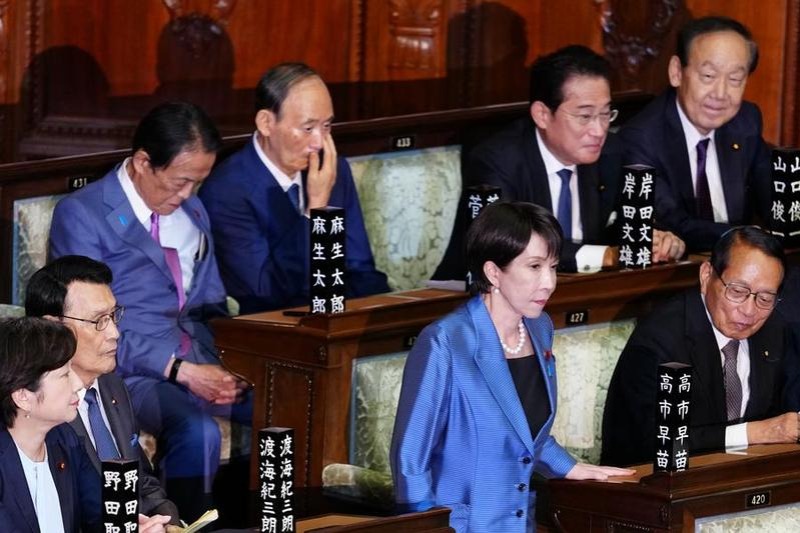
China has issued a stern warning to Japan following provocative remarks made by Japanese Prime Minister Sanae Takaichi regarding Taiwan, signaling readiness to implement further countermeasures if Tokyo fails to retract its statements. Observers and analysts emphasized that Japan must bear full responsibility for any ensuing consequences, as Takaichi’s comments have severely strained bilateral relations and threatened regional stability. Takaichi’s assertion that a potential Chinese mainland ‘use of force on Taiwan’ could constitute a ‘survival-threatening situation’ for Japan, potentially justifying military intervention, has been met with swift and forceful responses from Beijing. Senior Chinese officials in charge of diplomacy, defense, and Taiwan affairs have warned that Japan will face significant repercussions if it interferes militarily in Taiwan Strait affairs. In response to the escalating tensions, China’s Foreign Ministry and its diplomatic missions in Japan have advised Chinese citizens to avoid traveling to Japan, citing safety concerns and a deteriorating environment for people-to-people exchanges. Major Chinese airlines, including Air China, China Eastern Airlines, and China Southern Airlines, have offered special arrangements for Japan-bound travelers, allowing ticket changes or refunds. Additionally, China’s Ministry of Education and Ministry of Culture and Tourism have issued alerts advising against studying or traveling to Japan. Experts noted that Takaichi’s remarks have eroded mutual trust and undermined the political foundation of China-Japan relations, which are rooted in the one-China principle. The situation has escalated beyond a diplomatic dispute, with China emphasizing that Taiwan is an internal matter and that external interference is unacceptable. Historical context further complicates the issue, as Japan’s colonial rule in Taiwan and its wartime actions remain sensitive topics. Analysts warned that Japan’s right-wing tendencies and potential militaristic resurgence pose a threat to regional peace and stability. China’s coordinated responses underscore its commitment to safeguarding national sovereignty and territorial integrity, with observers noting that Beijing has provided Japan with opportunities to rectify its mistakes but will not hesitate to take stronger actions if necessary.
-
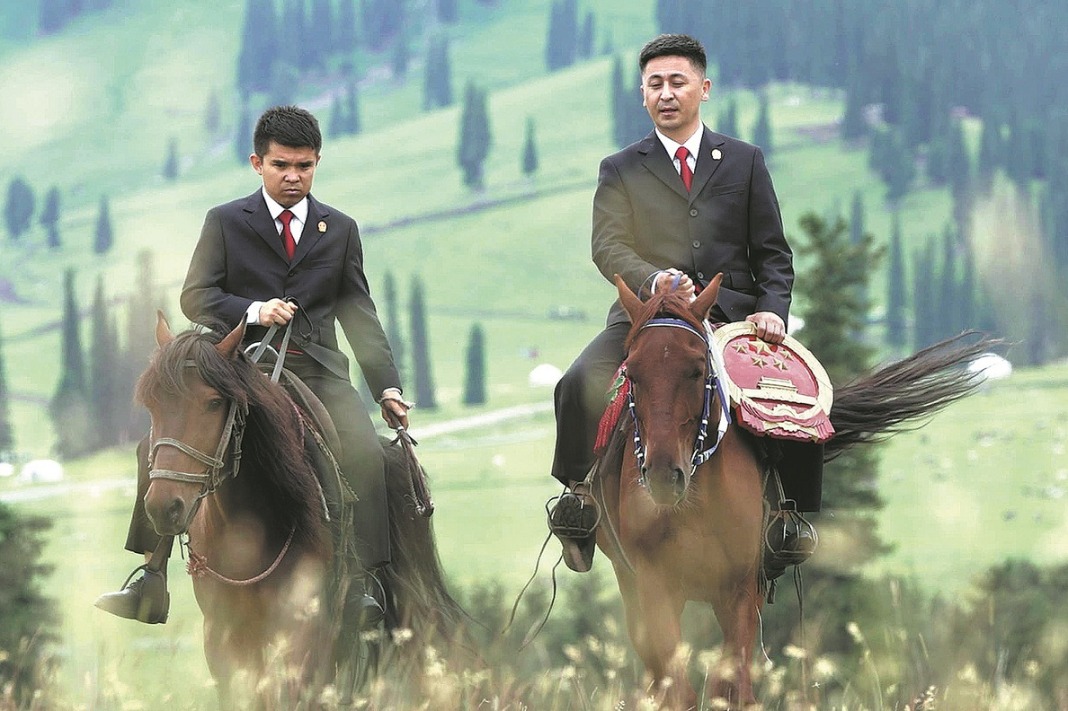
Mobile judicial teams ensure justice for all
In a groundbreaking initiative to ensure justice is accessible to all, mobile judicial teams in China are bringing legal services directly to remote areas and tourist hotspots. This innovative approach, part of the broader implementation of Xi Jinping Thought on the Rule of Law, aims to resolve disputes efficiently and equitably, even in the most challenging environments.
-

Preparations begin for new space mission
China has initiated preparations for the launch of the unmanned Shenzhou XXII spacecraft, which will deliver essential supplies and equipment to the Tiangong space station. Zhou Yaqiang, a senior engineer at the China Manned Space Agency, confirmed that all systems involved in the mission are undergoing rigorous testing and preparation. The spacecraft, originally intended to transport the Shenzhou XXII crew in April 2026, has been repurposed as a standby crew ship following the unexpected use of the Shenzhou XXI spacecraft for the return of the Shenzhou XX astronauts. The Shenzhou XX crew, who spent a record-breaking 204 days in orbit, returned safely to Earth despite minor damage to their capsule’s viewport window, likely caused by space debris. The astronauts are now in medical quarantine and will undergo comprehensive health evaluations before meeting the media. Additionally, four mice that accompanied the Shenzhou XXI mission to Tiangong have returned to Earth and are being studied by researchers at the Chinese Academy of Sciences. These studies aim to provide insights into the effects of space environments on living organisms. Other biological and scientific samples from the mission are also being analyzed to advance space research.
-
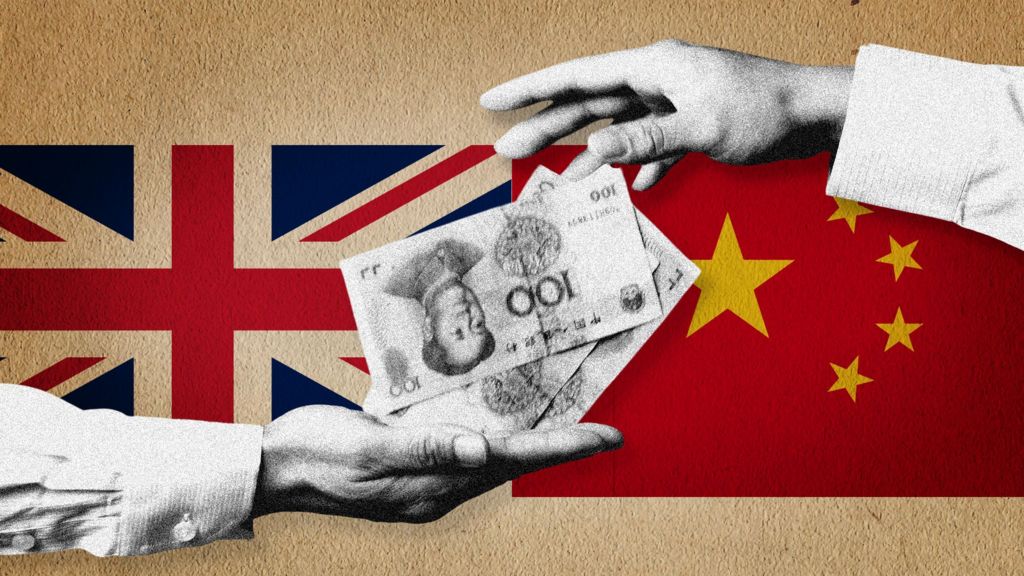
China’s investment spree in UK gave it access to military-grade technology, BBC told
China has invested over £45 billion ($59 billion) in UK businesses and projects since the turn of the century, with a significant portion of these investments aimed at acquiring cutting-edge technology, including military-grade capabilities. This investment surge, peaking after a 2015 Chinese state directive, has positioned the UK as the top destination among G7 nations for Chinese capital, relative to its population and economic size, according to US-based research group AidData.