标签: Asia

亚洲

  • Fuel shortage forces Gaza hospital to halt services as Israeli siege deepens

    Fuel shortage forces Gaza hospital to halt services as Israeli siege deepens

    A critical medical facility in the Gaza Strip has been compelled to halt most operations due to severe fuel shortages, exacerbating the humanitarian crisis in the conflict-ravaged territory. Al-Awda Hospital, situated in the Nuseirat refugee camp, announced the suspension of services on Thursday despite a ceasefire agreement intended to facilitate aid delivery.

    Hospital director Ahmed Muhanna conveyed to Al Jazeera Mubasher that staff made the decision ‘with a heavy heart’ as dwindling fuel supplies rendered normal operations impossible. The institution, which typically handles approximately 1,500 births monthly—representing nearly 30% of all deliveries in Gaza—has been a lifeline for maternal healthcare and malnutrition treatment.

    The suspension affects all but the most critical emergency and maternity cases, with at least 30 malnourished children requiring transfer to other medical facilities. Muhanna warned that complete cessation of services would trigger ‘a real crisis,’ appealing for international intervention to address the fuel shortage.

    This development occurs despite the October ceasefire agreement that obligated Israel to permit 600 aid trucks—including 50 fuel trucks—into Gaza daily. However, the Gaza-based Government Media Office reports only about 10% of the agreed fuel supply has reached the territory since the truce began. The resulting shortages have paralyzed hospitals, bakeries, and water treatment plants across the Strip.

    Concurrently, violence has persisted despite the ceasefire, with Israeli forces reportedly killing a Palestinian man in Beit Lahia on Thursday. Prime Minister Benjamin Netanyahu had previously threatened escalated attacks, accusing Hamas of violating the ceasefire and a proposed peace plan. Hamas denied involvement in an incident that wounded an Israeli soldier, suggesting it resulted from explosive remnants left by Israeli forces.
  • China sets a world record in maglev technology

    China sets a world record in maglev technology

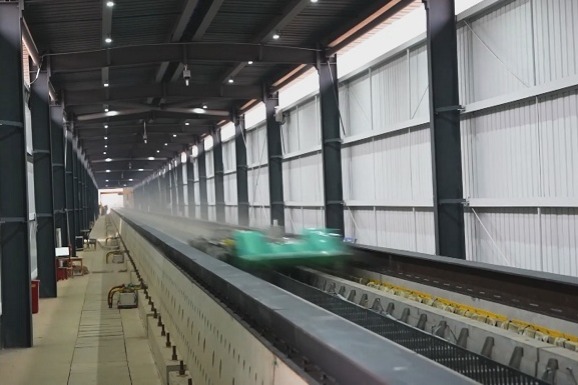
    China has established a new global benchmark in magnetic levitation technology by successfully accelerating a ton-scale maglev vehicle to 700 kilometers per hour within a remarkable two-second timeframe. This groundbreaking achievement, reported by China Central Television, represents the world’s fastest performance by a superconductive electric maglev system.

    The historic test was conducted on a 400-meter specialized track where researchers from the National University of Defense Technology demonstrated unprecedented capabilities in ultra-high-speed transportation. The team not only achieved the record-breaking velocity with substantial payload capacity but also ensured complete operational safety through controlled deceleration and precise stopping mechanisms.

    This technological milestone culminates a decade of dedicated research and development efforts focused on overcoming critical engineering challenges. The research team has made significant advancements in multiple core areas including ultra-high-speed electromagnetic propulsion systems, electric suspension guidance technology, transient high-power energy storage inverters, and high-field superconducting magnets.

    The breakthrough positions China at the forefront of ultra-high-speed maglev technology worldwide, creating new possibilities for future vacuum tube transportation systems. Beyond terrestrial transport applications, the technology offers innovative solutions for aerospace boost launch mechanisms and advanced experimental testing methodologies.

    Industry experts anticipate that subsequent technological iterations and industrial applications derived from this achievement will generate substantial momentum for China’s aerospace and rail transit sectors, potentially revolutionizing high-speed transportation paradigms globally.

  • China’s highest geological science prize awarded to 15 scholars

    China’s highest geological science prize awarded to 15 scholars

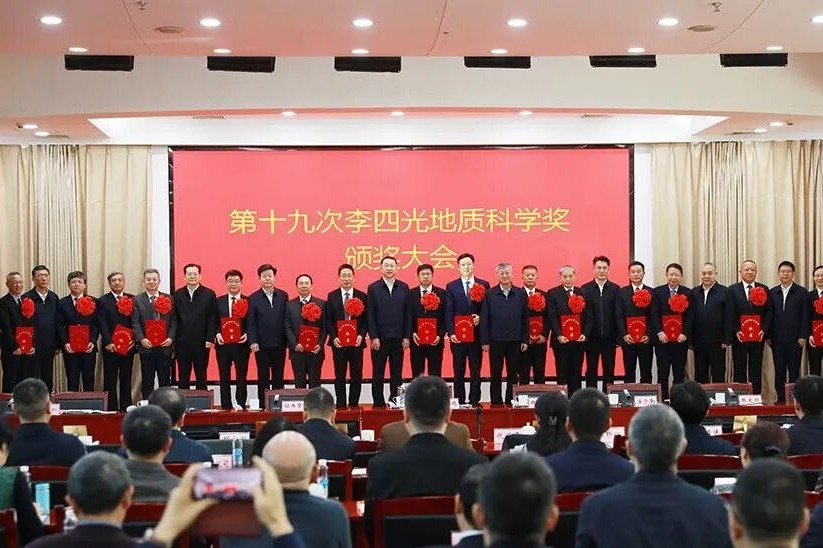
    Fifteen distinguished geoscientists have received China’s most prestigious geological honor, the Li Siguang Geological Science Award, in a ceremony held recently in Beijing. The awards recognize exceptional contributions to both field research and technological advancements within the geological sciences.

    The 19th edition of this biennial award distinguished eight recipients with the Field Work Award and seven scholars with the Research Award. The ceremony highlighted the critical role of geological work in China’s current development phase, particularly in ensuring national energy security and achieving scientific self-reliance.

    Natural Resources Minister Guan Zhiou congratulated the awardees and emphasized the evolving nature of modern geology. “Contemporary geology has transformed beyond a singular discipline into an integrated field combining artificial intelligence, big data, and advanced manufacturing technologies,” Minister Guan stated. He particularly stressed the importance of challenging conventional theories in deep-earth exploration projects to foster groundbreaking discoveries.

    The minister called upon geological professionals to embody the patriotic spirit and innovative mindset of Li Siguang, the renowned Chinese geologist commemorated by this award. He described innovation as “the primary driving force” advancing geological endeavors.

    Among the honorees, Chinese Academy of Sciences academician Dai Shifeng expressed gratitude for the national research system’s support and the foundational work of previous generations. Professor Dai committed to pursuing more systematic research on metallogenic mechanisms of key minerals within coal series and their practical applications. He also emphasized mentoring young scientific talent to ensure the continuation of Li Siguang’s legacy among new generations of geologists.

    Established to honor the scientific spirit of Li Siguang, this prestigious award serves as both recognition of exceptional achievement and inspiration for continued innovation in China’s geological community.

  • Dubai’s ‘water cities’ are reshaping the future of urban living

    Dubai’s ‘water cities’ are reshaping the future of urban living

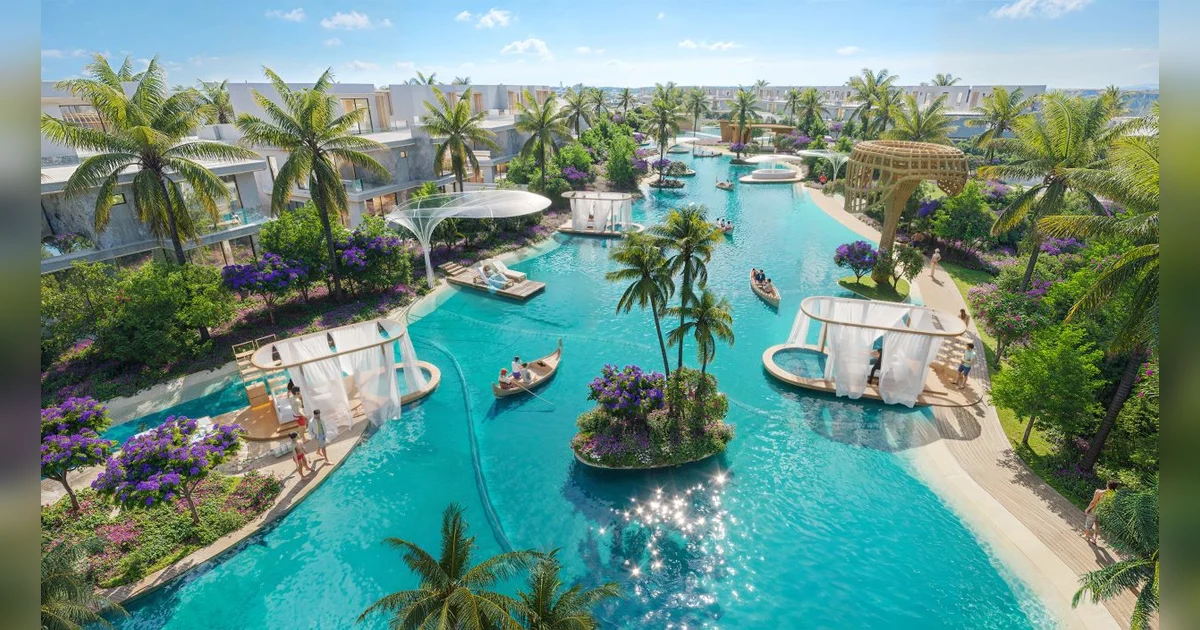
    Dubai’s real estate sector is undergoing a transformative shift as artificial ‘water cities’ emerge as the new benchmark for urban development. With natural coastline properties becoming increasingly scarce, developers are pioneering inland lagoon communities, floating neighborhoods, and marina-style districts that integrate water features deep within the urban fabric.

    This evolution transcends mere aesthetics, reflecting fundamental changes in residential preferences where wellness-oriented, nature-infused environments are becoming essential rather than optional. Industry leaders from Damac Properties, Metropolitan Premium Properties, and Golden Bridge confirm that water-centric developments align with Dubai’s 2040 Urban Master Plan, which prioritizes expanding blue and green corridors throughout the emirate.

    The technological advancements enabling this trend are significant. Modern lagoon systems utilize sophisticated water recycling mechanisms, advanced filtration, and energy-efficient operations that minimize environmental impact. These engineering solutions allow developers to create sustainable waterfront experiences without traditional ecological costs.

    Amira Sajwani of Damac Properties notes that water carries profound emotional value in desert cities, with created oases satisfying deep-seated human connections to water environments. Nikita Kuznetsov of Metropolitan Premium Properties emphasizes the economic rationale, noting that waterfront properties consistently command premium valuations and stronger rental yields.

    The concept of luxury itself is being redefined in Dubai’s market. Features once considered premium—private beaches, lagoon access, wellness facilities, and shaded walkways—are now standard expectations among buyers. Aamil Tabani of Golden Bridge observes that elevated living has become the baseline standard, with developers competing through execution quality, sustainability certifications, and integrated lifestyle programming rather than merely adding amenities.

    Differentiation now hinges on master plan completeness, maintenance reliability, and genuine lifestyle integration. Successful developments combine water features with everyday conveniences—grocery access, schools, healthcare, and hybrid workspaces—creating self-contained communities that offer both retreat and connectivity.

    Market indicators suggest this trend possesses staying power beyond cyclical fluctuations. Waterfront properties historically maintain value due to scarcity principles, and Dubai’s engineered water communities are demonstrating strong resale and rental performance. As global migration continues bringing residents with high lifestyle expectations, and as urban planning prioritizes wellbeing, water-inspired developments appear poised to remain central to Dubai’s residential landscape for decades ahead.

  • Meraki Developers brings thoughtful living to Dubai real estate

    Meraki Developers brings thoughtful living to Dubai real estate

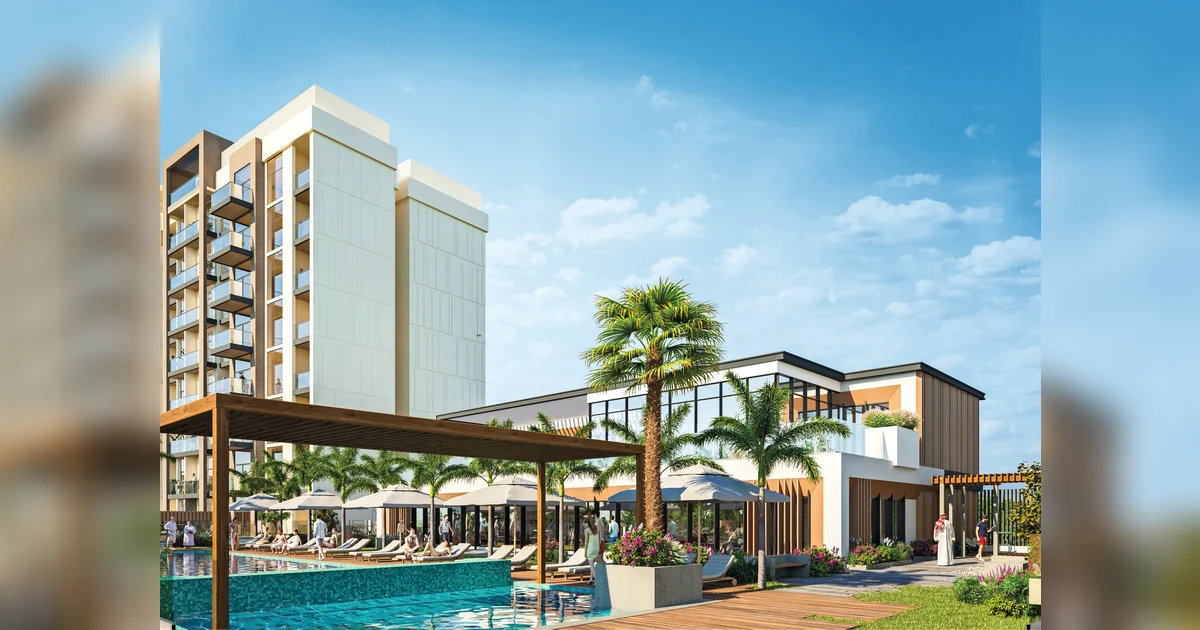
    Dubailand’s Majan district is undergoing a significant transformation with the introduction of The Haven, an innovative residential development by Meraki Developers that redefines luxury living through thoughtful community design. This project represents a paradigm shift in Dubai’s real estate landscape, emphasizing purposeful living over mere extravagance.

    Meraki’s distinctive integrated development approach sets them apart in Dubai’s competitive market. The company maintains complete in-house control over all project phases—from initial planning and engineering to final construction and finishing—resulting in delivery timelines approximately four months faster than conventional outsourced methods. This streamlined process doesn’t compromise quality, as demonstrated by The Haven’s impressive handover results: 73% of homeowners reported snag-free apartments during pre-handover inspections.

    The developer’s reputation for reliability is further validated by industry recognition. Their previous project, Meraki Genesis, was honored by the Dubai Land Department as one of the “Top 10 Projects of 2020,” specifically praised for exceptional construction speed and efficiency.

    The Haven’s residences feature spacious layouts, premium finishes, and abundant natural light, but the development’s true innovation lies in its community-focused amenities. The property includes a vibrant clubhouse, dedicated indoor and outdoor play areas, separate swimming pools for adults and children, communal co-working spaces, and a fully equipped gym. Its proximity to a seven-acre park provides tranquil green spaces within the urban environment.

    Sustainability is integral to The Haven’s design, with solar-powered parking and comprehensive bicycle facilities seamlessly integrated into the architecture. This eco-conscious approach addresses growing demand for sustainable living options among environmentally aware investors.

    Meraki maintains an ongoing relationship with residents post-handover, viewing property management as a sustained partnership rather than a transaction conclusion. This philosophy reflects their conviction that true luxury encompasses thoughtful design, ease of living, and genuine community connection rather than mere opulence.

    As Dubai’s real estate market continues its robust performance, Meraki’s innovative methodology and proven track record position them advantageously for investors seeking to capitalize on the growing preference for community-oriented, sustainably designed developments.

  • Preschool teacher jailed for abusing eight children in Liaoning

    Preschool teacher jailed for abusing eight children in Liaoning

    In a landmark ruling from Northeast China’s Liaoning province, a preschool educator has been incarcerated and permanently barred from working with minors following convictions of systematic child maltreatment. The Dawa District People’s Court delivered the verdict on Thursday, sentencing Zhang Xu to two years imprisonment for repeatedly assaulting eight children under her care.

    The disturbing case unfolded at Pengcheng Kindergarten in Panshan county, where surveillance footage revealed Zhang’s pattern of physical violence between March 3 and 21. The court documented numerous incidents of intimidation, pushing, hitting, dragging, and striking directed at vulnerable young children.

    The investigation was triggered on March 21 when a concerned mother, identified only as Li, reviewed classroom recordings after noticing concerning behavior in her child. The footage captured the moment Zhang slapped and shoved her child, causing the child’s head to strike a wall resulting in a diagnosed scalp contusion.

    Despite Zhang’s admission of guilt and partial forgiveness from some parents, the court emphasized the severity of her actions. The ruling noted her fundamental breach of professional ethics, the prolonged nature of the abuse, and the significant social risks posed by her behavior toward multiple vulnerable children.

    In a related development, local authorities conducted a comprehensive investigation of the kindergarten facility, uncovering multiple regulatory violations. The inspection revealed unqualified teaching staff, expired operational licenses, and unsafe physical facilities. Consequently, the kindergarten has been permanently shut down, with disciplinary measures implemented against 24 staff members.

  • UAE: Dubai Capitals sail into play-offs with six-wicket win over Sharjah Warriorz

    UAE: Dubai Capitals sail into play-offs with six-wicket win over Sharjah Warriorz

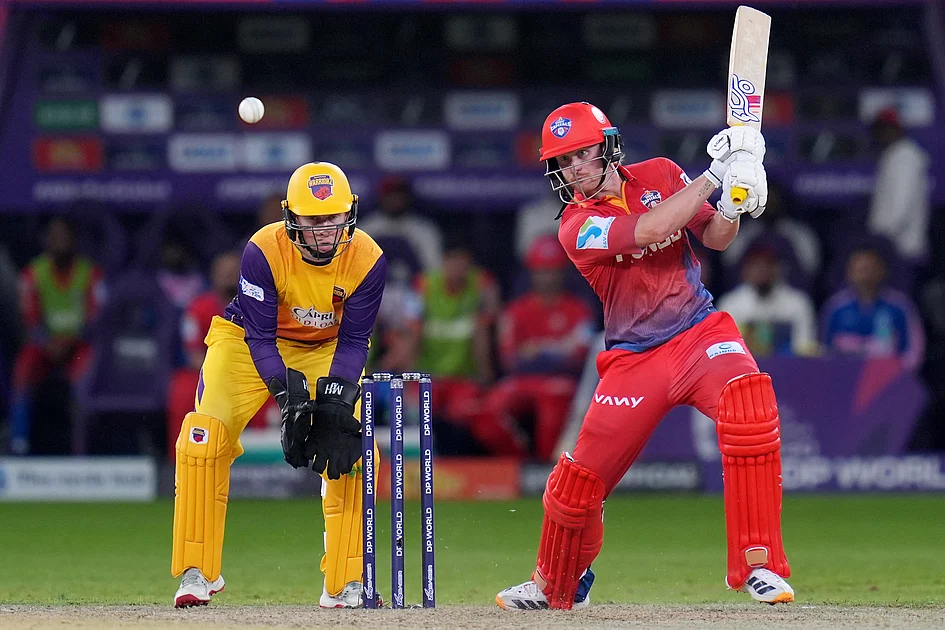
    In a decisive display of cricketing prowess, Dubai Capitals clinched their place in the tournament playoffs with a comprehensive six-wicket triumph against Sharjah Warriorz at Dubai International Stadium on Christmas Eve.

    The defending champions demonstrated superior all-round capabilities, first restricting Warriorz to a modest 134/8 before chasing down the target with five deliveries remaining. The bowling unit set the tone for victory, with Haider Ali’s remarkably economical spell of 2/13 in four overs and Waqar Salamkheil’s 2/29 effectively containing the opposition batsmen.

    Sharjah Warriorz’s innings never gained momentum despite Johnson Charles’ resilient 43 off 46 deliveries. Early setbacks included the run-out of Monank Patel (24 off 13) and the quick dismissals of Tom Abell and Tom Kohler-Cadmore, the latter smartly stumped by wicketkeeper Shayan Jahangir off Haider Ali’s bowling.

    The chase began shakily for Capitals with the early departure of Sediqullah Atal at 17 runs. However, Jahangir and Jordan Cox engineered a match-defining partnership of 76 runs from 63 balls that essentially secured the outcome. Jahangir’s aggressive 51 off 42 deliveries earned him Player of the Match honors, while Cox remained unbeaten on 61 from 50 balls, an innings featuring six boundaries and one maximum that also propelled him to the top of the tournament’s scoring rankings.

    Although Sikandar Raza briefly revived Warriorz hopes with two quick wickets in the 14th over, removing both Jahangir and Mohammad Nabi, the Capitals maintained their composure. Cox’s mature innings guided the team across the finish line, cementing their third consecutive victory and playoff qualification.

    Post-match reflections highlighted contrasting emotions. Cox praised his partner’s aggressive approach: ‘Jahangir was very impressive. We’ve been encouraging him to be aggressive, and it was great to watch from the other end.’ Warriorz captain Tim Southee remained pragmatic: ‘The nature of the wickets is keeping sides in it for long. Not over for us. One game left, we win that and give ourselves a chance.’

  • Line helps Zhanjiang flex tourism muscles

    Line helps Zhanjiang flex tourism muscles

    The recent inauguration of the Guangzhou-Zhanjiang High-Speed Railway has sparked a tourism renaissance in Zhanjiang, Guangdong’s southernmost coastal city. On its inaugural operation day, approximately 200 travelers participated in a specially curated journey organized by Guangzhou’s cultural and tourism authorities in partnership with GZL International Travel Service.

    Tourists now have multiple itinerary options, ranging from immersive three-day cultural explorations of Zhanjiang to extended five-day experiences combining Zhanjiang with Hainan province. The integrated transportation network enables seamless high-speed rail and ferry connections across the Qiongzhou Strait, offering visitors both scenic beauty and duty-free shopping opportunities.

    The economic impact has been immediate and substantial. GZL International Travel Service reported a remarkable 50% increase in revenue from Zhanjiang-related tourism products compared to 2024 figures. Vice-President Wen Shuang confirmed the destination’s growing popularity among travelers seeking authentic cultural experiences.

    Zhanjiang, celebrated as the birthplace of Leizhou culture, boasts exceptional natural landscapes and cultural resources that are now more accessible than ever. The railway’s opening has transformed Xiashan district, home to Zhanjiang North Railway Station, into a strategic gateway hub that significantly influences visitors’ overall travel experience.

    The infrastructure project connects cultural landmarks, scenic attractions, and culinary destinations along its route. According to Xu Hechang, a village official in Mazhang district, tourists can now experience unique ecological tourism activities, including enjoying seafood harvested directly from the pristine mangrove ecosystems.

    Local business leaders have welcomed the development enthusiastically. Chen Yu, chairman of Guangdong Maodegong Group, emphasized how the railway fulfills long-standing local expectations: “With increased visitor numbers, we’re excited to showcase Zhanjiang’s beautiful sights, culinary delights, and engaging activities to friends nationwide and globally.”

    The enhanced connectivity has revitalized short-distance and weekend travel markets, boosting ancillary industries including hospitality, dining, and retail. Shen Guanxiong, staff member at May Coast Bed and Breakfast on Naozhou Island, reported extensive renovations and service preparations to accommodate the tourism surge.

    At a recent press conference, Liu Chunhui, deputy director of Zhanjiang’s commerce bureau, outlined strategic initiatives leveraging the railway as a core driver for the city’s consumption season. The integration of high-speed rail with flagship events like ‘celebrate the New Year in Zhanjiang’ features carefully designed travel routes combining transportation, winter tourism, cuisine, and shopping experiences.

    The city has launched complementary consumer coupon campaigns and partnered with renowned dining establishments recognized for ‘Zhanjiang’s top 10 traditional dishes.’ Additional upcoming activities include winter vacation study tours offering immersive Lingnan cultural experiences for families.

    According to Chen Chen, deputy director of Zhanjiang’s culture and tourism bureau, the city is accelerating quality enhancements across its cultural and tourism sectors. The comprehensive strategy aims to establish an integrated development model combining transportation, cultural tourism, and consumption, positioning Zhanjiang as the premier destination for ‘weekend micro-vacations’ from the Guangdong-Hong Kong-Macao Greater Bay Area.

  • UAE Rulers extend warm wishes on Christmas, hope for ‘peace, love’ across the world

    UAE Rulers extend warm wishes on Christmas, hope for ‘peace, love’ across the world

    In a notable demonstration of interfaith solidarity and cultural inclusivity, the United Arab Emirates’ highest leadership has disseminated heartfelt Christmas messages to both residents and the global community. UAE President Sheikh Mohamed bin Zayed Al Nahyan utilized social media platforms to convey his “warmest regards to all those celebrating Christmas in the UAE and around the world,” expressing hopes that the occasion would bring “peace, joy, and harmony” to celebrants and their families.

    Simultaneously, Sheikh Mohammed bin Rashid Al Maktoum, Vice-President and Prime Minister of the UAE and Ruler of Dubai, extended congratulations to Christian communities worldwide, emphasizing aspirations for “the prevalence of values of peace, fraternity, and human coexistence.” His message specifically highlighted the reinforcement of “mercy and love among all the peoples of the world” during this festive period.

    The nation’s Christmas observances manifested through multiple dimensions of societal participation. Hundreds of UAE residents gathered at Dubai’s St. Mary’s Church for Christmas Eve services on December 24, while astronomical enthusiasts captured a celestial phenomenon dubbed the ‘Christmas Tree cluster’ through a 35-hour imaging project spanning one month.

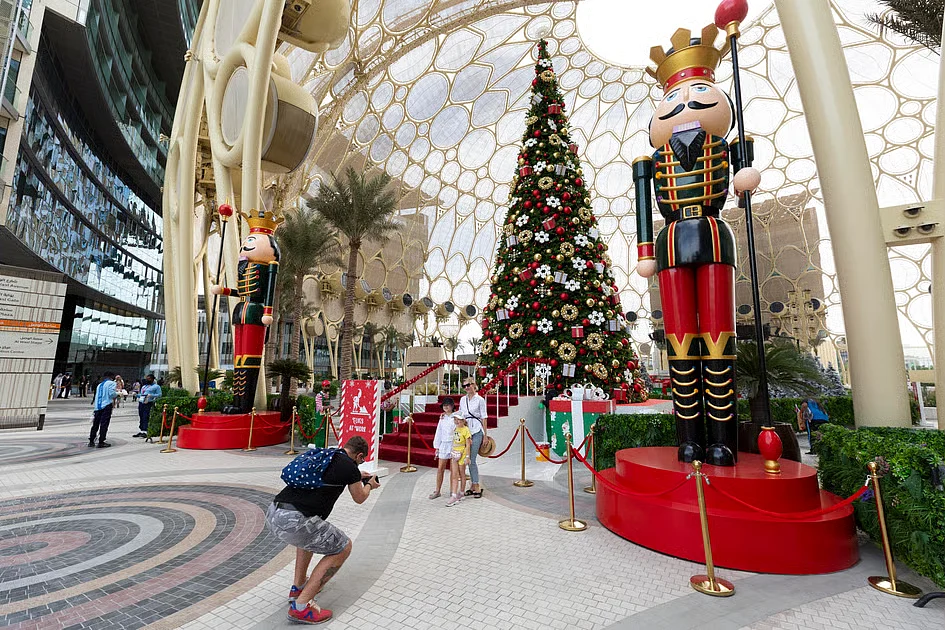
    Urban centers across the Emirates have transformed into holiday destinations with elaborate decorations, including magnificent Christmas trees illuminating major shopping malls. Numerous families have embraced the seasonal spirit by adorning their homes with festive decorations, enhanced by the region’s cooler winter temperatures that create an authentic holiday atmosphere.

    Notably, many corporations throughout the UAE have implemented internal leave policies for Christmas Day and Boxing Day, providing all employees with extended holiday breaks. This practice, established through corporate policy rather than official public holiday designation, reflects evolving workplace norms and efforts to synchronize with international calendars while offering staff additional recuperation time.

    The comprehensive Christmas celebrations underscore the UAE’s ongoing commitment to religious tolerance and cultural diversity, positioning the nation as a model of multicultural coexistence in the Gulf region.

  • Watch: Navi Mumbai airport begins operations with arrival of IndiGo flight

    Watch: Navi Mumbai airport begins operations with arrival of IndiGo flight

    India’s aviation landscape entered a transformative phase on December 25, 2025, as the Navi Mumbai International Airport (NMIA) commenced commercial operations with the historic arrival of its first flight. The landmark event marked the culmination of extensive planning and development efforts that promise to reshape air travel infrastructure in the country’s financial capital.

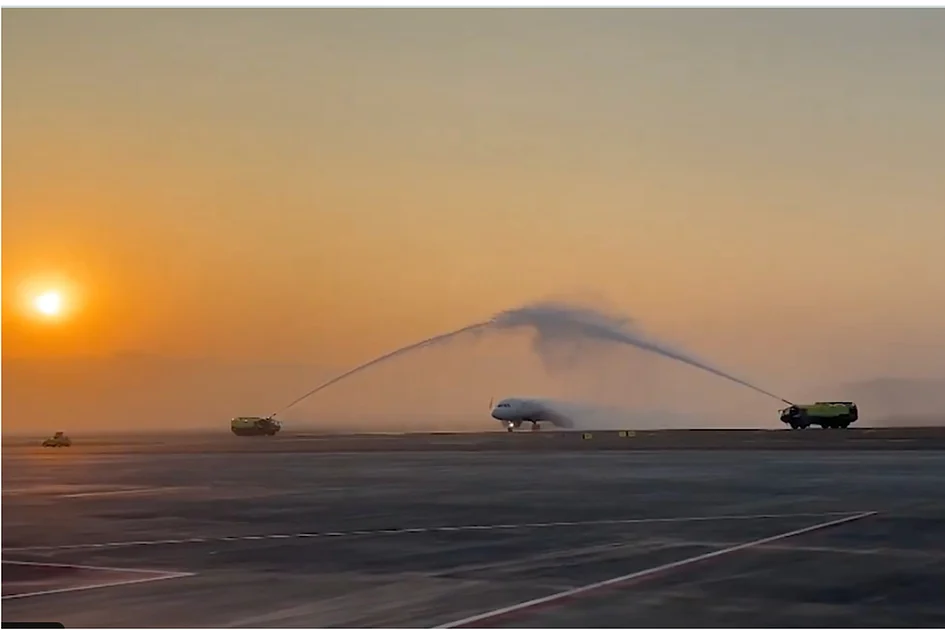
    The inaugural flight, IndiGo service 6E460 originating from Bengaluru, touched down precisely at 08:00 hours local time, receiving a ceremonial water cannon salute traditionally reserved for significant aviation milestones. This was swiftly followed by the airport’s maiden departure, IndiGo flight 6E882 bound for Hyderabad, which took off at 08:40 hours, completing the facility’s first operational cycle.

    In a statement circulated through social media channels, the Adani Group proclaimed the opening as the dawn of ‘a new era for Indian aviation.’ The conglomerate emphasized the strategic importance of NMIA, which is engineered to eventually accommodate 90 million passengers annually upon full completion of all development phases. The project represents a critical infrastructure enhancement designed to benefit not only Mumbai but the entire nation through improved connectivity and reduced congestion.

    The preceding evening witnessed a breathtaking drone spectacle that illuminated the night sky with intricate formations, including a blooming lotus motif and airport logo displays. This visually stunning presentation symbolized the integration of design excellence, sustainable practices, and advanced connectivity solutions that characterize the new aviation hub.

    Initial flight operations will see Akasa Air connecting Navi Mumbai to four key domestic destinations—Delhi, Kochi, Ahmedabad, and Goa (Mopa). Meanwhile, IndiGo will establish connections to ten cities including Bengaluru, Hyderabad, Jaipur, Lucknow, Mangalore, and Nagpur, providing substantial network coverage from the facility’s launch period.

    The establishment of NMIA creates a dual-airport system for Mumbai, positioning the metropolitan region alongside global aviation hubs like Dubai, New York, and London that operate successful multi-airport models. Projections indicate that by 2032, Mumbai’s combined airport infrastructure—comprising both NMIA and the existing Chhatrapati Shivaji Maharaj International Airport—will handle between 140 million and 160 million passengers annually, significantly enhancing capacity and operational efficiency for India’s premier financial center.