标签: Asia

亚洲

  • China dismisses claims of support to Iran’s military as ‘false information’

    China dismisses claims of support to Iran’s military as ‘false information’

    In a formal online press briefing held Thursday, China’s Ministry of National Defense has categorically denied unsubstantiated media claims that Chinese entities have provided chip manufacturing equipment and intelligence assistance to Iran’s military, labeling the assertions outright false information.

    Spokesperson Zhang Xiaogang addressed the allegations during the briefing, which centered on two specific claims: first, that Shanghai-based Semiconductor Manufacturing International Corp (SMIC) had supplied chipmaking gear to Iran’s armed forces, and second, that a Chinese commercial satellite firm had intentionally distributed imagery of United States military installations across the Middle East.

    Zhang emphasized that Beijing maintains a firm stance against the circulation of speculative, insinuating, and factually incorrect content crafted to target China. He also pushed back against recent remarks from United States officials, who claimed they had detected coordinated efforts by both China and Russia to bolster Iran’s military capabilities and were prepared to take responsive measures if deemed necessary.

    “China’s position on the Iran issue is open, aboveboard, and completely clear,” Zhang stated. “We have long maintained an objective and impartial stance, consistently working to advance peace negotiations and de-escalation, and we have never at any point added fuel to the fire of regional tensions.”

    The spokesperson further pointed out that the international community has a clear-eyed view of which powers engage in duplicitous rhetoric versus action, and which actors have been the root cause of widespread war and conflict across the globe. The statement comes amid rising geopolitical scrutiny of major powers’ engagements in the Middle East, as Washington has repeatedly sought to level unsubstantiated accusations against Beijing regarding its regional activities.

    Updated on April 9, 2026, the formal denial reaffirms China’s longstanding commitment to regional stability and diplomatic resolution of the ongoing tensions surrounding Iran.

  • 15th China International Garden Expo to open on April 15

    15th China International Garden Expo to open on April 15

    China’s 15th iteration of the International Garden Expo will welcome its first visitors on April 15 in the coastal city of Wenzhou, located in eastern China’s Zhejiang province, marking the first time the event has been hosted in this region. The official announcement of the opening timeline and event details was made during a press conference held this Wednesday, which also confirmed that general admission to the expo will be completely free for all visitors.

    Among the standout exhibition spaces at this year’s expo is the Maritime Silk Road Cooperation Garden, one of dozens of international-focused garden displays that highlight cross-border cultural and ecological collaboration. Officials emphasized that the event has been developed in direct response to growing public demand for improved green public spaces and a higher quality of urban life.

    Hu Zijian, director of the urban construction department under China’s Ministry of Housing and Urban-Rural Development, explained that the expo brings accessible green landscapes and park amenities directly to local communities. By expanding access to well-designed public green space close to residential areas, the event serves as a tangible implementation of China’s ‘people-centered city’ development philosophy, which prioritizes the well-being and daily needs of urban residents.

  • Israel reopens Al-Aqsa Mosque as it extends settler raid hours

    Israel reopens Al-Aqsa Mosque as it extends settler raid hours

    One of Islam’s most sacred religious sites, Al-Aqsa Mosque in occupied East Jerusalem, has reopened its gates to Palestinian worshippers after an extraordinary 41-day closure ordered by Israeli authorities, a shutdown that spanned the major Muslim holidays of Ramadan and Eid al-Fitr.

    When the first dawn Fajr prayer was held on Thursday morning, more than 3,000 Palestinian worshippers gathered inside the mosque’s sprawling courtyards to worship for the first time since the joint US-Israeli assault on Iran began on February 28. Viral footage circulated on social media captured jubilant crowds streaming through the reopened gates, their relief and joy palpable after the weeks of forced exclusion. Preparations for the reopening had begun days earlier, with volunteer teams and mosque custodians working to clean and restore the site ahead of worshippers’ return.

    Israeli officials have justified the total closure, which blocked all Palestinian Muslim access even for weekly Friday prayers, by citing security risks tied to the conflict with Iran. But Palestinian leaders and community members have openly questioned this justification, pointing out that Israeli authorities allowed large-scale gatherings for Jewish religious holidays were permitted to proceed elsewhere in the region throughout the closure. Many Palestinians argue Israel is using the war on Iran as a cover to tighten its unilateral control over the site, altering longstanding rules governing access, opening hours, and permitted religious activities.

    Al-Aqsa Mosque, located within Jerusalem’s walled Old City, has been governed for decades by the international Status Quo agreement, a framework that explicitly recognizes the site’s Islamic identity and grants exclusive authority to Muslim religious bodies for all matters of access, worship, and site maintenance. However, this longstanding arrangement has been repeatedly eroded by Israeli actions, including frequent incursions and unauthorised prayer by ultranationalist Jewish groups, carried out under armed Israeli police protection. The international community almost universally considers Israel’s 1967 annexation and ongoing occupation of East Jerusalem, including the Old City, as a violation of international law, which holds that occupying powers cannot claim sovereignty over captured territory and are barred from imposing permanent structural changes.

    The developments following the mosque’s reopening have already raised fresh alarms about escalating Israeli changes to the site. Within hours of worshippers completing Thursday’s dawn prayer, Israeli authorities allowed a new expanded schedule of daily incursions by ultranationalist groups, extending the total daily duration of these visits. On the first day of reopening, dozens of ultranationalist visitors entered the site shortly after 6:30 a.m. local time, immediately after Palestinian worshippers were cleared from the area. Video footage shows the visitors conducting unauthorised prayers and dances inside the mosque compound, surrounded by a heavy detachment of armed Israeli police.

    The practice of regular, guarded incursions traces back to 2003, during the Second Palestinian Intifada, and was formalized in 2008 when a limited morning visits of up to three hours were institutionalized. Over the following decades, both the number of participants and the duration of daily visits have grown steadily. Before the recent closure, incursions were split into two daily shifts on weekdays: 7:00 a.m. to 11:00 a.m., and 1:30 p.m. to 2:30 p.m. Under a new schedule approved prior to the February assault on Iran, incursions now run from 6:30 a.m. to 11:30 a.m. and 1:30 p.m. to 3:00 p.m., totaling six and a half hours of daily access for ultranationalist groups, a major expansion from prior arrangements.

    The Jerusalem Governorate has condemned the extended incursion schedule as a dangerous escalation that further undermines the fragile Status Quo agreement. In an official statement following the reopening, the Governorate noted: “The extension reflects an acceleration in efforts to impose new realities at Al-Aqsa Mosque and entrench time-based division, particularly following its reopening after a 40-day closure.”

    This report was originally published by independent outlet Middle East Eye, which specializes in original coverage of the Middle East and North Africa region.

  • Japan’s ambition for military expansion laid bare, says PLA spokesman

    Japan’s ambition for military expansion laid bare, says PLA spokesman

    In a recent official statement reported by China Daily on April 9, 2026, a spokesperson for the People’s Liberation Army (PLA) of China has publicly called out Japan’s growing military ambitions, bringing long-simmering regional concerns about Tokyo’s shifting defense posture into the global spotlight.

    Over the past decade, Japan has steadily eroded the constraints of its post-World War II pacifist constitution, expanding the scope and operational capacity of its self-defense forces beyond what regional stakeholders have long considered acceptable boundaries. Recent policy shifts, including significant increases in defense spending, plans to acquire long-range strike capabilities, and closer military integration with extra-regional powers, have accelerated this trajectory, raising alarms across East Asia.

    The PLA spokesperson emphasized that these incremental moves are not, as Japanese officials have repeatedly claimed, simple adjustments to address modern security challenges. Instead, they represent a deliberate, long-term push to rewrite the post-war regional security order and rebuild a large-scale offensive military capability that threatens the sovereignty and security of neighboring countries. For nations that suffered from Japanese militarist expansion in the 20th century, the accelerating military buildup is seen as a dangerous departure from decades of pacifist policy that requires close and constant vigilance.

    Regional analysts note that the public statement from the PLA spokesperson reflects a broad consensus within China that Tokyo’s military ambitions can no longer be downplayed. As Japan continues to push for greater military power projection beyond its own borders, the risk of miscalculation and heightened tension across the East Asian region is projected to grow, making transparent monitoring of its military policy shifts more critical than ever for regional peace and stability.

  • Chinese scientists shed light on how brain switches between thinking, perceiving

    Chinese scientists shed light on how brain switches between thinking, perceiving

    For decades, neuroscientists have puzzled over a fundamental question of human cognition: how does the same large-scale brain network seamlessly shift between deep internal thought — remembering a childhood celebration, planning next week’s work schedule, or reflecting on personal experiences — and active engagement with the outside world, such as reading a conversation partner’s facial expression or processing spoken language? Now, a team of Chinese researchers says they have resolved this longstanding mystery, uncovering a core organizational rule that governs one of the brain’s most important cognitive networks.

    Led by researchers from the Institute of Psychology at the Chinese Academy of Sciences, the work centers on the default mode network (DMN), a interconnected system of brain regions that has been studied by neuroscientists for decades. For years, the scientific consensus held that the DMN was exclusively dedicated to internal cognitive processes. But newer research has challenged that view, finding that the DMN also activates during externally focused cognitive tasks, from interpreting emotional cues to parsing spoken language. Prior to this new study, no research had been able to explain how a single network could effectively carry out two seemingly conflicting roles.

    To untangle this question, the research team integrated three distinct analytical approaches across multiple independent brain activity datasets: analysis of directional functional connectivity (which maps the direction of information flow between brain regions), assessment of the DMN’s intrinsic internal structure, and measurement of brain activity triggered by specific cognitive tasks. What they found upends long-held assumptions about how the DMN is organized: rather than being a single, uniform network, the DMN is actually split into two functionally distinct subregions, each specialized for a unique cognitive role.

    The team’s findings, published in the leading peer-reviewed journal *Proceedings of the National Academy of Sciences* (PNAS), classify these subregions by their function: receiver-type areas and sender-type areas.

    Receiver-type subregions are optimized to absorb incoming information from the outside environment, the research confirms. These areas take the lead when the brain processes external sensory input — what a person sees, hears, or experiences in their immediate surroundings — to support perception of the outside world. Sender-type subregions, by contrast, are specialized to transmit stored internal information to other brain systems. These areas draw on memories, past experiences, and internal thought to guide decision-making and action.

    Using cutting-edge functional brain imaging and large-scale data analysis techniques, the team verified these distinct roles through task-based testing. When participants completed perception-focused tasks like recognizing a familiar face, receiver-type areas showed significantly higher activation. When participants relied on stored memory to make decisions, sender-type areas became the more active of the two subregions.

    Zhang Meichao, the lead researcher on the project, explained that the DMN’s ability to support both external perception and internal cognition directly stems from this natural structural division into functionally distinct sender and receiver zones. This organizational framework allows the brain to shift smoothly between internal thought processes and engagement with the external world without conflict or cognitive overload.

    Zhang added that this breakthrough offers a new, simplified framework for understanding how the brain’s association cortex — the region responsible for high-order cognitive functions including complex thinking and flexible cognition — enables seamless transitions between internal reflection and interaction with the surrounding environment. The discovery lays a critical foundation for future research into cognitive processing, and may open new avenues for understanding neurological conditions that impact cognitive flexibility.

  • Tennis-playing humanoid robot debuts in Beijing

    Tennis-playing humanoid robot debuts in Beijing

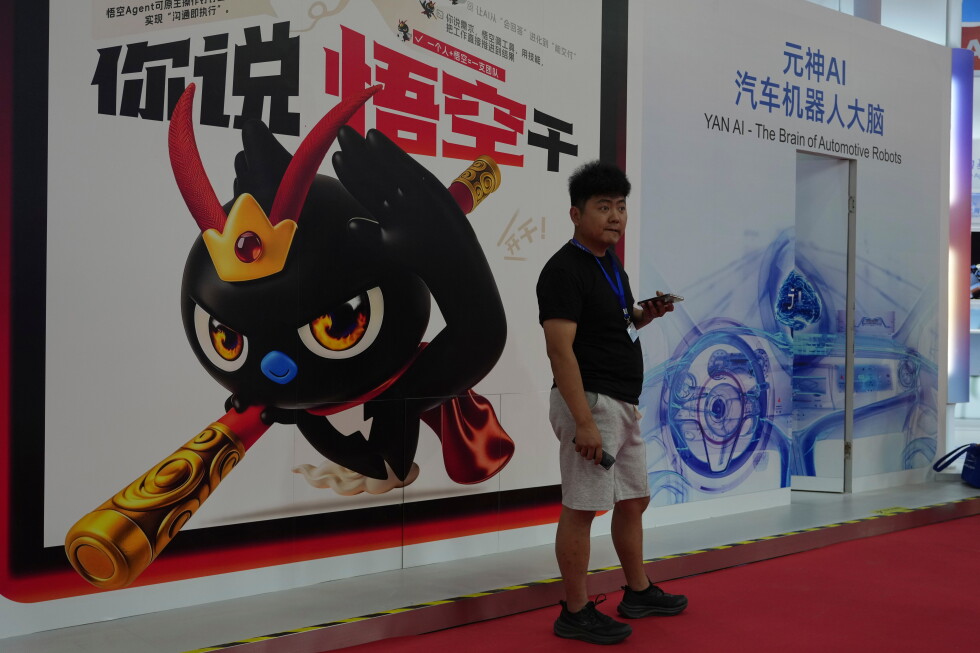
    In a landmark milestone for global embodied intelligence and humanoid robotics development, the world’s first humanoid robot capable of playing competitive tennis has made its public debut in Beijing, developed by a local innovative startup in partnership with one of China’s top academic institutions.

    The breakthrough machine was created by Galbot, a Beijing-based robotics firm headquartered in the city’s Haidian District, a rapidly growing national hub for advanced artificial intelligence and humanoid robot innovation. Working in close collaboration with Tsinghua University, the engineering team behind the robot broke from long-standing industry conventions that rely on pre-programmed motion scripts and external motion capture systems to enable robotic movement. Instead, the new humanoid integrates real-time environmental perception and full-body dynamic coordination to hold sustained rallies with human players on a standard tennis court, local state-run newspaper Beijing Daily reported on Thursday.

    At the core of the robot’s capability is a proprietary technological advancement called the LATENT algorithm. Unlike conventional machine learning frameworks that require large, complete, structured datasets to master new motor skills, this innovative algorithm allows the robot to acquire complex tennis techniques — including footwork adjustment, racket swinging, and directional positioning — from fragmented samples of human movement data. This learning framework empowers the robot to autonomously complete a full sequence of actions: detecting an incoming tennis ball, predicting its flight trajectory, adjusting its on-court position in real time, and executing an accurate, controlled stroke in response.

    Industry analysts note that this breakthrough carries far-reaching implications for the global robotics sector beyond recreational sports. The technological advances in real-time perception, dynamic motion control, and autonomous decision-making demonstrated by the tennis-playing robot clear a path for the wider deployment of humanoid robots in unstructured, unpredictable real-world environments, where pre-programmed systems have long struggled to operate effectively.

    Galbot has already begun translating these core technological advancements into commercial applications outside of sports R&D. Currently, the company operates more than 40 fully autonomous, robot-staffed retail stores across China, bringing the benefits of embodied intelligence to the commercial sector.

    The debut of the world’s first tennis-playing humanoid also underscores Haidian District’s growing status as a global center for embodied intelligence innovation. To date, the district is home to more than 300 enterprises focused on embodied intelligence research and development, including 24 dedicated humanoid robot manufacturers. This dense ecosystem of innovation, backed by strong ties between top local academic institutions and industrial partners, has positioned the region to lead global advances in next-generation robotics technology.

  • England to play World Cup warm-up games in Florida against New Zealand and Costa Rica

    England to play World Cup warm-up games in Florida against New Zealand and Costa Rica

    LONDON – The Football Association of England has confirmed the schedule for the men’s national team’s pre-World Cup warm-up fixtures, revealing two high-profile exhibition matches will take place across Florida in June ahead of the 2026 FIFA World Cup co-hosted by North America.

    Announced on Thursday, Thomas Tuchel’s Three Lions will kick off their warm-up campaign at Tampa’s Raymond James Stadium on June 6, taking on Oceania qualifier New Zealand. Four days later on June 10, the squad will move across the state to face CONCACAF representative Costa Rica at Orlando’s Inter&Co Stadium.

    To streamline their final preparations for the expanded 48-team tournament, which will run across June and July 2026, England has chosen south Florida as the location for its pre-tournament training camp. Once the World Cup gets underway, the squad will relocate to a permanent basecamp in Kansas City, Missouri for the duration of their participation in the competition.

    England has been drawn into Group L for the group stage of the tournament, where they will face Croatia, Ghana and Panama. All three of the team’s group-stage fixtures will be hosted across major U.S. cities: Dallas, Boston, and the New York/New Jersey metropolitan area.

    Both selected venues have established histories hosting major global and professional sporting events. Raymond James Stadium, which welcomed over 70,000 fans for the 2021 Super Bowl LV, is the regular home ground of the National Football League’s Tampa Bay Buccaneers. Inter&Co Stadium, meanwhile, is the home venue for Major League Soccer’s Orlando City SC and the National Women’s Soccer League’s Orlando Pride, purpose-built for top-tier professional soccer competition.

    The 2026 FIFA World Cup marks the first time the tournament has been co-hosted by three nations, with matches split across 16 host cities across the United States, Canada, and Mexico. England’s pre-tournament North American tour is designed to help the squad acclimate to travel conditions, time zones, and playing surfaces ahead of their bid for the country’s second World Cup title.

  • China successfully launches 23rd space mission of 2026

    China successfully launches 23rd space mission of 2026

    In another landmark step for China’s expanding space program, the country successfully placed a new batch of internet satellites into planned orbit early Thursday, marking its 23rd space launch mission of 2026. The launch was carried out by a Long March 6A carrier rocket, lifting off at 3:38 a.m. local time from the Taiyuan Satellite Launch Center located in northern China’s Shanxi Province, according to mission contractor China Aerospace Science and Technology Corp.

    This latest group of spacecraft represents the 21st batch of low-orbit satellites built for China’s state-operated global space-based internet network. Developed by the Innovation Academy for Microsatellites, a Shanghai-based subsidiary of the Chinese Academy of Sciences, all satellites were successfully delivered to their preassigned orbital positions shortly after liftoff.

    With this latest deployment, the Chinese mega-constellation — frequently compared to SpaceX’s Starlink network in global aerospace circles — now operates nearly 170 low-Earth orbit satellites. When fully completed, the large-scale network is planned to include approximately 13,000 low-orbit satellites that will deliver continuous global internet coverage across the world.

    The Long March 6A rocket, which carried out this mission, was developed by the Shanghai Academy of Spaceflight Technology as a medium-lift launch vehicle tailored for modern satellite deployment missions. Standing 50 meters tall, the rocket features a liquid-fueled core booster paired with four solid-propellant side boosters, with a total liftoff weight of 530 metric tons. It is capable of delivering payloads to a range of orbital regimes, including low-Earth orbit, sun-synchronous orbit and intermediate circular orbit. This mission marked the sixth flight of the Long March 6A that has been dedicated to deploying satellites for the low-orbit internet constellation.

    Nationwide, this successful launch also pushed the total number of flights for China’s entire Long March rocket family to 637, underscoring the reliability and consistent progress of the country’s commercial and governmental launch programs. The steady cadence of missions in 2026 — already 23 completed before the end of the second quarter — reflects China’s ongoing push to advance its space infrastructure and expand its capabilities in satellite-based communications.

  • Former Anhui official investigated for suspected discipline, law violations

    Former Anhui official investigated for suspected discipline, law violations

    China’s top anti-corruption watchdog announced on Thursday that a retired former senior political advisor from east China’s Anhui province has been put under formal disciplinary review and supervisory investigation over suspected violations of Party rules and national law.

    Yao Yuzhou, 66, who once served as vice-chairman of the Anhui Provincial Committee of the Chinese People’s Political Consultative Conference (CPPCC), is suspected of committing serious breaches of Party discipline and legal regulations, according to an official statement released by the Central Commission for Discipline Inspection (CCDI) and the National Commission of Supervision (NCS), the country’s top anti-graft bodies.

    A native of Anhui, Yao built his decades-long public service career entirely within the province. He entered the workforce in 1979 and became a member of the Communist Party of China in 1987. Over his decades of service, he held a series of key provincial and municipal leadership posts: he assumed the role of mayor of Ma’anshan city in 2003, before moving to the position of Party chief of Tongling city in 2008, later taking the top Party post in Xuancheng in 2013 and then Chuzhou in 2016.

    Towards the end of his career, Yao was appointed secretary of the Political and Legal Affairs Commission of the Communist Party of China Anhui Provincial Committee. He was named vice-chairman of the Anhui Provincial CPPCC Committee in 2020 and officially stepped down from public office for retirement in 2023.

    The investigation marks another step forward in China’s ongoing nationwide anti-corruption campaign, which has targeted both high-ranking officials and lower-level public servants across all regions and sectors of government since it was launched, demonstrating the country’s consistent commitment to rooting out graft and enforcing disciplinary and legal accountability for all public officials, regardless of their position or retirement status.

  • BTS battle torrential rain to kick off $1bn world tour

    BTS battle torrential rain to kick off $1bn world tour

    After four years apart for mandatory military service, the world’s biggest K-pop act BTS made their long-awaited return to the global concert circuit on Thursday, launching their Arirang World Tour at Goyang Stadium outside Seoul against a torrential downpour that failed to stop 40,000 in-person fans and millions more online from celebrating their iconic comeback.

    The open-air venue turned into a waterlogged performance space as nonstop heavy rain drenched every member of the septet and their audience from the first note to the last. Band member V joked about the extreme conditions as he splashed across the stage’s 360-degree rotating platform, noting “It’s raining like crazy,” while Suga quipped that the stadium felt more like a water park than a concert venue. Jimin admitted the messy, wet conditions left him “frustrated and stressed” early on, but quickly reframed the moment for the crowd: “But that’s not what’s important. What’s important is that you’re here with us.”

    Even with the weather throwing off plans, the seven members delivered a relentless, high-energy 23-song set that leaned into their new artistic direction and highlighted the unshakable chemistry they’ve built over more than a decade together. When the rain dragged into the second hour, Jimin even paused to towel dry V’s soaked hair mid-performance, a small, warm moment that went viral with fans watching online. V leaned into the chaos, turning the persistent rain into a spontaneous bit of performance: he laid flat on the waterlogged stage to mimic doing the breast stroke while delivering an impromptu rendition of their new comeback single, *Swim*.

    The show also marked a triumphant return to full performance for band leader RM, who tore a ligament in his ankle during rehearsal three weeks prior to the opening night. Though he performed from a stool during a promotional concert in Seoul last month, RM was back on his feet for the opening of the tour, which took place in his hometown. Still, to avoid straining his injury, he was carried around the stadium’s extended catwalks on a makeshift throne during a fan meet segment. Addressing the crowd’s concerns, he downplayed the injury: “It’s been three weeks [since the injury] so the doctor said I can perform. It’s not that big of a deal. We just wanted to give it our all today.”

    The extreme weather didn’t dim fan enthusiasm in the slightest. Eager attendees began lining up outside the stadium as early as 6:30 a.m. to claim the best viewing spots, huddling under umbrellas and sharing snacks and stories as lines snaked for blocks around the venue. Hundreds of fans without tickets even braved the downpour to gather outside the stadium gates just to listen to the performance and feel part of the moment.

    Musically, the opening night centered heavily on BTS’s new studio album *Arirang*, which weaves traditional Korean folk melody and mythology into the group’s signature experimental, high-energy pop sound. Almost every new track from the record made the setlist, opening with a dramatic entrance: a lone hooded figure ran onto the stage holding a red flare as 40,000 fans chanted “BTS” in unison, before the full band strode out to launch into *Hooligan*, an incendiary rap track that includes an ironic on-the-nose line from RM calling for “a bigger mop.”

    The night leaned into the grittier, rap-focused side of BTS’s discography, prioritizing hard-hitting tracks like *Mic Drop*, *Run BTS* and *FYA* over the softer melodic pop hits that first catapulted them to global fame. This shift gave the show an unrelenting, propulsive energy, with the septet running up and down the four compass-point catwalks extending from the central stage, backed by explosive pyrotechnics, flame walls and thousands of coordinated LED lights. After an opening sequence of rap-forward tracks, *Swim* brought a moody, sultrier energy, with choreography that underscored its core message of pushing through adversity in uncertain, choppy waters.

    A standout moment of the night was an unexpected performance of *Not Today*, the band’s anthemic track dedicated to “all the underdogs in the world.” As the group sang about fighting injustice and corruption, they were surrounded by dancers in hockey masks holding glowing fluorescent lights, creating an urgent, powerful tone that marked a clear shift from the carefree, high-production fun of their last world tour. Another noticeable change from previous tours was a reduction in tightly scripted, large-scale group choreography, with the band focusing more on interacting and energizing the crowd. While the wet stage likely played a role in this shift, it also gave the concert an raw, immediate intimacy that over-rehearsed, scripted shows often lack. The unplanned vibe culminated in an spontaneous moment toward the end of the night, when V and Jimin broke into an impromptu performance of the dance routine for their early hit *I Need U*, surprising and delighting their bandmates and capturing the easy, longstanding chemistry the group shares after all their years together.

    The main set closed with an extended version of *Idol*, the 2018 hit from *Love Yourself: Answer*, which saw the band walk along the edge of the stadium to interact with fans in the upper tiers as the entire crowd chanted the chorus in unison. The encore leaned into joy and nostalgia, pairing the upbeat English-language hits *Dynamite* and *Butter* with the fan-favorite 2019 track *Mikrokosmos*. Each member took a moment to share their reflections on the long-awaited comeback, with Jin calling the night an “unforgettable moment” and Jungkook saying he’d “made a good memory today.” Jimin laughed as he told the crowd, “I’m soaked down to my underwear, but the most important thing was getting to see you all. For four years, I couldn’t see you and it was tough, but it’s an honour that I got to see again.” RM summed up the night’s core feeling: “More than anything, having all seven of us together is what matters most.”

    The show wrapped with *Into The Sun*, a new track whose lyrical mantra “I’ll follow you into the sun” was written as a dedication to the band’s loyal global fanbase. The love between the group and their fans was fully mutual, with viewers of the official live stream sharing glowing reactions online. One viewer wrote, “Their voices are so strong now and they looked amazing, wet hair and all,” while others joked they should have bought a three-day pass to the stream, with one quipping “My wallet is crying” in reference to the pay-per-view fee.

    BTS is scheduled to play two more sold-out nights at Goyang Stadium, with 40,000 in-person tickets sold for each show. All tour dates are being streamed live on WeVerse, the social media platform owned by the group’s label Hybe (formerly Big Hit). Opening night alone drew more than four million paying live stream viewers worldwide, generating an estimated $168 million in stream revenue on just the first night.

    Industry analysts predict the Arirang World Tour will go down as one of the highest-grossing concert tours of all time, with some projections suggesting it could even surpass the $2 billion haul of Taylor Swift’s record-breaking Eras Tour. Even before that milestone, it is already set to be the largest world tour ever mounted by a South Korean band, with 85 shows scheduled across 34 cities worldwide. The tour will hit London in July for two shows at Tottenham Hotspur Stadium, marking BTS’s first UK concerts since 2019, when they made history as the first K-pop act to headline Wembley Stadium.