标签: Asia

亚洲

  • Trump offers rare praise of Hamas and threatens Iran during State of the Union

    Trump offers rare praise of Hamas and threatens Iran during State of the Union

    In a notable departure from conventional diplomatic rhetoric, President Donald Trump utilized his State of the Union platform to extend unexpected commendation towards Hamas for their collaborative efforts with Israeli authorities. The President detailed a joint operation which successfully recovered the remains of 28 Israeli captives, emphasizing the perceived impossibility of such an achievement through conventional channels.

    Within a broader segment addressing international conflicts, Trump asserted his administration had facilitated the cessation of eight distinct wars, enumerating them as Cambodia-Thailand, Pakistan-India, Kosovo-Serbia, Israel-Iran, Egypt-Ethiopia, Armenia-Azerbaijan, Congo-Rwanda, and the ongoing Gaza conflict, which he characterized as proceeding ‘at a very low level.’ He credited senior advisors Jared Kushner and Steve Witkoff, along with Secretary of State Marco Rubio, for their roles in these diplomatic endeavors.

    The address was markedly punctuated by vocal dissent from certain congressional members. Representatives Rashida Tlaib and Ilhan Omar engaged in repeated heckling, with Tlaib adorned in culturally significant accessories—a keffiyeh-style scarf and watermelon earrings—alongside a profane anti-ICE badge. The confrontation escalated as Trump directly rebuked Omar, stating she ‘should be ashamed of yourself.’ Meanwhile, Texan Democrat Al Greene was removed from the chamber for displaying a sign condemning recent racist imagery shared by the President.

    Shifting focus to Iran, Trump framed his administration’s actions within a stark dichotomy of diplomatic peacemaking and military confrontation. He claimed the June offensive had ‘obliterated Iran’s nuclear weapons programme,’ despite Pentagon assessments suggesting a more modest setback of up to two years. The President accused the Iranian regime of spreading global terrorism, highlighted the targeted elimination of General Qassem Soleimani, and cited the alleged killings of 32,000 protesters. While acknowledging ongoing negotiations, Trump emphasized his unwavering stance against permitting Iran to develop nuclear capabilities, a claim consistently denied by Iranian officials who maintain the program’s civilian purposes.

  • Over 300 million passenger trips handled by railway since starting of Spring Festival travel rush

    Over 300 million passenger trips handled by railway since starting of Spring Festival travel rush

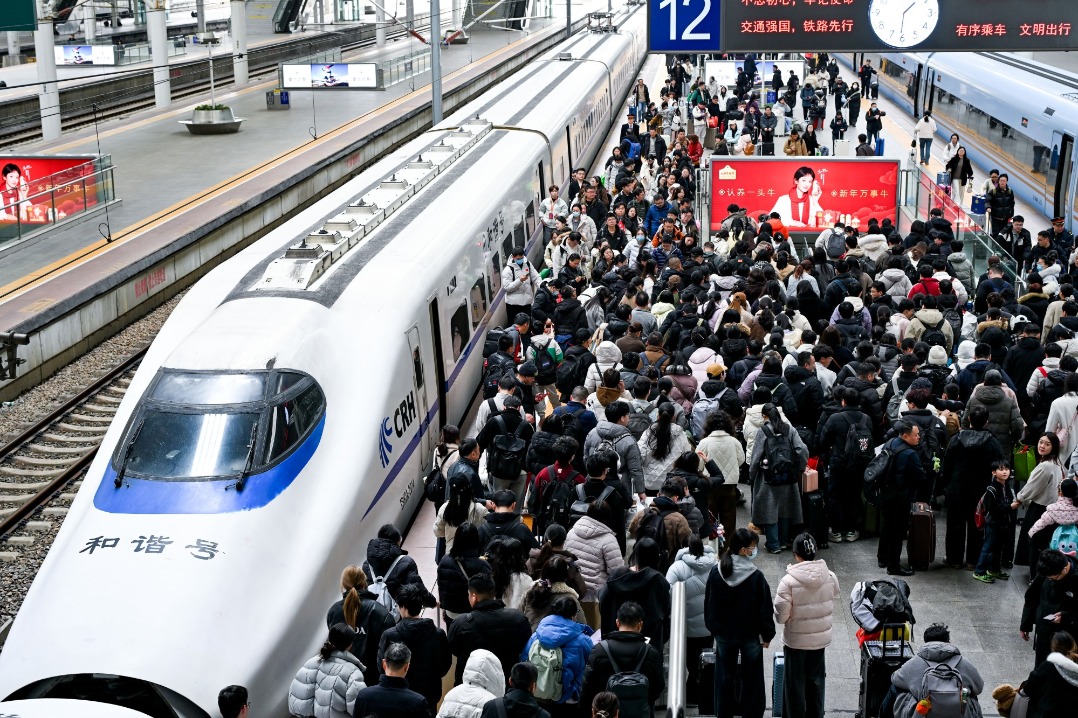
    China’s extensive railway infrastructure has successfully facilitated over 300 million passenger journeys since the commencement of the Spring Festival travel period on February 2, according to official data released by China State Railway Group. The national railway operator confirmed that transportation services have maintained optimal safety standards and operational efficiency throughout this massive annual migration event.

    Recent statistics reveal that passenger volumes have consistently exceeded 15 million trips daily for five consecutive days, with February 24 alone recording 18.1 million journeys. The system achieved a remarkable milestone on February 23, handling 18.73 million passenger trips—setting a new historical record for single-day transportation capacity during the Spring Festival travel season.

    Railway authorities have implemented enhanced operational measures and strengthened passenger services to ensure smooth and efficient travel experiences. These efforts have simultaneously supported uninterrupted logistics operations during the holiday period, demonstrating the system’s dual capacity for both passenger mobility and cargo transportation.

    The Spring Festival travel rush, recognized globally as the largest annual human migration phenomenon, continues to serve as a critical benchmark for evaluating China’s transportation capabilities and operational management systems. This year’s performance indicators demonstrate significant advancements in handling extreme passenger volumes while maintaining service quality and safety protocols.

    The 40-day chunyun period represents not only a logistical challenge but also a cultural tradition that sees millions of Chinese citizens traveling to reunite with families during the most important holiday in the Chinese calendar. The railway network’s ability to manage these extraordinary passenger volumes reflects China’s ongoing investments in transportation infrastructure and operational expertise.

  • Get to know Shanghai’s first shop dedicated to elderly

    Get to know Shanghai’s first shop dedicated to elderly

    Shanghai has unveiled an innovative retail concept specifically designed to serve its aging population with the opening of China’s first dedicated senior citizen store in Putuo District. This pioneering establishment represents a significant shift in retail philosophy, moving beyond mere product sales to create a comprehensive senior-focused experience.

    The store features carefully curated merchandise addressing common challenges faced by elderly consumers, including products with enhanced grip mechanisms, simplified digital interfaces, and specialized mobility aids. More significantly, the space functions as a research laboratory where staff actively collect customer feedback and wish lists for future product development.

    This retail innovation forms part of Shanghai’s broader strategy to address demographic challenges through age-friendly urban planning. As China’s population rapidly ages—with over 300 million citizens expected to be over 60 by 2025—such initiatives demonstrate how cities can adapt infrastructure and services to meet evolving demographic needs.

    The store’s interactive approach allows senior customers to directly influence product design and availability, ensuring future merchandise accurately reflects their actual requirements rather than corporate assumptions about elderly needs. This model potentially establishes a new standard for senior-focused retail that could be replicated across China and other aging societies worldwide.

    Urban planners and gerontology experts are closely monitoring the project’s development, viewing it as a test case for commercial adaptation to demographic shifts. The success of this venture could inspire similar specialized retail environments in other major cities facing comparable aging population challenges.

  • Filipinos protest corruption on anniversary of Marcos’s ouster

    Filipinos protest corruption on anniversary of Marcos’s ouster

    Thousands of Filipino demonstrators converged on Manila’s streets Wednesday, marking the 40th anniversary of dictator Ferdinand Marcos Sr.’s overthrow with renewed demands for accountability in a massive corruption scandal plaguing his son’s administration. Under intense tropical heat, protesters targeted a billion-peso flood-control infrastructure scheme allegedly funneling taxpayer funds to phantom projects in the storm-vulnerable archipelago.

    The demonstrations, strategically timed on a workday to maximize visibility, saw brief confrontations as shield-carrying police initially blocked marchers before permitting their passage toward the People Power Revolution monument. This symbolic site commemorates the 1986 uprising that ended the elder Marcos’s two-decade rule, which included nine years of martial law marked by alleged embezzlement and political repression.

    Nineteen-year-old student Dustin Salazar articulated widespread frustration: ‘Our money is being stolen by politicians. I want everyone involved jailed starting from the top.’ His sentiments echoed those of 72-year-old Dee Van Nostrand, who traveled 180 kilometers to participate, stating citizens ‘deserve a better government and better life.’

    Despite President Ferdinand Marcos Jr. highlighting the corruption case in a July address, no sitting lawmakers have been detained despite promises of ‘big fish’ arrests. The rallies represented the third major protest targeting the scandal but recorded the smallest turnout yet, with police estimating fewer than 6,000 participants across multiple locations.

    Political analyst Lawrence Anthony Borja from De La Salle University suggested public anger had dissipated due to historical patterns where high-ranking officials typically escape serious consequences. However, Ateneo Policy Center researcher Michael Henry Yusingco countered that protest fatigue shouldn’t be misinterpreted as apathy, noting the events serve as ‘an overt warning to prosecutors about their duties.’

    University of the Philippines professor Jean Franco observed that while overt public anger may be limited, citizens remain engaged with ongoing cases. Father Victor de Jesus, a 65-year-old seminarian who participated in the original 1986 revolution, acknowledged the frustration but emphasized that meaningful change requires persistent effort: ‘A revolution takes time and a lot of work.’

  • Nepali migrant workers influence polls, but can’t vote

    Nepali migrant workers influence polls, but can’t vote

    As Nepal prepares for its first parliamentary elections on March 5th following September’s youth-led uprising that toppled the government, a critical democratic paradox emerges: the nation’s 2.5 million overseas workers significantly influence electoral outcomes despite being systematically excluded from voting themselves. This Himalayan republic’s political landscape remains fundamentally shaped by migrant laborers who constitute 7.5% of the population and generate remittances equivalent to over one-third of GDP, yet cannot participate in the democratic process they financially sustain.

    The September revolution, fueled by economic despair and vanishing opportunities, highlighted the growing influence of Nepal’s diaspora community. According to government statistics, these migrant workers—dispersed across Gulf nations, Saudi Arabia, India, and Malaysia—serve as primary breadwinners for their families back home. Political parties actively court this excluded constituency recognizing their powerful influence over domestic voting patterns through financial support and digital advocacy.

    Ganesh Gurung of Nepal’s Policy Research Institute observes: ‘As the main economic providers, migrant workers wield substantial influence over family voting decisions. Their robust social media engagement consistently demonstrates profound frustration with successive governments.’ A recent survey by migrant rights organizations Shramik Sanjal and LAPSOJ revealed nearly 90% of overseas workers maintain strong interest in voting, with indirect participation through family recommendations and online campaign support becoming commonplace.

    Despite clear democratic demand, systemic barriers persist. Legal challenges to a 2017 election ruling have stagnated, with no functional system for embassy voting, postal ballots, or electronic participation. The interim government installed after September’s uprising expressed support for electoral reform but failed to implement changes before the imminent elections. Election Commission spokesman Prakash Nyaupanem cited procedural limitations: ‘The system couldn’t be modified without legal foundation and comprehensive training—these elections were organized under extreme time constraints.’

    Historical context reveals prolonged stagnation. The Supreme Court’s 2018 directive for reform produced no ‘significant development’ according to human rights lawyer Barun Ghimire. A drafted 2023 voting act collapsed due to budgetary constraints and electronic voting security concerns, as confirmed by an anonymous former Electoral Commission member.

    The political influence of excluded migrants already manifests dramatically. The Rastriya Swatantra Party (RSP)—which made migrant voting rights a central platform—shocked establishment parties by becoming parliament’s fourth-largest force in 2022. That same year, Balendra Shah leveraged migrant support to win Kathmandu’s mayoral race and now stands as RSP’s prime ministerial candidate. National Network for Safe Migration representative Nilambar Badal confirms: ‘Shah secured victory primarily through pressure from overseas Nepalis who influenced Kathmandu voters.’

    Shah told AFP he would address voting rights if elected, stating migrants ‘should get voting rights.’ Comparative international models demonstrate feasibility, with former chief election commissioner Neil Kantha Uprety noting: ‘With sufficient governmental and commission willingness, the election timeline could have been extended to include overseas Nepalis.’

    Despite current exclusion, lawyer Ghimire remains optimistic: ‘Change appears inevitable. The mere existence of this debate represents progress.’ He envisions transformative democratic impact once inclusion occurs: ‘One million concentrated votes could reshape the political landscape and ensure genuine accountability from elected officials.’

  • Pro-Palestine activists plead not guilty and go to trial over ‘intifada’ calls

    Pro-Palestine activists plead not guilty and go to trial over ‘intifada’ calls

    In a landmark legal proceeding at Westminster Magistrates’ Court, three pro-Palestine activists have entered not guilty pleas against charges of inciting racial hatred through protest chants. Abdallah Alanzi (24), Haya Adam (21), and Azza Zaki (60) face allegations of using “threatening, abusive or insulting words or behaviour intending thereby to stir up racial hatred” during a December demonstration.

    The case represents the first criminal charges brought under new police guidelines announced by both the Metropolitan and Greater Manchester police forces, which specifically target the chanting of “globalise the intifada” at protests. The police statement warned that “those using it at future protests or in a targeted way should expect police to take action.”

    Following an investigation by the Met’s Public Order Crime team that examined multiple chants from the protest, the defendants will now face trial at Southwark Crown Court on March 25th. Outside the courthouse, demonstrators waved Palestinian flags, beat drums, and demanded the charges be dropped.

    The case has sparked significant debate about protest language and interpretation. Pro-Palestine activists vehemently deny that “globalise the intifada” constitutes antisemitic rhetoric or incitement to violence, noting that British Jews have been prominent participants in pro-Palestine marches throughout the UK.

    Linguistic and historical context adds complexity to the case. The term “intifada” derives from the Arabic root “nafada,” meaning “to shake off” or “to rise up.” While some historical intifadas in Arab history employed peaceful methods, those in occupied Palestine involved both civil disobedience and armed resistance against Israel.

    The legal proceedings occur against a backdrop of heightened tensions following October’s deadly attack on a Manchester synagogue that killed two Jewish worshippers. Prime Minister Keir Starmer previously characterized calls to “internationalise the intifada” as essentially “a call to attack Jewish communities around the world.”

  • Hong Kong to contribute in various areas under national 15th Five-Year Plan: HKSAR financial chief

    Hong Kong to contribute in various areas under national 15th Five-Year Plan: HKSAR financial chief

    Hong Kong’s Financial Secretary Paul Chan has announced the establishment of a high-level cross-bureau task force that will spearhead the special administrative region’s integration with China’s national 15th Five-Year Plan. This marks the first time Hong Kong will develop its own comprehensive five-year strategic blueprint in synchronization with national development objectives.

    During Wednesday’s budget address, Chan detailed how the national plan explicitly supports Hong Kong’s enhanced integration into China’s development framework while strengthening its global position as an international financial, shipping, and trade hub. The strategy additionally targets Hong Kong’s transformation into an international innovation and technology center alongside establishing itself as a global talent acquisition hub.

    The financial secretary emphasized Hong Kong’s distinctive advantages in artificial intelligence, life sciences, financial technology, and renewable materials research. He outlined how the city’s robust financial ecosystem will drive ‘Finance+’ initiatives—leveraging financial services to bolster real economic sectors and foster synergistic growth between finance and technological innovation.

    Chan highlighted Hong Kong’s unique institutional advantages under the ‘one country, two systems’ framework, positioning the territory as both a ‘super connector’ and ‘super value-adder’ in China’s high-level opening-up strategy. The city’s world-class aviation, shipping, and logistics infrastructure will facilitate international business expansion and foreign investment attraction.

    The talent development strategy encompasses both attracting elite global researchers through Hong Kong’s internationally renowned universities and nurturing local expertise, aligning with national goals for integrated education-technology-talent development.

  • Couple arrested for assaulting teen after traffic spat in Henan

    Couple arrested for assaulting teen after traffic spat in Henan

    A disturbing case of road rage escalation has resulted in criminal charges against a married couple in China’s Henan province. The Jiaxian County Public Security Bureau confirmed the arrest of Liu and Han, a middle-aged couple, following their brutal attack on a 15-year-old girl that left her with serious facial injuries.

    The incident originated from a minor collision between electric bicycles on the evening of February 19th near the Ciba Town Health Center. The victim, identified only as Ding, was traveling with her 12-year-old brother when their vehicle made contact with that of a 65-year-old woman surnamed Yang.

    What began as a routine traffic disagreement rapidly spiraled into violence when Yang summoned her son and daughter-in-law to the scene. The responding couple initially targeted three bystanders—two women and a teenage boy—whom they mistakenly believed had insulted the elderly woman. After recognizing their error, Liu and Han redirected their aggression toward the young Ding, subjecting her to a physical assault that resulted in a fractured orbital bone.

    Medical forensic evaluation conducted on February 23rd classified Ding’s injuries as Grade 2 minor harm, requiring hospitalization and treatment. Local prosecutors have formally approved criminal detention for both assailants on charges of ‘picking quarrels and provoking trouble,’ a legal classification often applied to disruptive public behavior under Chinese law.

    Authorities indicate that the investigation remains active as they examine the full circumstances surrounding the attack and its aftermath. The case has drawn attention to issues of public safety and conflict resolution in community settings.

  • India shuts five streaming platforms showing ‘obscene’ content

    India shuts five streaming platforms showing ‘obscene’ content

    The Indian government has implemented a comprehensive ban against five over-the-top (OTT) streaming services for disseminating content deemed obscene and in violation of national digital media regulations. The prohibited platforms—MoodXVIP, Koyal Playpro, Digi Movieplex, Feel, and Jugnu—were officially shut down following an inter-ministerial consultation process.

    India’s Ministry of Information and Broadcasting clarified that the regulatory action stems from existing information technology laws rather than an attempt to suppress creative expression. ‘The primary objective of these restrictions is to enforce compliance with established legal frameworks while safeguarding viewers from exposure to harmful or illegal material,’ the ministry stated in an official release. The government emphasized its commitment to maintaining public decency, protecting national interests, and upholding ethical standards across digital journalism platforms.

    The decision followed extensive consultations with multiple government entities including the Ministries of Home Affairs, Women and Child Development, Electronics and Information Technology, and Law and Justice. Industry representatives from the Federation of Indian Chambers of Commerce and Industry (FICCI) and the Confederation of Indian Industry (CII), alongside experts in children’s and women’s rights, contributed to the evaluation process.

    This enforcement action references India’s Information Technology (Intermediary Guidelines and Digital Media Ethics Code) rules, which explicitly prohibit content characterized as obscene, pornographic, privacy-invasive, gender-based harassment, racially objectionable, or promoting hate speech and violence. The government noted that intermediaries failing to observe these legal obligations forfeit their immunity under Section 79 of the IT Act, becoming subject to full legal consequences.

    The recent ban continues India’s pattern of digital content regulation, following July’s blocking of 25 OTT platforms allegedly distributing vulgar and pornographic media. Officials noted that despite previous warnings, the prohibited services persisted in publishing objectionable content through alternative domains. India’s self-regulatory body, the Digital Publisher Content Grievances Council—comprising approximately 40 OTT members—had previously identified several platforms exhibiting ‘distasteful and bizarre’ scenes.

  • DoorDash exits 4 markets, including Japan, to focus on growth elsewhere

    DoorDash exits 4 markets, including Japan, to focus on growth elsewhere

    DoorDash Inc. announced on Wednesday its strategic decision to cease operations across four international markets: Qatar, Singapore, Japan, and Uzbekistan. This move follows an extensive multi-month evaluation of market-specific conditions and competitive landscapes.

    The San Francisco-based food delivery giant stated that this consolidation will enable the company to concentrate its investment resources on territories where it can achieve sustainable scaling and establish long-term market dominance. Miki Kuusi, Head of DoorDash International, emphasized that the company’s immediate priority is ensuring a structured transition process for affected employees and partner networks.

    DoorDash entered several of these markets considerably later than established competitors. Its 2021 launch in Japan placed it five years behind rival Uber Eats, while its acquired subsidiary Deliveroo (purchased in 2023) only commenced Qatar operations in 2022—nearly a decade after regional leader Talabat began serving the Qatari market.

    The company faces intensely competitive environments in these exiting markets, including opposition from GrabFood and Foodpanda in Singapore, and Russia’s Yandex Eats in Uzbekistan.

    Despite these operational withdrawals, DoorDash confirmed that the closures will not affect its existing financial guidance. Investor response appeared positive, with company shares rising approximately 5% during midday trading following the announcement.

    While DoorDash maintains market leadership in the United States, it continues to pursue international expansion through strategic acquisitions, including the 2021 purchase of Finland’s Wolt Enterprises Oy which facilitated its European market entry.