标签: Asia

亚洲

  • Trump team denies Iran hit US warship entering Hormuz Strait

    Trump team denies Iran hit US warship entering Hormuz Strait

    Tensions between the United States and Iran have spiked dramatically this week after Iranian state media claimed Tehran’s forces struck a U.S. Navy warship entering the Strait of Hormuz without authorization, a claim immediately and categorically rejected by the Trump administration.

    The standoff traces back to an announcement over the weekend from former President Donald Trump, who unveiled what the U.S. calls “Project Freedom” – an initiative under which the U.S. Navy would provide armed escort for commercial vessels transiting the strategic waterway. Iranian officials swiftly pushed back against the move, framing it as a deliberate provocation designed to draw Tehran into retaliatory action that would justify further escalation. Iranian military leaders pledged that any vessel attempting to pass through the strait without explicit Iranian approval would be intercepted immediately.

    On Monday morning, Iran’s Fars News Agency, an outlet closely tied to the Islamic Revolutionary Guard Corps (IRGC), reported that such an interception had already escalated to an attack. Citing unnamed local sources, the agency said two missiles had struck a U.S. Navy frigate that had violated transit security protocols off the coast of Jask, after the vessel ignored repeated warnings from the Iranian Navy. The report claimed the strike disabled the warship, forcing it to retreat from the area and abandon its attempt to traverse the strait.

    A senior Iranian official later told Reuters that it remained unclear how much damage the vessel had sustained, if any. Separately, Iran’s Tasnim News Agency released a statement from the Iranian army’s public affairs division claiming that Iranian naval forces had successfully prevented “enemy American-Zionist destroyers” from entering the Strait of Hormuz region through swift, decisive action.

    U.S. Central Command (CENTCOM) moved within hours to debunk the Iranian claims, publishing an official fact-check across its social media channels. The command explicitly refuted the assertion that the IRGC had struck a U.S. warship with two missiles, stating flatly: “No U.S. Navy ships have been struck.” CENTCOM added that U.S. forces continue to operate in support of Project Freedom and uphold an existing naval blockade on Iranian ports, noting that U.S. guided-missile destroyers recently transited the Strait of Hormuz to operate in the Persian Gulf, and are actively facilitating safe passage for commercial shipping. As an initial milestone, the command said two U.S.-flagged merchant vessels had already successfully transited the waterway and are continuing their voyages safely.

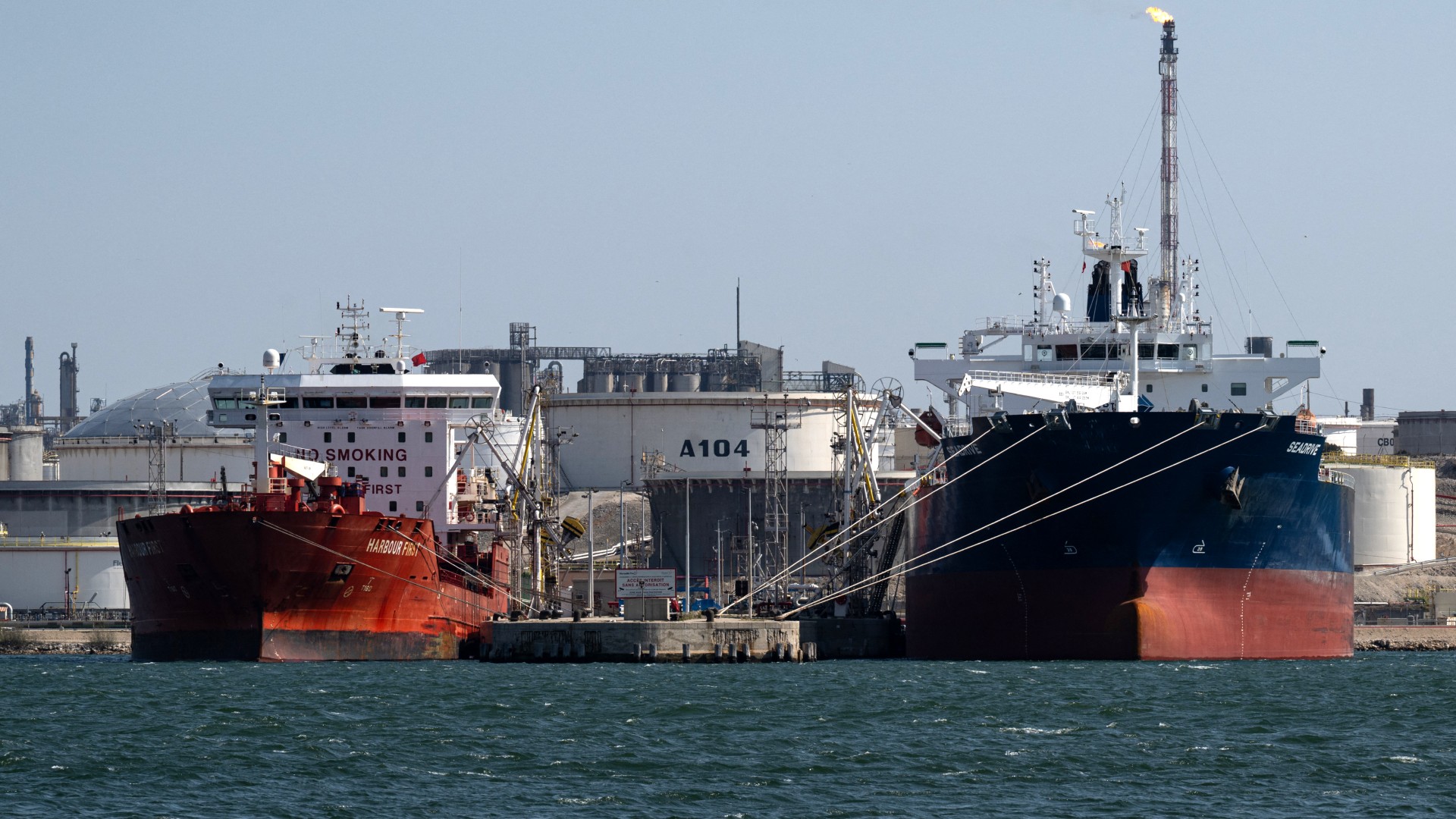
    The strategic Strait of Hormuz, which carries roughly 20 percent of the world’s seaborne oil shipments, has been the focal point of a high-stakes standoff between Iran and the U.S.-led bloc since Iran moved to restrict access for unauthorized vessels in retaliation for a U.S.-Israeli military campaign launched in late February. The restrictions have already roiled global energy markets, pushing global oil prices sharply higher, driving average U.S. gasoline prices above $4 per gallon, and adding new inflationary pressure to economies worldwide.

    Independent verification of both sides’ competing claims remains elusive. Open-source marine tracking analysts have noted that public tracking data does not show the two U.S.-flagged merchant vessels transiting the strait on Monday, though the vessels could have disabled their tracking systems to conceal their movement.

    Critics have called into question the credibility of the Trump administration’s denial, pointing to a pattern of misleading statements from past U.S. military encounters in the region. Matt Duss, a former foreign policy advisor to U.S. Senator Bernie Sanders, warned the public to approach the administration’s claims with deep skepticism, citing a repeated pattern of immediate denials that are later walked back as damaging information emerges slowly over time, after public attention has shifted.

    As a prominent example, Duss noted that after the first Trump administration assassinated IRGC General Qassem Soleimani in 2020, Trump initially claimed Iranian retaliatory strikes on Iraq’s Al Asad Air Base, a U.S. military installation, caused zero American casualties. In the weeks that followed, declassified Pentagon information confirmed more than 100 U.S. troops had suffered traumatic brain injuries from the attacks. More recently, Duss added, CENTCOM initially denied Iranian claims to have shot down a U.S. fighter jet in early April, claiming “all aircraft are accounted for” – even as one aircraft had indeed been downed, requiring a multi-day covert operation to rescue two pilots from Iranian territory.

  • An explosion at a fireworks plant in China kills at least 21 people, state media says

    An explosion at a fireworks plant in China kills at least 21 people, state media says

    BEIJING – A devastating explosion at a fireworks manufacturing facility in southern China has claimed 21 lives and left 61 people injured, according to official Chinese state media reports released Tuesday.

    The accident unfolded on Monday afternoon at a factory operated by Huasheng Fireworks Manufacturing and Display Co., located in Liuyang—a county-level city administered by Changsha, the capital of Hunan province. Liuyang has long been recognized as one of China’s most prominent centers of fireworks production, with deep historical roots in the industry stretching back more than 1,000 years.

    Aerial footage broadcast by China’s state-owned CCTV on Tuesday morning revealed lingering white smoke still rising from sections of the blast site, where industrial buildings have been left collapsed or severely damaged by the force of the explosion.

    In response to the disaster, Chinese authorities dispatched nearly 500 professional rescue workers to the scene, and moved quickly to evacuate all residents from nearby high-risk zones. The evacuation order was prompted by the presence of two unharmed black powder storage warehouses adjacent to the explosion site, which posed major secondary hazard risks for first responders. To mitigate these risks and prevent follow-up accidents during search and rescue operations, crews implemented safety protocols including continuous water spraying and site humidification to neutralize residual explosive materials. Three specialized search and rescue robots were also deployed to assist in accessing unstable, high-risk areas of the site to locate missing people and clear debris.

    Shortly after the blast, Chinese President Xi Jinping issued formal instructions calling for all-out efforts to locate any remaining missing people and provide urgent medical care to the injured. He ordered authorities to accelerate the investigation into the root cause of the explosion, hold responsible parties legally accountable per national safety regulations, and strengthen systemic public safety management across China. President Xi also emphasized the urgent need for nationwide risk screening and hazard control enforcement across all high-risk key industries, to prevent similar deadly accidents from occurring.

    As of Tuesday’s official updates, the person in charge of the Huasheng facility has been taken into police custody, while the formal investigation into the cause of the blast remains ongoing.

    Liuyang’s connection to fireworks production dates to the Tang Dynasty, between 618 and 907 CE. According to Guinness World Records, the first formally documented firework was developed by Li Tian, a Tang Dynasty monk who lived near modern Liuyang. Li discovered that packing gunpowder into hollow bamboo stalks created powerful loud explosions, and he bundled these stalks together to create the traditional Chinese New Year firecrackers, a tradition that remains central to Chinese cultural celebrations to this day.

    This latest explosion marks another fatal industrial accident in China’s fireworks industry this year. In February, during the Lunar New Year holiday period, two separate deadly blasts at fireworks retail shops killed multiple people across the country, prompting calls for tightened safety oversight ahead of this year’s peak production and celebration season.

  • UAE says missile and drone strikes launched from Iran

    UAE says missile and drone strikes launched from Iran

    Just one month after agreeing to a fragile ceasefire with the United States, Iran has dramatically escalated tensions across the Persian Gulf by launching a coordinated barrage of missiles and drones against the United Arab Emirates, marking the first major assault on a Gulf Cooperation Council state in the post-ceasefire era. The large-scale attack has triggered immediate warnings from Abu Dhabi that it reserves the right to launch retaliatory action, stoking fears of a wider regional conflict.

    In an official statement released following the assault, the UAE’s foreign ministry condemned the operation as a reckless and unacceptable escalation that directly undermines the sovereignty, security and territorial stability of the country. “These attacks represent a dangerous escalation and an unacceptable transgression, posing a direct threat to the state’s security, stability, and the safety of its territories,” the statement read, confirming that the Emirates would exercise its full legitimate right to respond to the unprovoked aggression.

    The assault unfolded shortly after the United States unveiled a new maritime security plan to escort commercial vessels transiting the Strait of Hormuz, the critical chokepoint through which roughly a fifth of the world’s global oil supplies pass daily. Iranian state-run Fars News Agency initially claimed that Iranian military forces had struck a U.S. warship with two anti-ship missiles while the vessel was traversing the strategic waterway. That claim was swiftly rejected by then-U.S. President Donald Trump, who clarified Monday that only a South Korean-flagged vessel had been damaged in the incident. Trump added that U.S. forces had destroyed seven Iranian fast-attack craft operating in the area, a statement that Tehran quickly denied. U.S. Central Command also issued a formal rebuttal of Fars News’ report of a struck American warship.

    According to the UAE’s defense ministry, at least four cruise missiles were launched toward Emirati territory from Iranian soil. The country’s integrated air defense systems intercepted and destroyed three of the incoming projectiles, while the fourth missile impacted harmlessly in the open waters of the Gulf. A separate drone attack, however, ignited a blaze at an energy facility located in Fujairah, the UAE’s critical Indian Ocean port that serves as a key export hub for Emirati oil that avoids passing through the Strait of Hormuz.

    Local civil defense teams were deployed to the site within minutes of the attack. “Fujairah Civil Defence teams immediately responded to the incident and are continuing their efforts to control it,” the Fujairah media office confirmed in an update. Three Indian nationals working at the facility sustained moderate injuries in the strike, the Emirati federal government confirmed.

    The spillover from the attack extended to neighboring Oman, where local authorities reported two people were injured after a strike targeted a residential building in Bukha. The town of Bukha, which lends its name to the surrounding Omani province, sits in an Omani exclave along the Gulf coast, just northwest of the Emirate of Fujairah, putting it in the direct path of projectiles launched toward the UAE.

    Monday’s coordinated strikes have upended the tentative de-escalation that followed last month’s U.S.-Iran ceasefire, with regional powers already moving to reinforce military positions and issue diplomatic condemnations. The incident also underscores the persistent volatility of the Gulf region, even amid diplomatic efforts to reduce the risk of open conflict between Iran and Western-aligned Gulf states.

  • Criminal complaint filed against Norwegian politicians over complicity in Gaza genocide

    Criminal complaint filed against Norwegian politicians over complicity in Gaza genocide

    A landmark legal development has put four of Norway’s most senior current and former political leaders under formal criminal investigation over allegations they aided and abetted genocide in Gaza through their oversight of the country’s $2.2 trillion sovereign wealth fund. The complaint, filed by Norwegian activist groups, alleges the officials violated domestic Norwegian laws that integrate provisions of the Rome Statute banning genocide by allowing the Government Pension Fund of Norway (GPFG)—the world’s largest single sovereign investor—to maintain holdings in firms linked to Israeli war crimes in Gaza.

    Named in the primary complaint brought by Grandmothers Against Genocide (Grag) are sitting Prime Minister Jonas Gahr Store, current Foreign Minister Espen Barth Eide, former Finance Minister Trygve Slagsvold Vedum, and former NATO Secretary General Jens Stoltenberg, who also previously served as Norway’s finance minister. A complementary complaint submitted by the Palestine Committee of Norway adds two more senior figures: GPFG Chief Executive Nicolai Tangen and Ida Wolden Bache, governor of Norway’s central bank, which manages the fund.

    In a reversal of an earlier dismissal, documents obtained exclusively by Middle East Eye confirm that Norway’s Prosecuting Authority has formally ordered the country’s national criminal investigation unit, Kripos, to open a full probe into the allegations. Prosecutors have also instructed Kripos to formally notify all respondents named in the complaint of the pending investigation.

    The case centers on the GPFG’s controversial investment strategy related to firms operating in or linked to Israel. In 2025, the fund divested from 23 Israeli companies over documented violations of its internal ethical investment guidelines, a decision that drew fierce public backlash from the United States, with State Department officials stating they were “very troubled” by the move. Despite that divestment, the fund retained stakes in 29 other Israeli firms, and continues to hold shares in major multinational arms manufacturers including Leonardo and ThyssenKrupp—both of which supply military equipment directly to the Israel Defense Forces, which has killed more than 72,000 Palestinians in Gaza since the outbreak of hostilities in October 2023, according to Gazan health authorities.

    A parliamentary push for full, blanket divestment from all companies linked to Israeli war crimes was defeated in the Norwegian Storting (parliament) in June of last year, after the governing Labour Party joined conservative opposition parties to reject the proposal. Months earlier, United Nations Special Rapporteur for the Occupied Palestinian Territories Francesca Albanese had written directly to Stoltenberg warning that the fund’s ongoing holdings put Norway at risk of violating binding international law.

    Activists behind the complaint say the investigation is long overdue and would set a critical precedent for holding elected officials accountable for mass atrocities abroad. Kirsti Maehle, co-founder of Grag, argued that prosecuting responsible officials would establish a clear guiding principle for Norwegian representatives who have thus far ignored the suffering of Palestinian civilians. “They sit in our parliament, the Storting, and vote in favour of the investments. That amounts to voting to contribute to crimes against humanity, which is absolutely outrageous,” Maehle stated.

    Legal analysis backing the complaint, prepared in a personal capacity by Terje Einarsen, a law professor at the University of Bergen, notes that explicit intent to enable atrocities is not required to establish legal liability under Norwegian law. Einarsen told Middle East Eye that senior Norwegian government leaders have almost certainly been aware of the core crimes committed in Gaza and the role that fund-invested companies play in enabling those abuses. “They may thus be legally responsible for aiding and abetting one or more crimes,” Einarsen explained.

    Complaints have also been bolstered by a 118-page independent academic report from the group Historians for Palestine, published in June 2024, which documents the GPFG’s holdings in firms linked to human rights violations and war crimes. The report was submitted alongside the criminal complaint as key evidence. Co-author Pal Nygaard, a professor of economic history at the Norwegian Business School, emphasized that continuing these investments directly reinforces impunity for Israel. “It is important that the fund follows its own ethical guidelines and acts as a truly responsible investor, and that means divesting from all companies that contribute to Israel’s illegal occupation of Palestine, their apartheid system, and their genocide,” Nygaard said. He added, “The continued investments in companies that actively contribute to Israel’s violation of international law equals accepting these mass atrocities. In the end, it is the politicians who designed this system for responsible investments, and they are then also ultimately responsible for ensuring that the fund and its Council on Ethics manage the fund’s investments accordingly.”

    Earlier this week, Grag submitted updated evidence regarding the fund’s investments to Norway’s Standing Committee on Finance and Economic Affairs. Middle East Eye has reached out to the Norwegian Prime Minister’s Office, GPFG, Kripos, and the Norwegian Prosecuting Authority for comment on the investigation, and had not received a response as of publication.

  • She was an award-winning Broadway star – but still struggled to land roles

    She was an award-winning Broadway star – but still struggled to land roles

    Thirty-five years ago, a young Filipina performer named Lea Salonga stepped onto the Broadway stage and made history, winning a Tony Award for her breathtaking lead performance in *Miss Saigon*. What many do not know, however, is that even after this career-defining win, systemic barriers kept her from chasing the next opportunity. In a candid interview with the BBC, Salonga opened up about the rampant anti-Asian bias that defined her early years in Western theater: agents would submit her for auditions, only for casting teams to reject her out of hand, citing her ethnicity as the reason. “They were unable to imagine someone like me playing those roles,” she recalled.

    Today, that kind of outright exclusion feels almost unthinkable. We live in an era where K-pop powerhouses BTS and Blackpink top global music charts, Asian-led hits like *Shōgun* and *Squid Game* dominate major awards ceremonies, and Asian-led projects draw sold-out crowds on Broadway. For Salonga, who has since cemented her status as a global Broadway icon and national treasure in the Philippines, this sea change has been decades in the making.

    Even as a Tony-winning performer, Salonga’s path to the next landmark role of her career was only possible through the support of insider advocates. The opportunity to play Eponine in the long-running hit *Les Misérables* came to her without an audition, thanks to the producers of *Miss Saigon*, who also backed the iconic musical. Salonga made history as the first Asian actor to land a principal role in the production, but she remembers the casting being framed internally as little more than a low-stakes experiment.

    “When I was cast, the show had already run for five years, and January is usually a slow ticket season, so producers felt there was minimal risk,” she explained. At the time, she was the only person of color in the entire company, and the production openly questioned whether casting an Asian actor in a traditionally white role was just a publicity stunt. “Is this going to work? If it works, the reward would be great,” was the general attitude, she said.

    Stepping into that role was an experience Salonga describes as “incredibly stressful” — far more nerve-wracking than *Miss Saigon*, where she played an Asian character that fit casting expectations. “With *Les Mis*, it’s like, we’re going to cast this Asian chick in this show — and there’s never been an Asian in this show,” she said. Yet even amid the pressure, she understood the magnitude of what that breakthrough meant for future generations: “It meant that anyone who had their sights on Eponine could play it. Because if I could do it — then anyone else could, regardless of ethnic background.”

    More than 30 years later, that breakthrough has come full circle during the 2026 Singapore run of *Les Misérables The Arena Spectacular*, where Salonga now performs alongside 28-year-old Nathania Ong — the current actress playing Eponine, and the first Singaporean to ever take on the role on London’s West End. Watching Ong from backstage as she prepares for her own performance, Salonga says it’s clear the experiment she joined all those years ago worked. “It makes me think that the experiment worked. And it’s something I’m very proud to have participated in. And now it’s time for the next generation of actors to step up,” she joked.

    Ong grew up watching trailblazers like Salonga break barriers, but says she did not immediately grasp the historic weight of her own casting. “I didn’t even realize what a big deal it was to have gotten the part,” she shared. “It took a few months before I was like… I’ve made it. I’ve actually done something with this.” While she credits Salonga for opening doors for all BIPOC performers, she notes that the fight for equal representation has evolved — but is far from over. Today, the struggle is no longer just about getting a foot in the audition room: it’s about being recognized for your talent, not just hired to check a diversity box. “The thing with going for parts as an East Asian is that sometimes we struggle with the idea of: ‘Have we been hired to meet a diversity quota, or are we actually being hired because we’re good at our jobs?’” she said.

    For Salonga, the biggest and most exciting shift extends beyond casting of traditional Western roles: Asian creators are now writing and headlining their own stories, rather than just fitting into narratives crafted by others. She points to the recent Tony-winning success of *Maybe Happy Ending*, the South Korean musical that earned the country its first ever Tony Award, as a perfect example of this new era. “Seeing a show like that…winning so many awards… tells me that if something is just so good that it cannot be ignored, it will be seen,” she said. When she was a young performer, she never could have imagined a story so inherently Asian earning such widespread acclaim on Broadway, and she notes how transformative that representation is for young Asian artists growing up today. “I think for a lot of young people to be able to see somebody that looks like them up on that stage… is incredible. I think there was a generation of Asians who wanted to do this but didn’t have that representation upon which they could reflect themselves,” she said. “I’m so glad that I am now getting to see it because now my son gets to see it.”

    Salonga is also a self-described huge fan of BTS, whose global dominance she calls a landmark moment for Asian artists. She sees a familiar weight in the pressure the band carries, recalling the expectation she felt as a young performer breaking out on the global stage: “When you head to the West End and you have to be excellent or you will let 75 million people down [the population of the Philippines], that’s a lot to put on your shoulders. The responsibility is heavy,” she said. “That’s also why I appreciate BTS so much because it’s like, here you go, the weight of all of Asia is now on your shoulders.”

    The momentum for authentic Asian storytelling extends far beyond Broadway, Salonga adds, pointing to her own upcoming project: a DreamWorks animated film entirely rooted in Philippine folklore, a project she never thought possible earlier in her career. “An animated film that is based on my culture… I’d never thought I’d see something like that in my lifetime,” she said.

    When asked what her 18-year-old self would make of how far the industry has come, Salonga says the younger version of herself would be incredulous — but also inspired to know there is a space for Asian talent. “Incredibly shocked, but I think also inspired to know… that there is a space for me,” she said. “You know, you can push us to the margins – but we’re just going to centre ourselves.”

  • Trump’s Hormuz ‘protection’ seeks ‘pretext for escalation’: Iran

    Trump’s Hormuz ‘protection’ seeks ‘pretext for escalation’: Iran

    Tensions have escalated sharply in the Persian Gulf after former U.S. President Donald Trump unveiled a new U.S. military-led initiative to escort stranded commercial vessels through the closed Strait of Hormuz, a move Iranian officials have decried as a deliberate provocation designed to trigger conflict and justify expanded military aggression against the Islamic Republic.

    The plan, branded “Project Freedom” and scheduled to launch Monday, was first announced by Trump on his social media platform Truth Social, and later confirmed by U.S. Central Command (CENTCOM). In his announcement, Trump framed the operation as a humanitarian gesture, stating his administration had notified nations with ships trapped in the key waterway that U.S. forces would safely guide vessels out of Iranian restricted areas so they could resume commercial activity. CENTCOM later released detailed force deployments for the mission: it will include guided-missile destroyers, more than 100 land and sea-based aircraft, multi-domain unmanned surveillance and combat systems, and a contingent of 15,000 active-duty service members. The command also noted the operation will be backed by a new cross-agency international coordination framework called the Maritime Freedom Construct, which pairs diplomatic outreach with military coordination to bolster maritime security in the strait.

    Iran, which closed the strategically critical strait in response to the U.S.-Israeli war and the Trump administration’s naval blockade of the country, has issued a firm, unified rejection of the plan. An anonymous senior Iranian official told independent outlet Drop Site that Trump’s proposal is engineered to goad Iran into firing the first shot, creating a false pretext for military escalation. The official stressed that any commercial vessel attempting to traverse restricted transit routes without prior coordination with Iranian authorities will be intercepted immediately by Iranian security forces. Should U.S. military vessels intervene to disrupt these interceptions, the official added, Iran will respond with immediate, proportional force. The official also noted that U.S. warships are currently positioned far from the restricted transit corridor, meaning Iran would engage non-compliant commercial vessels long before they could reach American assets, accusing Trump of leveraging civilian ships as political pawns in his domestic and geopolitical agenda.

    Ebrahim Azizi, chair of the Iranian Parliament’s national security commission, echoed the criticism, warning that any U.S. interference in Iran’s new maritime regulatory framework for the Strait of Hormuz constitutes a direct violation of the ceasefire brokered earlier this April. He dismissed Trump’s initiative outright, stating that the strategically vital waterway cannot be governed by “delusional posts” on social media.

    The escalation over the strait comes as both sides navigate fragile, indirect negotiations to end the three-month-long war. Iranian Foreign Ministry spokesperson Esmaeil Baghaei confirmed Sunday that Tehran is currently reviewing the U.S. government’s response to Iran’s 14-point peace proposal, which was shared via Pakistani intermediation. Baghaei clarified that the proposal is exclusively focused on ending immediate hostilities, and that no nuclear-related negotiations are currently underway, despite repeated claims from Trump and U.S. Defense Secretary Pete Hegseth that halting Iran’s purported nuclear weapons program is a core U.S. war aim. Iran has long denied pursuing nuclear weapons, and U.S. intelligence assessments have repeatedly concluded Iran does not maintain an active nuclear weapons program as described by U.S. officials. Trump has already cast doubt on the proposal’s viability, writing on social media Saturday that he cannot imagine the plan being acceptable, claiming Iran has not paid a sufficient price for its actions over the past 47 years.

    The exact details of the 14-point proposal remain publicly unconfirmed, but foreign policy analysts have offered preliminary assessments. Trita Parsi, executive vice president of the Quincy Institute for Responsible Statecraft, argued Sunday that the proposal represents an unstated push for a broad grand bargain to resolve the 47-year history of U.S.-Iran hostility, rather than just a temporary ceasefire. Parsi noted the plan implicitly calls for both sides to restrain their regional proxies, including Israel and Hezbollah, an approach that could align with Trump’s known negotiating instincts.

    Domestically, the war has become a growing political liability for Trump. A new ABC News/Washington Post/Ipsos poll released Friday found that 61% of U.S. voters view Trump’s decision to launch the war as a mistake, while 66% disapprove of his handling of the conflict. The poll also recorded Trump’s lowest presidential approval rating to date.

    Analysts have noted that Iran’s current strategy, which includes closing the Strait of Hormuz to disrupt global energy and commodity trade, aligns directly with a long-documented asymmetric warfare doctrine developed by Iran’s military leadership. Archival footage from the 1990s, recently shared online by journalist Séamus Malekafzali, featured late Iranian Revolutionary Guard Corps commander Hossein Salami — who was killed in a U.S.-Israeli strike last year — outlining the doctrine for IRGC staff. Salami argued that while direct conflict with the U.S. is possible, victory is achievable if Iran can shift fighting to terrain that neutralizes U.S. military advantages and exploits U.S. weaknesses. Geopolitical analysts paraphrase the doctrine as focusing on drawing out conflict to raise economic costs and fuel domestic political turmoil in the U.S., eroding its political will to sustain military engagement.

    This approach is already visible in the closure of the Strait of Hormuz, a waterway that carries roughly 25% of global seaborne oil trade and one-third of the world’s seaborne fertilizer trade annually. Harrison Mann, a fellow with the advocacy group Win Without War, explained the dynamic during a Sunday CNN appearance, noting that Iran is able to inflict meaningful economic pain on the U.S. and its allies through this form of economic warfare, a pressure campaign that will be unsustainable for Trump over the long term.

    Project Freedom has drawn immediate backing from hardline U.S. Iran war supporters, including South Carolina Senator Lindsey Graham, a leading Republican advocate for military action against Tehran. Graham said he fully endorses Trump’s decision, stating that while he supports a diplomatic end to the conflict, it is past time to reestablish freedom of navigation in the strait and respond forcefully to Iran if it continues what Graham described as “terrorizing the world.”

  • Israel killing Palestinians ‘like we haven’t since 1967’, top commander says

    Israel killing Palestinians ‘like we haven’t since 1967’, top commander says

    Leaked closed-door comments from the head of Israeli military forces in the occupied West Bank have laid bare the staggering scale of Palestinian fatalities under current operational policies, with the commander admitting killings have reached a level unmatched since the 1967 Six-Day War, Israeli daily newspaper Haaretz has reported.

    Major General Avi Bluth, a West Bank settler who took command of the Israeli Army’s Central Command in 2024, made the explosive remarks during a closed forum, where he also defended relaxed rules of engagement that grant troops broad permission to open fire on unarmed Palestinian civilians. In a striking admission of systemic bias, Bluth confirmed that Israeli troops operate a discriminatory policy: Jewish Israelis who throw stones at security forces are never targeted with lethal force, while Palestinians who carry out the same actions are shot to kill.

    Claiming credit for the high death toll, Bluth stated that over a three-year period, Israeli forces had killed 1,500 people he labeled as “terrorists” — a term his command applies broadly to Palestinian individuals. Puzzling over the absence of large-scale popular unrest against Israeli occupation, he said, “So how is there no intifada? Why aren’t they taking to the streets? Why is the Palestinian public indifferent? Why are there no disturbances?” He went on to attribute the lack of mass uprisings to the deterrence created by the harsh crackdown, arguing, “The Arabs understand that ‘if someone rises to kill you, kill him first’ is part of the rules of the Middle East, and therefore we are killing like we have not killed since 1967.”

    Official data from the United Nations Office for the Coordination of Humanitarian Affairs (OCHA) backs up the severity of the current surge in fatalities: since October 7, 2023 alone, Israeli forces have killed 1,081 Palestinians in the occupied West Bank and East Jerusalem, including at least 235 children. Bluth explicitly linked the rising death toll to his own orders, which removed previous restrictions on soldiers opening fire on civilians. He detailed one policy that permits troops to shoot Palestinian people attempting to cross the West Bank separation barrier from the knee down, saying, “Today, there are many ‘limping memorials’ in Palestinian villages of those who tried to infiltrate and got hit, so there is a price that is paid.”

    When pressed on the double standard applied to Jewish and Palestinian stone-throwers, Bluth cited “sociological implications” as the reason his forces do not target Israelis engaging in the same activity he frames as terrorism for Palestinians. He confirmed that in 2025 alone, Israeli forces killed 42 Palestinians accused of throwing stones. When shown footage of extremist Israeli settlers throwing stones at troops, he pointed to a single incident in which two masked Israelis were shot, noting that the incident sparked a massive public outcry that would prevent similar action going forward.

    Bluth’s comments have emerged against a backdrop of growing tension between his command and extremist, hilltop settler militias that routinely carry out attacks on Palestinian communities in the West Bank. These militant settlers see Bluth as too soft, claiming he has bowed to pressure from left-wing Israeli groups and the international community. Last week, Haaretz reported that Bluth had publicly labeled rising settler violence against Palestinians as “terror,” and criticized unauthorized outposts built by hilltop youth without prior military coordination. Even so, Bluth also acknowledged that the military, working in coordination with settler groups, has established roughly 150 new unauthorized outposts in Area C of the West Bank over recent years. He claimed these outposts help prevent what he calls Palestinian “terror” and block Palestinian residential expansion.

    The commander’s remarks have already sparked political backlash: Knesset Member Limor Son Har-Melech, a prominent backer of settler militias, has publicly called on Israeli Defense Minister Israel Katz to immediately dismiss Bluth from his post.

    Parallel to the political firestorm over Bluth’s comments, Israeli anti-settlement NGO Peace Now released a new report Sunday exposing that the Israeli government has allocated 130 million shekels (roughly $35 million) to the same settler groups responsible for frequent violence against Palestinians, under the false pretense of curbing settler violence. Official government documents frame the funding as aimed at “reducing risk situations and expanding positive responses for youth in the Judea and Samaria area” — the official Israeli terminology for the occupied West Bank. But Peace Now says the funding will in reality go toward expanding existing Israeli settlements and directing millions of public shekels to settler regional councils.

    In an official statement, Peace Now said, “The government uses every excuse to justify pouring more and more millions into settlements. This is a programme to expand settlements under the guise of combating violence.” The organization added that the government is directing most of the budget to the very groups and activities that are the primary backers of the unauthorized outposts and settler farms from which most anti-Palestinian violence originates, and called on the government to cancel the funding allocation while demanding the military and police crack down on ongoing settler violence.

    This report was originally carried by independent Middle Eastern news outlet Middle East Eye, which provides exclusive, unfiltered coverage of the Middle East and North Africa region.

  • AP, Reuters, Minnesota Star Tribune among Pulitzer winners for 2025 work

    AP, Reuters, Minnesota Star Tribune among Pulitzer winners for 2025 work

    NEW YORK — The 2026 Pulitzer Prizes, one of the most prestigious honors in global journalism, have named their latest recipients, recognizing groundbreaking investigative work spanning international surveillance, U.S. presidential power shifts, and community tragedy, just one week after a high-profile security incident targeting a major Washington journalism event.

    The Associated Press took home the coveted 2026 Pulitzer Prize for International Reporting for a years-long probe into mass surveillance infrastructure and its human and societal impacts within China. Over three years of work that involved combing through thousands of official documents and conducting dozens of on-the-ground interviews, the AP investigation uncovered a key, underreported link: U.S. tech firms have contributed to building the foundational framework of the Chinese government’s mass monitoring and citizen policing system. The project also exposed longstanding regulatory gaps across multiple U.S. presidential administrations that have allowed both American technology companies and Chinese officials to evade rules designed to block Beijing from accessing sensitive restricted materials, including cutting-edge advanced computer chips.

    In this year’s award cycle, Reuters secured two Pulitzer distinctions. The outlet won the Pulitzer Prize for National Reporting for its in-depth examination of how former President and current U.S. President Donald Trump has leveraged the authority of the federal government and the influence of his political base to expand unilateral executive power and target political opponents, award judges confirmed. Reuters also took home a prize in the newly revived beat reporting category for its rigorous coverage of social media conglomerate Meta.

    The breaking news Pulitzer went to the *Minnesota Star Tribune* for its on-the-ground coverage of a 2025 mass shooting at a Minneapolis-area Catholic school. Judges commended the outlet’s work for its remarkable “thoroughness and compassion” in covering the devastating attack that unfolded during the first school Mass of the academic year. The shooting left two children dead and more than a dozen other people injured; the gunman was later found dead from an apparent self-inflicted gunshot wound.

    This year’s award announcement, delivered via online livestream with the traditional awards dinner scheduled for later in the year, comes just over a week after a violent security incident outside the White House Correspondents’ Association dinner in Washington D.C., one of the most high-profile annual gatherings for U.S. journalists. A gunman rushed a security checkpoint outside the venue and exchanged gunfire with Secret Service agents; he has since been charged with attempting to assassinate Trump, who made his first appearance as sitting president at the annual event.

    Administered by Columbia University in New York, the Pulitzer Prizes recognize outstanding journalism produced in 2025 by U.S.-based newspapers, wire services, digital news outlets, magazines, and broadcaster websites that center text-focused submissions. Entries can include multimedia components such as video, photography, graphics, and audio alongside core written work. Beyond journalism, the 2026 awards also honor outstanding achievement in books, music, and theater.

    Established in 1917 through a provision in the will of iconic newspaper publisher Joseph Pulitzer, the awards carry a $15,000 cash prize for most winning entries, while the prestigious Pulitzer Prize for Public Service is awarded a gold medal. All winners are selected by the Pulitzer Prize Board, which counts AP Executive Editor Julie Pace among its newest appointed members this cycle.

  • Greens compare Reform UK’s detention centre pledge to racist 1960s Tory campaign slogan

    Greens compare Reform UK’s detention centre pledge to racist 1960s Tory campaign slogan

    Days ahead of the UK’s May 7 local elections, where both Reform UK and the Green Party are projecting major gains, the right-wing populist party has sparked national outrage with a controversial pledge that weaponizes migration policy for partisan gain.

    Reform UK, led by Nigel Farage, has already made clamping down on unauthorized migration a core campaign promise, previously committing to deport 600,000 people residing in the UK illegally and construct a network of new detention facilities with capacity for up to 24,000 detainees. In a provocative announcement Sunday, Reform UK’s home affairs spokesperson Zia Yusuf laid out explicit partisan criteria for where these facilities will — and will not — be located.

    Yusuf confirmed that no detention centres would be sited in any parliamentary constituency represented by a Reform UK MP, nor in local councils controlled by the party. “Of the remaining areas, we will prioritise Green-controlled parliamentary constituencies and Green-controlled councils to locate the detention centres,” he said. Yusuf framed the policy in blunt electoral terms: “Put simply, if you vote in a Reform council or Reform MP, we guarantee you won’t have a detention centre near you. If you vote Green, there’s a good chance you will.”

    Yusuf justified the policy by pointing to an internal Green Party policy document that states the party “wants to see a world without borders,” arguing the partisan siting was a fitting consequence of the Greens’ open-borders stance. To pre-empt expected legal challenges to the plan, Yusuf added that a Reform UK government would push through new legislation to block courts from halting construction, mandating that facilities be built in Green-leaning areas regardless of legal pushback. He framed the upcoming local elections as a fundamental clash for the UK’s future, claiming “the failed era of the Tory-Labour uniparty is over” and that the 7 May votes are “a battle for the soul of Britain between Reform and the Greens.”

    The pledge has drawn fierce condemnation from across the political spectrum, starting with the Green Party. A senior Green Party source told Middle East Eye that the policy is “reminiscent” of the racist 1960s campaigning by the Conservative Party, specifically calling out parallels to the 1964 election campaign of Conservative politician Peter Griffiths. Griffiths infamously distributed racist flyers in the Smethwick constituency urging voters: “If you want a n****r for a neighbour, vote Labour.” The source also dismissed Farage as a desperate “establishment stooge” whose credibility is eroding among his own base.

    Criticism has also extended to figures on the British right, who have rejected the policy as an unacceptable abuse of state power. Fraser Nelson, a conservative columnist for The Times, described the pledge as a “new departure for UK politics” that rejects the longstanding principle of a prime minister governing for all citizens, in favor of an overtly partisan approach to state policy.

    Simon Clarke, director of centre-right think tank UK Onward, called the proposal “abhorrent.” Clarke noted that the policy explicitly targets sites for detention centres as political punishment for communities that do not support Reform UK — a penalty that would not only apply to Green voters, but to supporters of the Conservatives, Liberal Democrats and Labour as well. He added that the plan would “almost certainly be deemed an abuse of ministerial power for political purposes, and as such would likely be struck down in court before ever being implemented, wasting millions for the taxpayer without detaining anyone.”

  • Israeli MP calls for ‘conquest, expulsion, settlement’ as she tours Gaza boundary

    Israeli MP calls for ‘conquest, expulsion, settlement’ as she tours Gaza boundary

    Against a backdrop of growing speculation that Israel is preparing to restart large-scale military operations in Gaza, a senior far-right Israeli lawmaker has reignited controversy with extreme new calls for the full occupation of the Gaza Strip and the forced expulsion of its civilian population, framing the move as the sole path to long-term Israeli security.

    Limor Son Har-Melech, a parliament member from the far-right Otzma Yehudit party led by National Security Minister Itamar Ben-Gvir, made the remarks in a social media post on X Sunday following an official inspection tour of communities along the Gaza-Israel border. In the post, which included photos and video from her tour, she argued that Israel remains trapped in what she called a failed strategic framework for Gaza, and that there is no substitute for military conquest, mass displacement of local residents, and the establishment of new Jewish settlements across the enclave.

    “Any other solution is unfeasible and will bring upon us the next massacre,” she wrote. Son Har-Melech also emphasized that Israel has no choice but to seize full control of the Netzarim Corridor, a strategic strip of land that splits Gaza into separate northern and southern zones, and to build a permanent chain of Israeli settlements along the route.

    This latest statement is far from an outlier for the hardline politician, who has a long track record of incendiary rhetoric targeting Palestinians. In previous public remarks, she has praised an Israeli citizen convicted of murdering three members of a Palestinian family, and backed a group of Israeli prison staff accused of sexually assaulting Palestinian detainees, falsely claiming the officers were framed. Son Har-Melech has also organized and participated in multiple public events advocating for Israeli resettlement of occupied Palestinian territories, including a conference hosted inside Israel’s parliament, the Knesset, that explicitly called for the expulsion of all Palestinians from Gaza and laid out detailed plans for Jewish settlement construction in the enclave.

    Son Har-Melech’s comments come as Israeli military leaders are pushing for an immediate resumption of offensive operations in Gaza, according to reporting from Israeli Army Radio. The outlet cited senior defense officials who argue that the current moment presents a unique and optimal window to defeat Hamas, the governing group of Gaza. Planners have already finalized military blueprints for the renewed offensive, Army Radio reported, with only a final sign-off from Israel’s top political leadership required to launch hostilities.