标签: Asia

亚洲

  • Paolo Maldini adds his name to growing list of global celebrities setting up base in the UAE

    Paolo Maldini adds his name to growing list of global celebrities setting up base in the UAE

    Italian football legend Paolo Maldini has joined the growing roster of international celebrities establishing strategic investments in the United Arab Emirates, specifically aligning with Ras Al Khaimah’s rapidly expanding luxury hospitality sector. The AC Milan icon has partnered with RRS International Development for the launch of NH Collection Ras Al Khaimah Al Marjan Island Hotel & Apartments, a $100 million mixed-use development scheduled for completion in 2027.

    In an exclusive interview, Maldini revealed his attraction to the project stemmed from a personal introduction to RRS’s founders and their straightforward, founder-led methodology. ‘The approach felt genuinely serious—focused on destination development, hospitality concepts, and long-term asset growth without unnecessary pressure or theatricality,’ Maldini stated.

    The former defender emphasized Ras Al Khaimah’s unique appeal compared to other emirates, noting its ‘calmer rhythm, natural surroundings, and accessibility.’ He described the emirate as a place that ‘integrates seamlessly into real life rather than representing a complicated plan.’

    Market data substantiates Maldini’s investment rationale. Ras Al Khaimah’s real estate market demonstrated remarkable performance throughout 2025, achieving double-digit growth fueled by investor demand, luxury developments, and vigorous off-plan activity. Apartment sales prices escalated by 30.4%, while villa prices witnessed an extraordinary 41.9% increase.

    According to CBRE analytics, the emirate registered a 39% year-on-year surge in residential prices during Q1 2025, predominantly driven by branded and waterfront developments, particularly those situated on Al Marjan Island. This artificial archipelago has emerged as the epicenter of buyer demand, with average apartment prices climbing 21.3% to Dh1,328 per square foot in 2025.

    Maldini perceives Al Marjan Island as cultivating a distinctive identity rather than merely constructing a skyline, creating hospitality and leisure experiences designed to encourage repeat visits and sustain long-term value. Enhanced infrastructure, including significant road-capacity improvements between Dubai and Ras Al Khaimah expected to reduce travel time by 45%, further bolsters investor confidence.

    The broader economic context provides additional momentum, with Ras Al Khaimah’s economy projected to maintain approximately 4% annual growth through 2027, supported by sustained tourism and real estate investment. The upcoming Wynn Al Marjan Island integrated resort development further reinforces these favorable conditions.

    Maldini articulated his investment philosophy, contrasting boutique luxury with mere extravagance: ‘Authentic luxury isn’t about quantity—it’s about quality. This project exemplifies curated design and a serene atmosphere rather than excessive opulence.’

    The developer’s decision to retain approximately 50% of the inventory signaled strong confidence in the asset’s long-term appreciation potential, a factor that significantly influenced Maldini’s participation.

    Beyond individual endorsement, market metrics paint a compelling picture. Ras Al Khaimah’s property transactions doubled to Dh15.08 billion in 2024, reflecting intensifying international investor interest. The market maintains competitive rental yields, with Al Marjan Island apartments delivering approximately 5.75% gross yields alongside annual capital appreciation of 15-20% in premium segments.

    Maldini summarized his cross-industry perspective: ‘In football, discipline creates longevity. In real estate, discipline creates value.’ With disciplined developers, increasing global attention, and an evolving luxury-hospitality ecosystem, Ras Al Khaimah—and particularly Al Marjan Island—appears positioned for its most robust investment cycle to date.

  • American rock climber Alex Honnold climbs Taipei 101 skyscraper without ropes

    American rock climber Alex Honnold climbs Taipei 101 skyscraper without ropes

    In a breathtaking display of human endurance and skill, renowned American rock climber Alex Honnold successfully scaled Taipei 101, one of the world’s tallest skyscrapers, without ropes or protective equipment on Sunday. The daring ascent of the 508-meter (1,667-foot) tower captivated spectators and raised questions about the ethics of broadcasting high-risk athletic endeavors.

    Honnold, celebrated for his unprecedented free solo climb of Yosemite’s El Capitan, commenced his vertical journey using the building’s horizontal metal beams as handholds. Clad in a distinctive red short-sleeve shirt, the climber periodically paused during his ascent to acknowledge the cheering crowd below, creating dramatic moments during the live broadcast on Netflix, which employed a 10-second delay for safety considerations.

    The architectural complexity of Taipei 101 presented unique challenges, particularly the middle section comprising 64 floors known as ‘bamboo boxes’—the building’s signature feature. This segment required navigating eight distinct phases, each featuring eight floors of steep, overhanging climbing followed by balcony areas where Honnold took strategic rests.

    While French climber Alain Robert previously ascended the building during its 2004 inauguration using safety equipment, Honnold’s achievement marks the first completely unprotected climb of the Taipei landmark. The event, originally scheduled for Saturday, was postponed due to adverse weather conditions, adding another layer of anticipation to the already dramatic feat.

  • Reed pulls four shots ahead with McIlroy 11 adrift at Dubai Desert Classic

    Reed pulls four shots ahead with McIlroy 11 adrift at Dubai Desert Classic

    Patrick Reed seized commanding control of the Dubai Desert Classic on Saturday, firing a five-under-par 67 to establish a formidable four-shot advantage heading into the tournament’s final round. The American veteran’s stellar performance at the Emirates Golf Club’s Majlis course propelled him to a 14-under total, distancing himself from the chasing pack.

    Spanish rising star David Puig emerged as Reed’s closest challenger, carding an impressive 66 to reach 10-under par. The 24-year-old sensation, who claimed victory at last December’s Australian PGA Championship, demonstrated his growing prowess with seven birdies against a single bogey.

    Norway’s Viktor Hovland, the 2022 tournament champion, ignited his title hopes with the day’s lowest round—a spectacular 65 that featured seven birdies without dropping a shot. His remarkable surge positioned him just five strokes behind the leader, setting the stage for a compelling final-round showdown.

    Meanwhile, world number two Rory McIlroy’s title defense effectively ended with a disappointing 71 that left him languishing at three-under overall. The four-time Dubai champion managed only two birdies against one bogey, finding himself tied for 27th position and facing an insurmountable 11-shot deficit.

    Reed’s round showcased both resilience and technical mastery. After an uncharacteristic bogey on the opening hole, the 35-year-old found his rhythm with a crucial drive on the eighth hole that sparked his charge. Though he narrowly missed birdie opportunities on the 15th through 17th holes, his overall performance demonstrated the composure of a seasoned champion.

    Defending champion Tyrrell Hatton’s hopes evaporated with a disappointing 76 that dropped him into a tie for 42nd place, while Reed positioned himself to claim his first full-field title in the $9 million event—adding another chapter to his three-win DP World Tour legacy.

  • Israeli strike kills teenage cousins gathering firewood in northern Gaza

    Israeli strike kills teenage cousins gathering firewood in northern Gaza

    In a tragic incident underscoring the ongoing humanitarian emergency in Gaza, two Palestinian adolescents lost their lives on Saturday during an Israeli drone strike in the northern region. The victims, identified as 13-year-old Salman al-Zawarah and his 15-year-old cousin Mohammed al-Zawarah, were reportedly gathering essential firewood in the Beit Lahia project area adjacent to Kamal Adwan Hospital when the attack occurred.

    This lethal strike represents the latest breach of the ceasefire agreement established between Israel and Hamas in October 2025. According to Gaza medical authorities, the casualties bring the number of Palestinians killed since the truce began to 483, with injuries surpassing 1,300 individuals.

    The tragedy compounds an already dire situation where environmental and infrastructural collapse has created additional health hazards. Just days prior to this incident, two infants succumbed to extreme cold and dehydration resulting from exposure to sewage-contaminated environments. The Palestinian Health Ministry reports at least ten child fatalities from hypothermia since winter began.

    The humanitarian catastrophe continues to intensify despite international agreements. United Nations assessments indicate approximately one million Gazans urgently require emergency shelter assistance. Following nearly two years of sustained bombardment, Israeli military operations have damaged or destroyed approximately 90% of Gaza’s infrastructure, displacing most residents into inadequate temporary shelters with insufficient heating capabilities.

    The UN Office for the Coordination of Humanitarian Affairs (OCHA) maintains that ‘the humanitarian situation and crisis in Gaza is far from being over,’ noting that Israeli attacks have resulted in 216 Palestinian fatalities—including 46 children and 28 women—in areas distant from established conflict zones, frequently affecting IDP shelters and residential buildings.

  • UAE Lottery: 3 players take home Dh100,000 each in latest draw

    UAE Lottery: 3 players take home Dh100,000 each in latest draw

    In the latest weekly Lucky Day draw conducted under the UAE Lottery’s newly reformed structure, three fortunate participants each secured substantial prizes of Dh100,000. The drawing, which now occurs every Saturday following a significant system overhaul announced during the lottery’s first anniversary celebrations, continues its pattern of creating multiple high-value winners.

    The winning identification numbers for this week’s Lucky Chance segment—AS1781137, DU9745571, and BN3833225—have transformed the financial circumstances of their respective holders. Since the implementation of the revised weekly format, this popular lottery mechanism has already generated over 200 Lucky Chance winners across the Emirates.

    The redesigned lottery framework features an impressive multi-tier prize structure, including an extraordinary Dh30 million grand prize, a substantial Dh5 million secondary prize, and the weekly Dh100,000 Lucky Chance awards that continue to distribute significant wealth to participants. The winning numbers for this particular draw were confirmed as 12, 25, 31, 22, 11, and 14, with the Lucky Month number standing at 3.

    This regular Saturday event has become an anticipated weekly occurrence for UAE residents, offering life-changing financial opportunities through its structured prize distribution system. The lottery’s administrative team has successfully maintained the initiative’s momentum while ensuring transparent and verifiable drawing procedures that uphold the organization’s credibility and public trust.

  • Myanmar holds its last election round with the army already certain to keep control over government

    Myanmar holds its last election round with the army already certain to keep control over government

    YANGON, Myanmar — Myanmar’s military junta concluded its orchestrated three-phase general election on Sunday, finalizing a political process designed to cement the authority of Senior General Min Aung Hlaing’s regime. The election, conducted over nearly a month, has been universally condemned by international observers and domestic opposition groups as a fraudulent endeavor to legitimize the military’s seizure of power in February 2021.

    The electoral framework guaranteed military dominance from the outset. With 25% of parliamentary seats constitutionally reserved for the armed forces, the army-backed Union Solidarity and Development Party (USDP) secured most contested seats during the initial voting phases in December and January. This pre-arranged structure ensures the military and its allies will command the parliamentary majority required to form the next government, with Min Aung Hlaing anticipated to assume the presidency.

    Voting occurred under severe restrictions that criminalized public criticism through a new Election Protection Law, which has already resulted in over 400 individuals facing charges for activities such as distributing leaflets or online commentary. The absence of voting in more than one-fifth of Myanmar’s 330 townships—due to both security concerns and active armed conflict—further undermined the process’s legitimacy.

    The Association of Southeast Asian Nations (ASEAN) explicitly declined to send observers or recognize the election results, with Malaysian Foreign Minister Mohamad Hasan citing concerns over the lack of inclusive participation. Only nations including Russia, China, Belarus, Kazakhstan, Nicaragua, Vietnam, Cambodia, India, and Japan dispatched observers.

    Notably absent from the polls was Aung San Suu Kyi’s National League for Democracy (NLD), which was forcibly dissolved in 2023 after refusing to register under new military regulations. Suu Kyi remains imprisoned on politically motivated charges totaling 27 years. Other opposition parties either boycotted the election or faced severe restrictions, while armed resistance groups disrupted previous voting rounds with attacks on polling stations that resulted in several casualties.

    The final phase of voting commenced at 6 a.m. Sunday across 61 townships in six regions and three states, many of which have experienced recent clashes between military forces and opposition groups. The election commission reported turnout between 50-60% in earlier phases, with approximately 35% fewer eligible voters compared to the 2020 election.

  • Exclusive: Weapons flow to RSF via Libya continue despite pressure on Haftar

    Exclusive: Weapons flow to RSF via Libya continue despite pressure on Haftar

    A complex geopolitical standoff is unfolding across North Africa as weapons shipments persistently transit from Libya to Sudan’s Rapid Support Forces (RSF), despite concerted pressure from Saudi Arabia and Egypt on Libyan commander Khalifa Haftar to terminate Emirati military support. Middle East Eye reveals that this ongoing arms transfer occurs amid escalating tensions between regional powers.

    Eastern Libya commander Khalifa Haftar faces mounting pressure from Cairo and Riyadh, with both nations warning that continued assistance to RSF could fundamentally reshape Egypt’s relationship with his administration. Earlier this month, Saddam Haftar, Khalifa’s son and deputy commander of the Libyan Arab Armed Forces, was unexpectedly summoned to Cairo where Egyptian officials delivered a stern warning demanding immediate cessation of support to RSF.

    Paradoxically, Libyan sources with direct knowledge confirm that Saddam Haftar simultaneously faces counter-pressure from the United Arab Emirates to maintain the weapon facilitation pipeline through eastern Libya. This places the younger Haftar in a precarious position, caught between regional heavyweights, even as arms continue flowing toward the Sudanese conflict zone.

    The pressure campaign constitutes part of a broader Egyptian-Saudi initiative to block transfers of arms, fuel, and fighters to RSF, curtail Emirati influence, and prevent further destabilization along the critical Egypt-Libya-Sudan border triangle. During Saddam Haftar’s Cairo visit, Egyptian intelligence officials presented compelling evidence of Emirati weapons shipments, drones, air defense systems, and fuel deliveries from Libya’s Sarir refinery reaching RSF leadership.

    Since the Sudanese conflict erupted in April 2023 between the Sudanese Armed Forces and RSF, Egypt has watched apprehensively as its southern neighbor descends into chaos. Cairo backs the Sudanese government and military, which have recently lost strategic territories including Darfur’s el-Fasher, where paramilitaries allegedly committed mass atrocities.

    The situation reveals strange bedfellows: while Haftar’s eastern Libyan administration receives longstanding Egyptian support, it simultaneously benefits from UAE backing. The Emirates serves as RSF’s primary patron, funneling weapons, mercenaries, and funds through Libya, Chad, and Ethiopia. Recent intelligence indicates these supply lines directly enabled RSF’s capture of el-Fasher following a 550-day siege.

    Egyptian surveillance has captured aerial imagery documenting weapons moving from Abu Dhabi to Haftar-controlled areas before reaching RSF, plus Libyan fuel tankers supplying paramilitaries in Darfur. Security agencies have also monitored mercenaries from Colombia and Venezuela transiting through Libya en route to join RSF ranks in Sudan.

    In response, Cairo and Riyadh offered Saddam Haftar cooperation alternatives including financial and military support to replace Emirati backing. This diplomatic maneuvering coincided with a substantial $4 billion Saudi arms deal with Pakistan, with weapons potentially allocated to both Haftar’s forces and Sudanese army leader Abdel Fattah al-Burhan.

    Adding complexity, Egyptian officials shared intelligence with Saddam Haftar outlining alleged Emirati plans to fragment Haftar’s territory once RSF secured control over Darfur and Kordofan. The purported strategy involved dividing Libya into multiple zones, potentially undermining Haftar’s authority in eastern and southern regions.

    The situation reflects broader regional realignments, with a public feud emerging between Saudi Arabia and the UAE. The Emirates faces accusations of sowing discord across the Middle East and Africa by backing insurgencies and separatist groups, including RSF which stands accused of genocide and war crimes.

    Recent developments in Yemen saw UAE-backed Southern Transitional Council separatists routed by pro-government fighters supported by Saudi air strikes, accompanied by rare public condemnations between Riyadh and Abu Dhabi. Egypt has joined Saudi Arabia in pushing back against Emirati regional policies, sharing intelligence on UAE activities in Yemen.

    Geopolitical analysts suggest UAE’s RSF backing forms part of a broader strategy to shape Sudan and Libya’s future while strengthening its foothold in the Horn of Africa and Sahel. These ambitions increasingly clash with Saudi interests, particularly as Riyadh perceives RSF’s rise as threatening regional stability and challenging Saudi-backed forces in Yemen.

  • Watch: Sheikh Mohammed gives ‘big surprise’ to residents, visits Quoz Arts Fest

    Watch: Sheikh Mohammed gives ‘big surprise’ to residents, visits Quoz Arts Fest

    In an unexpected display of cultural engagement, His Highness Sheikh Mohammed bin Rashid Al Maktoum, Vice President and Prime Minister of the UAE and Ruler of Dubai, made an unannounced appearance at the Quoz Arts Festival on Saturday morning. The visit created an atmosphere of excitement and delight among attendees and organizers alike.

    Arriving at approximately 11:00 AM at Al Serkal Avenue, Sheikh Mohammed, adorned in a traditional golden kandoora with matching gutra and carrying his distinctive kheyzrana cane, toured the festival grounds accompanied by a small delegation of officials. His spontaneous interactions with visitors, particularly children, became the highlight of the event as he engaged in conversations and shared moments of genuine connection.

    The surprise nature of the visit was emphasized by multiple witnesses. Afzal Dingankar, a Dubai resident participating in event management, recounted capturing the moment on video, noting the relatively uncrowded venue during the early hours. Hussain Lokhandwala, representing event organizer Giochi di Luce, expressed complete astonishment, stating that no prior notification had been given regarding any VIP attendance, much less the Ruler’s presence.

    Among the notable stops during the tour was the Fiker Institute, an interdisciplinary think tank where founder Dubai Abulhoul welcomed the distinguished guest. Abulhoul later shared photographs of the visit on her Instagram account, describing the occasion as a profound honor for the research institution.

    The Quoz Arts Festival, now in its annual iteration, serves as a platform for emerging artists and experimental formats to showcase regional narratives through pop-up installations, live performances, and culinary experiences. This year’s event gained additional significance through the Ruler’s demonstration of support for the local arts community, following another recent incident where a young resident had the opportunity to high-five Sheikh Mohammed at The Square in Nad Al Sheba.

  • Video: Truck fuel tank explodes in Oman; footage shows man on fire

    Video: Truck fuel tank explodes in Oman; footage shows man on fire

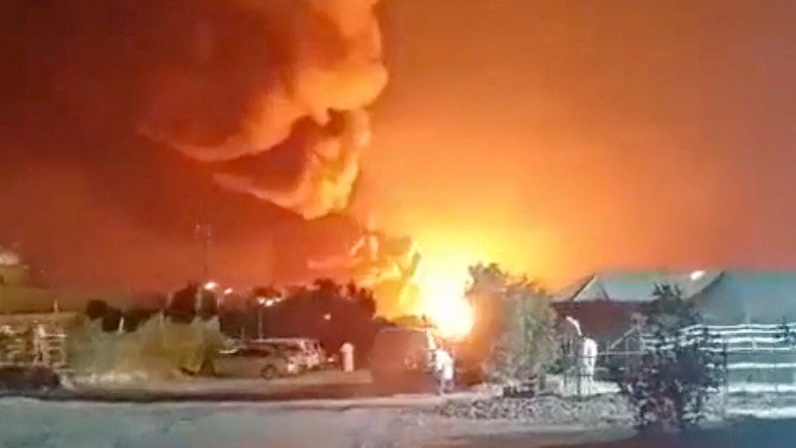
    A sudden and violent fuel tank explosion at a gas station in Oman’s Nizwa Governorate resulted in severe injuries to one individual, according to an official statement released by the Sultanate’s Civil Defence and Ambulance Authority on Saturday, January 24, 2026.

    The incident unfolded without warning as a truck was refueling at the station. Dramatic footage circulated by authorities captures the terrifying moment when the tank erupted, immediately engulfing a nearby man in flames. The video shows the victim desperately running while completely covered in fire.

    Emergency response teams from the Civil Defense and Ambulance Authority Operations Center reacted promptly to distress calls reporting the blast. Medical personnel provided critical on-site treatment before transporting the severely burned victim to a nearby hospital for specialized care. Officials confirmed the injured person received immediate medical attention, though their current condition remains undisclosed.

    While the exact cause of the explosion remains under investigation, the incident highlights the potential dangers present at fuel stations and the critical importance of safety protocols during refueling operations. The Omani authorities have launched a full investigation to determine the precise circumstances that led to this tragic accident.

    The Nizwa Governorate, located in northern Oman, is a historically significant region that now faces scrutiny regarding industrial safety standards following this alarming incident. This event serves as a stark reminder of the inherent risks associated with flammable materials and the necessity for rigorous safety measures in handling petroleum products.

  • The last two pandas in Japan are leaving for China as ties are strained

    The last two pandas in Japan are leaving for China as ties are strained

    TOKYO — Japan’s iconic panda era concluded Sunday as thousands of admirers gathered at Tokyo’s Ueno Zoo for the final viewing of twin pandas Xiao Xiao and Lei Lei before their repatriation to China on Tuesday. This departure marks Japan’s first panda-free period in fifty years, with dim prospects for replacement amid deteriorating Sino-Japanese relations.

    The pandas’ lineage traces to 1972, when China gifted the first bears to commemorate diplomatic normalization between the historically wary neighbors. These charismatic black-and-white ambassadors instantly captivated Japanese society, with twelve subsequent pandas achieving celebrity status. The current twins, born at Ueno in 2021, have drawn massive crowds despite strict one-minute viewing limits, with visitors documenting their bamboo-feeding sessions and leisurely movements.

    China maintains ownership of all pandas loaned internationally, including offspring born abroad. When questioned about future panda exchanges, Chinese Foreign Ministry spokesperson Guo Jiakun stated: ‘Giant pandas are loved by many in Japan, and we welcome Japanese friends to come visit them in China.’

    The emotional impact is profound for devotees like web engineer Takahiro Takauji, who has taken over 10 million panda photographs across fifteen years of daily zoo visits. ‘I never imagined there would come a day when pandas would be gone from Japan,’ expressed Takauji, who considers the twins ‘like my own children.’ His meticulously maintained blog ‘Every Day Pandas’ chronicles this extraordinary dedication.

    This diplomatic rift reflects broader tensions between Asia’s largest economies. Recent remarks by Japanese Prime Minister Sanae Takaichi regarding potential intervention in Taiwan-related scenarios angered Beijing, exacerbating existing territorial disputes in the East China Sea. The diplomatic strain is further evidenced by China’s month-long delay in approving a new Japanese consul for Chongqing.

    Panda diplomacy has evolved significantly since its inception. While China initially gifted pandas to Western nations including the United States, France, and Britain during the 1970s normalization period, it transitioned to leasing programs in the 1980s with fees supporting conservation research. Japan has previously experienced politicized panda diplomacy when a post-tsunami panda transfer to Sendai was canceled following 2012 territorial disputes.

    The economic impact is substantial. Kansai University economics professor Katsuhiro Miyamoto estimates annual losses of approximately 20 billion yen ($128 million) for the zoo region, warning that prolonged absence could create ‘tens of billions of yen’ in economic damage. Local merchants like souvenir shop manager Asao Ezure remain hopeful despite concerns, noting ‘Pandas are a symbol of Ueno, a star’ while maintaining panda-themed storefronts in anticipation of their eventual return.