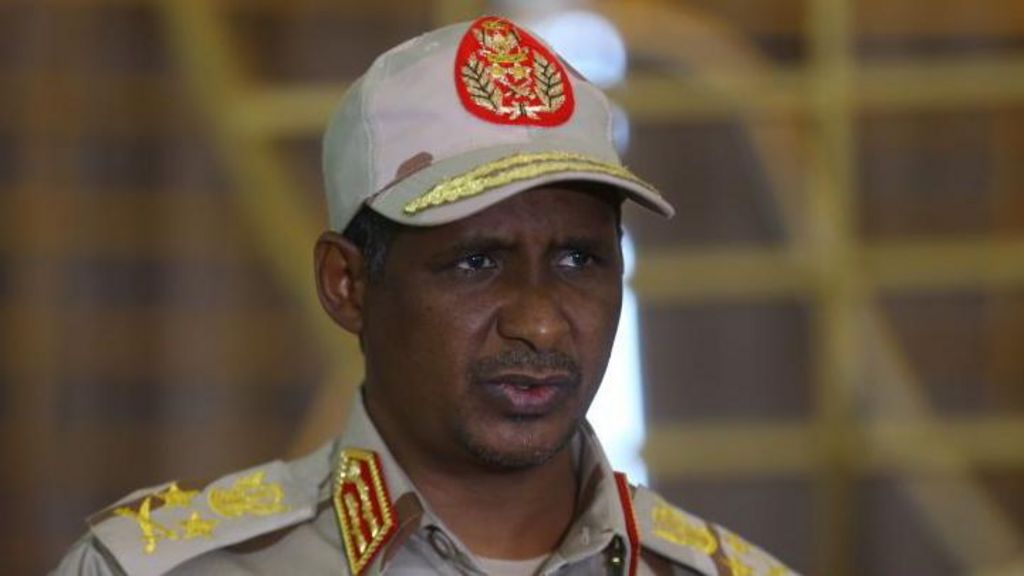
More than two years after Sudan’s brutal civil war erupted between the country’s two most powerful military factions, a Sudanese court operating out of army-controlled Port Sudan has issued a landmark ruling: paramilitary Rapid Support Forces (RSF) leader Mohamed Hamdan Dagalo — widely known as Hemedti — has been sentenced to death in absentia on charges of war crimes, crimes against humanity, and genocide tied to systemic atrocities in West Darfur.
Fifteen other high-ranking RSF commanders received identical death sentences in the ruling, including Hemedti’s brother and deputy Abdelrahim Hamdan Dagalo, a second brother Al-Qoni Hamdan Dagalo, and Abdul Rahman Juma Barkallah, the RSF’s top military commander for West Darfur. The court’s conviction centers on atrocities allegedly carried out in el-Geneina, the capital of West Darfur, most notably the 2023 assassination of West Darfur state governor Khamis Abbakar.
Judges also found all 16 defendants guilty of coordinating broad attacks on civilian populations, large-scale destruction of communities, widespread looting of private and public property, and deliberate targeting of civilian infrastructure including schools, houses of worship, and residential neighborhoods. Beyond the sentences, Special Judge Mohamed Al-Amin ordered the full confiscation of all RSF assets across territory controlled by the Sudanese Army, and formally directed national authorities to request Interpol Red Notices to facilitate the arrest and extradition of all convicted leaders.
As of this ruling, Hemedti’s current location has not been disclosed to the public, and the RSF has not issued any official response to the verdict. The group has repeatedly rejected all claims of war crimes since the conflict began in April 2023.
This conviction marks the first time the RSF’s top leadership has been found criminally liable by a domestic Sudanese court since the civil war began, though the practical impact of the ruling remains highly uncertain. The RSF continues to hold de facto control over large swathes of western Sudan, and its top leadership remains outside the reach of the Sudanese Army and the Port Sudan-based government.
The charges brought against the RSF echo longstanding findings from international investigators and human rights groups. UN investigators and independent watchdog organizations have long accused the RSF and its allied Arab militias of carrying out systematic ethnically targeted violence against the Masalit community, a majority non-Arab group native to Darfur. Earlier in July 2026, the International Criminal Court’s deputy chief prosecutor confirmed the body holds “concrete evidence” directly tying RSF leadership to perpetrated war crimes in the region.
A May 2024 report from Human Rights Watch documented that the RSF’s military campaign in and around el-Geneina between April and November 2023 killed thousands of civilians and forced hundreds of thousands more to flee their homes. The organization concluded that the patterns of abuse documented amounted to war crimes and crimes against humanity carried out as part of a deliberate ethnic cleansing campaign targeting the Masalit and other non-Arab communities across Darfur.
Notably, human rights monitors have confirmed that both factions in Sudan’s conflict have been responsible for widespread human rights abuses and violations of international war law. In a 2025 finding, United Nations investigators concluded that both the Sudanese Army led by Gen Abdel Fattah al-Burhan and the RSF have deliberately targeted civilian populations and critical civilian infrastructure, including medical facilities, in large-scale coordinated attacks.
Sudan’s current civil war erupted in April 2023, triggered by a violent power struggle between army leader al-Burhan and Hemedti, who once shared control of a transitional military government following the 2019 ousting of longtime dictator Omar al-Bashir. The conflict has since become one of the world’s worst humanitarian catastrophes: official estimates place the death toll at more than 150,000, with 12 million people displaced from their homes. International aid organizations warn that 28 million Sudanese currently face acute food insecurity, with millions on the brink of famine.