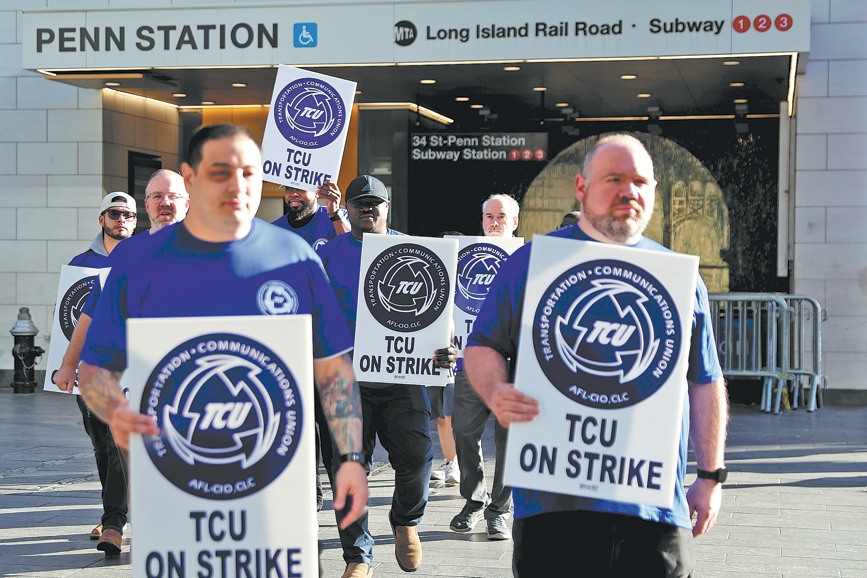
On Saturday, the Long Island Rail Road (LIRR) — the busiest commuter rail system across North America — ground to a complete halt after unionized workers launched a work stoppage, the first major industrial action the line has seen in 30 years.
Shortly after midnight, the entire rail network stopped operating. Five labor unions representing approximately half of the LIRR’s total workforce, totaling more than 3,500 employees ranging from locomotive engineers and signal technicians to ticket clerks, electricians, and machinists, walked off the job after months of stalled contract negotiations with the Metropolitan Transportation Authority (MTA), the public agency that oversees operations of the LIRR.
Negotiations between the two sides have hit an impasse over two core issues: worker wage adjustments and healthcare premium contributions. As of Saturday, no new bargaining sessions have been scheduled, according to Kevin Sexton, national vice-president of the Brotherhood of Locomotive Engineers and Trainmen.
By Saturday afternoon, the LIRR’s central hub, Manhattan’s Penn Station, bore little resemblance to its usual crowded weekend self. The bustling main concourse that normally teems with thousands of daily commuters hosted only a few dozen people, most of whom were transiting through the station to access unaffected Amtrak intercity services. Departure boards that once display upcoming LIRR trips by destination now carry unusual entries for “ghost trains” marked “No Passengers,” while hand-placed signs on locked customer service windows inform travelers of the strike-related shutdown. Barricades and roll-down gates block access to LIRR platforms, with MTA police officers posted to redirect displaced commuters to alternative travel options.
While the shutdown was felt immediately on Saturday, transportation officials and commuters are bracing for far more severe disruption when the workweek begins on Monday. On an average weekday, the LIRR carries nearly 300,000 commuters traveling between New York City and Long Island’s eastern suburbs. Displaced riders will need to rely on limited alternative bus service, which can only accommodate roughly 13,000 passengers during both morning and evening rush hours, or opt to drive into the city, despite ongoing elevated gas prices that already strain household budgets.
Speaking on the picket line outside Penn Station Saturday morning, union member Duane O’Connor acknowledged the widespread inconvenience the strike would impose on ordinary commuters and local communities, but emphasized that workers are only demanding fair compensation. “I feel terrible. Terrible. This is going to hurt. This is going to hurt the island, this is going to hurt the city … All we are asking for is fair wages,” O’Connor said.
This work stoppage marks just the fourth strike in LIRR’s recorded history, and the first since 1994. Previous strikes between 1980 and 1994 lasted anywhere from two to 11 days, leaving uncertainty for commuters who rely on the line for daily travel, as no end to the current shutdown is in sight with no new talks scheduled.