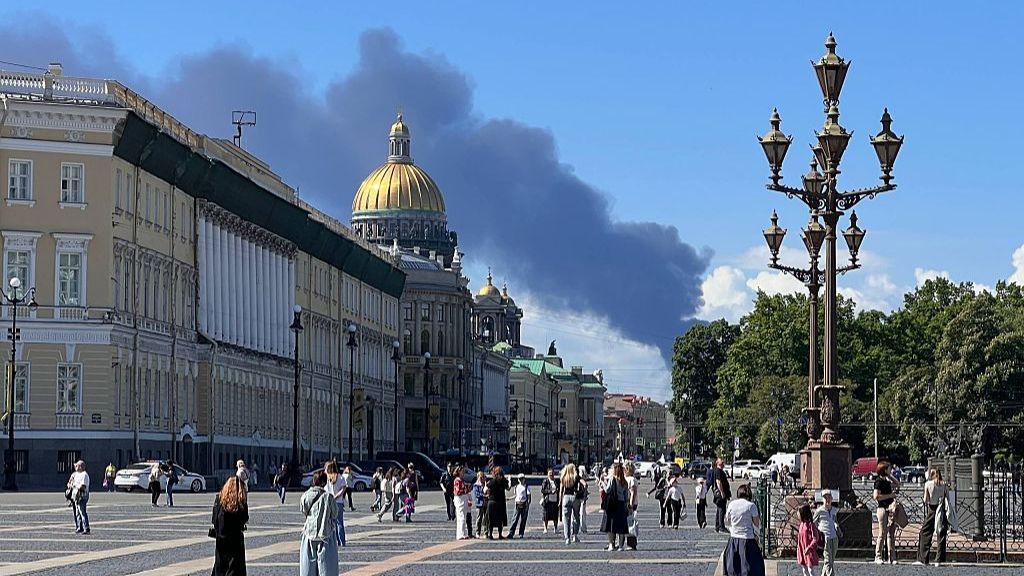
The 2026 St. Petersburg International Economic Forum (SPIEF), Russia’s flagship annual economic and diplomatic event, opened and closed this week against a backdrop of unexpected conflict and high-stakes diplomatic drama that overshadowed the carefully curated image of economic resilience the Kremlin sought to project.
On Wednesday, the opening day of the forum, a massive plume of thick black smoke rose high above the St. Petersburg skyline, visible to every delegate arriving at the city’s waterfront expo center. The smoke came from a Ukrainian drone strike that hit unspecified infrastructure in the area, local officials confirmed, marking a dramatic incursion deep into Russian territory that coincided with the forum’s high-profile sessions. A second drone attack hit the region on the forum’s closing day, amplifying the sense of ongoing vulnerability.
Even amid the chaos of the strikes, the forum played host to the kind of surreal, symbolic moments that underscored the disconnect between the curated narrative inside the conference halls and reality outside. Walking the exhibition floor, attendees encountered a performer dressed as Koshchei the Deathless, the immortal villain from Russian folklore, performing street magic for passersby — pulling coins from thin air, reassembling broken glasses, and generating puffs of smoke from his fingertips. “Russians are unpredictable people,” the performer told onlookers. “We do things no one expects.”
The most shocking unexpected development of the week came not from a street magician, however, but from Kyiv. Shortly after the first drone strike, Ukrainian President Volodymyr Zelensky published an open letter to Russian President Vladimir Putin that included a taunting critique of Russia’s battlefield setbacks and Putin’s age, before extending an offer to meet for face-to-face peace negotiations in a neutral third country.
Putin’s response was anything but unpredictable. The Kremlin leader, who has repeatedly rejected direct talks with Zelensky since the full-scale invasion began, dismissed the offer out of hand, criticizing the letter’s tone as “rude.” “It’s not the author of the letter I need to respond to,” Putin said during his plenary address at SPIEF. “It’s our soldiers on the frontline… I say to them: keep at it, brothers!” The comment made clear that Putin has no intention of ending the war on any terms other than Russia’s full compliance with his original demands.
In his address to assembled delegates, Putin stuck to a familiar script, projecting unwavering confidence and projecting strength. “There are wars and sanctions. But the economy is developing,” he claimed. “Everything is stable.” Inside the conference hall, surrounded by supportive business owners, allied foreign dignitaries, and government officials, the performance held together. Outside the bubble of the forum, however, a different picture emerges.
Russia has now been at war for five years, sustaining massive battlefield casualties that have strained both the country’s military and its domestic population. Ukrainian long-range drones now regularly strike targets hundreds of kilometers inside Russia’s borders, including major cities far from the front lines. When the outlet asked senior Russian officials about the war and its trajectory, nearly all fell back on pre-approved Kremlin talking points. When asked whether the five-year-long conflict would end soon, Alexander Zhukov, deputy speaker of Russia’s lower parliament the Duma, simply replied: “I can only respond in the words of our president. He said this situation must be resolved soon.”
Economically, the country is far from the stable, growing powerhouse Putin described. While outright collapse has not materialized, as many Western analysts initially predicted, ongoing sanctions and war spending have created significant strain across most sectors. Growth has stalled, and many independent Russian economists warn of broad stagnation and even decline in key industries. The war continues to suck up massive amounts of both human capital and federal budget resources. During a recent reporting trip to Russia’s Lipetsk region, small business owners described ongoing struggles to stay operational amid restricted access to global markets and supply chain disruptions.
Even some pro-business Russian figures acknowledged the headwinds. “Interest rates are a bit too high,” Kirill Dmitriev, Putin’s special envoy for foreign investment, admitted in an interview on the SPIEF sidelines. “We believe rates should be lower to attract more investments.” Still, Dmitriev pushed back on critics, arguing that “Russia’s economy has proved resilient over the last five years: something that many Western analysts believed was impossible.” A small number of domestic businesses have even found new openings amid the shifts: as international travel has become difficult and unwelcoming for most Russians, domestic tourism has grown, prompting new investment in domestic resort and tourist infrastructure.
Unlike the stage magician performing at the forum, the Kremlin cannot conjure new revenue out of thin air to close growing budget gaps created by war spending. It did, however, manage to attract a high-profile American guest that it leveraged for PR. Rodney Mims Cook Jr, chair of the U.S. Commission of Fine Arts who is overseeing the controversial renovation of the White House State Ballroom, brought a personal greeting from former U.S. President Donald Trump to Putin. Russian state media trumpeted his visit as the first official U.S. delegation to attend SPIEF in a decade. But the U.S. State Department quickly distanced itself from the visit: U.S. Secretary of State Marco Rubio said he was unaware of any official U.S. delegation attending the event, and noted the attendees were not high-ranking government officials.
Wandering the forum’s exhibition halls, one of the most striking installations was a giant “nevalyashka” — the traditional Russian roly-poly tumbler doll that wobbles when pushed but never falls over. The installation perfectly summed up the narrative Russian authorities want to project to the world: that despite five years of war and sweeping international sanctions, Russia remains standing, cannot be knocked off balance, and will outlast its opponents. It is a deliberately defiant image. But for foreign investors looking for stable, long-term opportunities to put capital to work, the constant wobbling that comes from ongoing conflict and geopolitical isolation is unlikely to make for an appealing sales pitch.