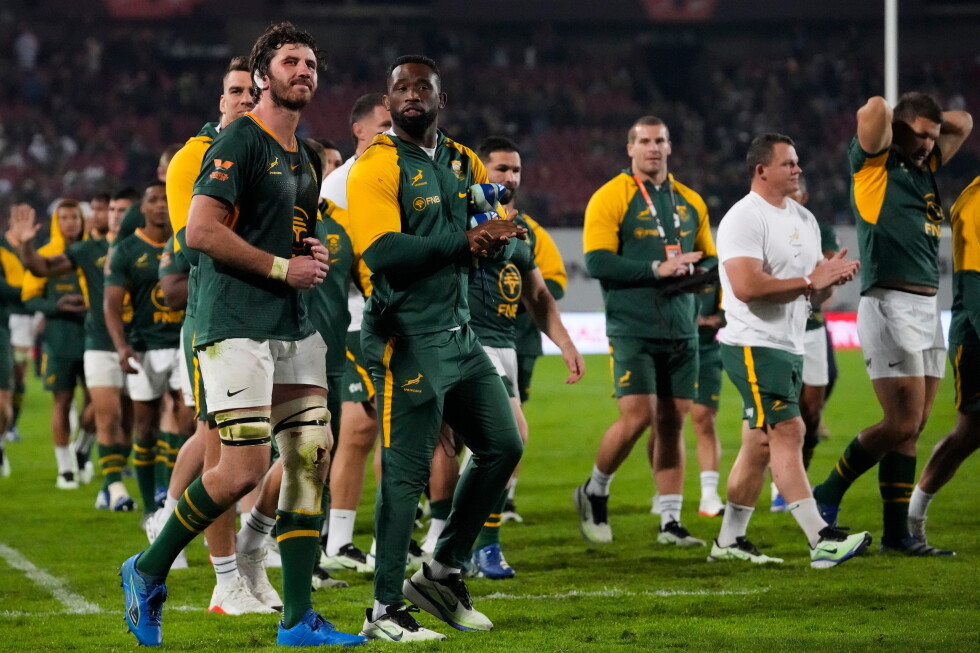
JOHANNESBURG – For the first time in nearly 12 months, South Africa’s world-famous Springboks have dropped from the top of global men’s rugby rankings, ceding the number one spot to New Zealand’s All Blacks after a lopsided 33-16 upset victory in the opening match of their four-test series last Saturday. The defeat marked South Africa’s heaviest home loss to New Zealand at Ellis Park in recent memory, and has turned this coming Saturday’s second test in Cape Town into a do-or-die fixture for the two-time world champions, who entered the series as heavy favorites and cannot afford a second defeat if they hope to claim the series title.
In response to the disappointing opening result, head coach Rassie Erasmus announced four key changes to the Springboks starting XV on Monday – the smallest number of starting lineup adjustments he has made all year – alongside five new additions to the reserve bench.
The only potential change to the forward pack comes down to captain Siya Kolisi’s fitness: Kolisi is bracketed alongside breakout star Paul de Villiers, after missing nearly all game time over the past two months with dual hamstring injuries. If Kolisi proves he can withstand full training this week, he will retain his starting spot and captaincy. Handré Pollard and Cobus Reinach will step into the starting half-back positions, while winger Ethan Hooker will replace injured star Cheslin Kolbe, who is sidelined with combined hamstring and ankle issues.
The reserve bench has been restructured to a 6-2 split, bringing in hooker utility Deon Fourie, prop Thomas du Toit, lock Lood de Jager, flanker Cameron Hanekom, and scrumhalf Morné van den Berg. All players except Fourie previously featured in South Africa’s 17-10 win over Argentina on August 8.
Reflecting on the opening test defeat, Erasmus acknowledged that most of the team’s struggles were self-inflicted. The Springboks dominated scrums, line-out mauls, and aerial play for the first 60 minutes of the match, but failed to convert their numerous scoring opportunities into points, while the All Blacks capitalized on every small chance they created – a hallmark of New Zealand rugby that has defined the side for decades.
“Most of the things we inflicted on ourselves, and that’s frustrating,” Erasmus said. “We’ve got a big hiding of 17 points. When they got two or three opportunities, like New Zealand most of the years in the past, they converted.”
Erasmus added that the reserve bench failed to deliver the impact he had anticipated, a problem rooted in the starters’ unfulfilled chances rather than the replacements’ performance. “Our plans didn’t work, and that’s on me,” he said. “We as coaches didn’t give those guys the platform to actually go on and finish those things. They had to chase the game from the start.”
On the topic of Kolisi’s potential return, Erasmus noted that de Villiers – who earned his first four test caps in Kolisi’s absence and turned in a strong performance in the first test – has earned his place in the squad, but the veteran captain’s all-round skill set addresses key gaps the Springboks displayed last Saturday. Specifically, Erasmus highlighted Kolisi’s ability to secure quick ball from breakdowns in attacking positions and organize the team’s defensive line alongside Pieter-Steph du Toit – two areas where the Springboks struggled against the All Blacks.
“Paul played well on Saturday and there’s no reason why we should keep him out,” Erasmus said. “But Siya is our captain… There were lots of times that we played badly, not because they did anything illegal, but we couldn’t get the ball away out of the breakdown when we were in really good attacking positions. Siya’s really good at that.”
If Kolisi is cleared to play, the Springboks will field their most experienced starting lineup in test history, with a combined 1,012 test caps across the side, including four players with more than 100 caps: Kolisi, caps record-holder Eben Etzebeth, Damian de Allende, and stand-in captain Pieter-Steph du Toit. Du Toit, a two-time World Player of the Year, will earn his 100th test cap on Saturday, making him just the 11th Springbok in history to reach the milestone, 11 years after his 2013 test debut.
Erasmus also explained his decision to recall Pollard to the starting flyhalf position, after rotating the position throughout the year. Pollard, who kicked South Africa to World Cup victories in both 2019 and 2023, brings a more conservative, strategic game than the dropped Manie Libbok and first test starter Sacha Feinberg-Mngomezulu, with elite game management and tactical kicking that Erasmus views as critical for turning the series around.
“Handré has delivered for us under extreme pressure,” Erasmus said.
The reshuffled squad also marks a fairy-tale recall for Deon Fourie, who earned his spot after an impressive performance for the Stormers on New Zealand’s earlier tour, returning to the Springboks after two years of constant injury setbacks. Fourie last earned a test cap in the 2023 World Cup final against New Zealand, and if he takes the field on Saturday, he will become the oldest test player in Springbok history at 39, surpassing former legends Victor Matfield and Schalk Brits.
In addition to Kolbe, South Africa will be without four other injured players: scrumhalf Grant Williams (ankle), utility back Canan Moodie (hamstring), and flanker Ben-Jason Dixon (concussion).
New Zealand, who claimed the number one ranking following their opening test win, will name their matchday squad on Thursday, and are set to play a friendly tour match against the Lions club at Ellis Park on Tuesday ahead of the second test.
Following the heavy defeat, Erasmus says the squad has already regrouped to address the flaws that cost them the opening match, and is focused on bouncing back to keep their series hopes alive. “One could see the hurt on everyone’s faces after Saturday’s match, and we know what we have to do to bounce back strongly this week,” he said. “We have regrouped and identified the areas of our game we need to fix.”