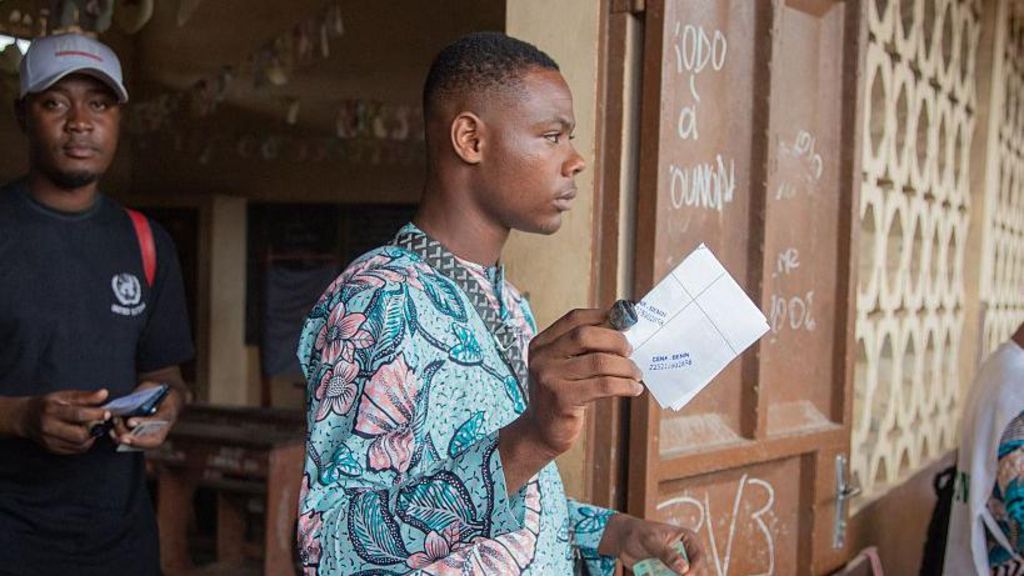
As Benin prepares for a pivotal presidential election on Sunday, the entire campaign season has been overshadowed by growing alarm over the expansion of a violent Islamist insurgency that has already destabilized much of West Africa, turning this once largely peaceful nation into the conflict’s latest front line.
The vote comes just four months after outgoing two-term President Patrice Talon survived a coordinated coup attempt, a crisis that was only averted when regional power Nigeria deployed warplanes to target mutinous soldiers plotting to overthrow his civilian government. Nigeria’s swift intervention stopped Benin from following the trajectory of neighboring Niger, Burkina Faso and Mali, all of which have fallen to military takeovers in recent years amid widespread public anger over civilian governments’ failure to counter al-Qaeda and Islamic State-affiliated militant groups.
Benin’s own vulnerability to the insurgency was underscored in late March, when fighters from Jama’a Nusrat al-Islam wal-Muslimin (JNIM), an al-Qaeda affiliate, killed 15 Beninese soldiers in a raid on a military outpost in Kofouno, near the Niger border. The attack continued a deadly pattern that emerged in 2025: that January, 28 soldiers died in an assault on W National Park, a vast protected reserve that spans Benin, Niger and Burkina Faso, and a further 54 troops were killed in the same area just three months later, marking the deadliest single string of losses for Benin’s military at the hands of insurgents.
W National Park, along with adjacent Pendjari and Arly Parks, forms West Africa’s largest contiguous protected wilderness, covering more than 1.7 million hectares of dense forest. Combined with the region’s highly porous international borders, the terrain provides ideal cover for militants to establish hidden bases and cross between countries undetected by security forces.
According to the Armed Conflict Location & Event Data Project (Acled), a violence monitoring organization, attacks in the border triangle linking Niger, Benin and Nigeria have spiked dramatically over the past 18 months, turning once-quiet remote transit routes into active conflict zones. Acled data shows that at least 1,000 people were killed in this border region in 2025, more than double the death toll recorded in 2024.
The rising violence has spread fear and disruption among local communities, who now worry their country could face the same level of devastation that neighboring Nigeria has endured from decades of Boko Haram insurgency. “We only want to work, to educate the youth, but it’s becoming so difficult,” a local school teacher told the BBC. “We can’t imagine our country becoming like Nigeria with Boko Haram’s threats, which has killed so many people.” A mother of one added: “We are afraid to go to the fields. I don’t know what to do, where to go. Anytime, those guys could come here and rape us, steal our stuff or kill us. It’s not easy. Benin doesn’t deserve this. The youth don’t deserve this.”
Heading into Sunday’s vote, the race for the presidency is a two-candidate contest between Romuald Wadagni, the 49-year-old incumbent finance minister and ruling coalition candidate who is currently the poll front-runner, and 56-year-old challenger Paul Hounkpè, a former culture minister.
In a bid to ease voter anxieties over security, Wadagni opened his campaign in March in Kandi, a key trade hub near the Niger-Nigeria border, before touring other violence-hit northern localities including Banikoara and Ségbana. Addressing thousands of cheering supporters, he pledged to make the safety of all Beninese citizens a non-negotiable daily priority if elected. “We will not let any dark forces come and take our lands or threaten citizens,” Wadagni said. “We will make sure our whole country is under protection.”
Hounkpè, who launched his campaign from Benin’s economic capital Cotonou, has echoed the focus on security while calling for a major shift in regional diplomacy. “We must join forces with our neighbours without losing our dignity,” he said. “Benin cannot act alone, close cooperation with Niger and Burkina Faso is essential.”
Hounkpè’s call for detente carries particular weight, as relations between Benin and the coup-ruled military governments of Niger and Burkina Faso have collapsed since 2023. Benin is a member of the Economic Community of West African States (ECOWAS), which suspended the membership of the three coup-hit nations and initially threatened military intervention to restore civilian rule in Niger. In response, the three military-led states formed a separate political alliance, reoriented their foreign policy toward Russia, and accused ECOWAS of acting as a proxy for Western powers – a claim the regional bloc denies.
While Wadagni has also signaled openness to improving ties with the military governments, he is widely viewed as closer to Western powers than Hounkpè. Relations between Benin and Niger, currently led by Gen Abdourahmane Tiani, are particularly strained: Niger has kept its border with Benin closed since Tiani seized power in 2023, citing what it calls “hostile manoeuvres” originating from Benin’s territory, a charge Talon’s outgoing government rejects.
The election comes as Talon steps down after completing two full terms in office. His supporters argue he has preserved Benin’s standing as a stable civilian democracy, a key distinction at a time when military leaders in the region such as Burkina Faso’s Capt Ibrahim Traoré have publicly argued that democracy “kills” and that populations must abandon democratic governance. But Talon’s critics say democratic institutions have eroded during his tenure, pointing to changes to electoral and party registration laws that have drastically reduced opposition participation in national politics.
The new rules led to the main opposition bloc, The Democrats, being completely shut out of all seats in January’s parliamentary elections. The party’s intended presidential candidate was also disqualified from Sunday’s vote, after failing to secure the required number of candidate sponsorships. In a recent analysis, the South Africa-based Institute for Security Studies noted that Hounkpè’s qualification for the race was only possible through a political arrangement with the ruling coalition, which provided the sponsorship signatures he needed to meet legal requirements.
With the main opposition excluded from the contest, many high-profile Democrats have thrown their support behind front-runner Wadagni, a move widely seen as a pragmatic bet on his likely victory and expectation of future government posts. Hounkpè, however, remains confident he can pull off an electoral upset, framing himself as the candidate of real change for Benin.
Regardless of which candidate claims victory on Sunday, most Beninese voters are anticipating a peaceful transfer of power, and share the same core hope: that the new administration will make greater progress repairing strained regional relations and rolling back the insurgency that has brought growing violence and uncertainty to the country’s northern borderlands.