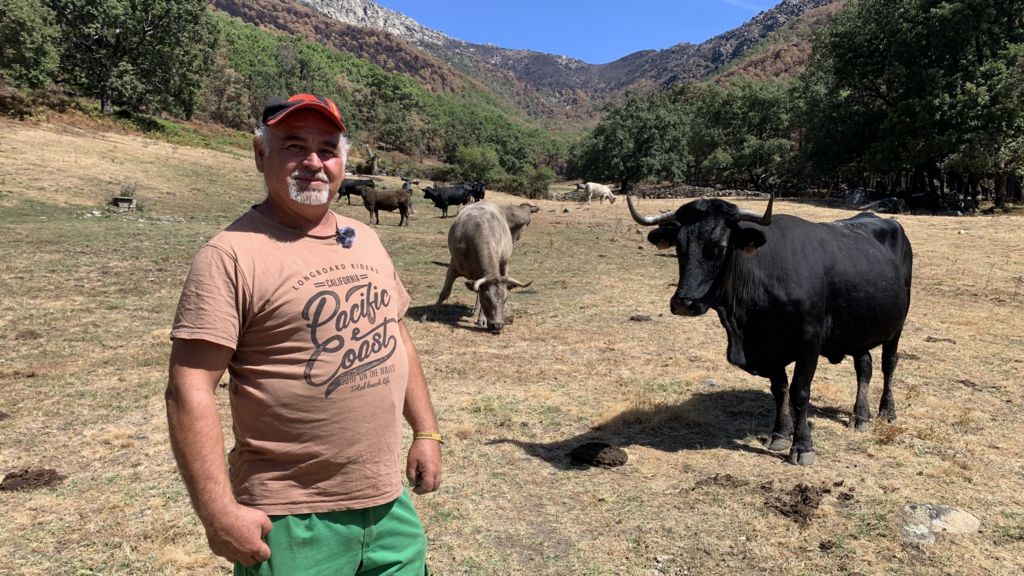
High in the Gredos Mountains, just a few hours west of Madrid, Juan Ángel Izquierdo’s cattle graze quietly on a small, sunlit meadow, the only sound the soft clinking of bells around their necks. The peace of this scene, however, is shattered by a grim, visible reminder of disaster: charred, blackened trunks of pine and oak trees stretch as far as the eye can see, the lingering mark of the largest wildfire ever recorded in Spanish history. For Izquierdo, whose family has tended livestock and farmed this land for two centuries, the fire that swept through the region in late July was an event unlike any he had ever experienced.
The blaze merged with two smaller nearby wildfires to consume nearly 80,000 hectares of land – an area roughly equal to 200,000 acres. By the time the flames were extinguished, more than two-thirds of Izquierdo’s property had burned to ash. Twelve of his 85 cows were killed, and eight additional injured animals had to be euthanized. Worse still, the entire stock of hay he had harvested to feed his herd through the winter was destroyed, leaving the farmer facing an uncertain future. Like many of his peers across the country, Izquierdo has watched seasonal conditions shift drastically in recent years, and growing anxiety has become a constant part of rural life. “For us farmers, summers are getting more and more worrying every year,” he explained. “They are hotter, we get less rain, the wet season ends earlier, and autumn starts much later. Those conditions are just a tinderbox waiting for a fire.” Even when there are no active blazes nearby, the fear never fully fades: “If you don’t think about it, you can feel okay, but as soon as a fire starts in a neighboring village, you start asking: are we next?”
Izquierdo’s struggle is just one example of the far-reaching damage climate change is inflicting on Spain. Wildfires, droughts, extreme heat, and catastrophic flash flooding have become increasingly common across the country in recent years, leaving thousands of livelihoods damaged or destroyed and threatening the stability of Spain’s most important economic sectors. A new analysis from the international research collective World Weather Attribution confirms that the record-breaking extreme conditions that fueled the 2025 wildfire season across Spain and Portugal are now 40 times more likely to occur than they were before anthropogenic climate change warmed the planet. Ernesto Rodríguez Camino, president of the Spanish Meteorology Association, emphasized that human activity is at the root of the growing crisis: “The main reason we are seeing more frequent and more intense wildfires is the rising concentration of greenhouse gases in the atmosphere, driven primarily by the widespread burning of fossil fuels.”
Spanish Prime Minister Pedro Sánchez, leader of the country’s Socialist government, has framed the ongoing environmental emergency as an existential threat, noting that Spain sits on the front lines of the global climate crisis. “The climate emergency kills,” Sánchez said during a July visit to the southern province of Almería, where a separate wildfire claimed the lives of 15 people. Data from the European Forest Fire Information System (EFFIS) underscores the severity of this year’s wildfire season: roughly 300,000 hectares of Spanish land have burned so far in 2026, accounting for nearly half of all burned area across the entire European Union. Over the past four decades, annual wildfire damage has exceeded 200,000 hectares just eight times – and three of those events have occurred since 2022.
Beyond the immediate human and ecological cost, the damage to Spain’s critical agri-food sector has been staggering. By mid-August, farming insurance group Agroseguro estimated that roughly 16,000 hectares of crops had been destroyed by wildfires, delivering a major blow to an industry that contributes 9% of Spain’s total GDP. Regional authorities in Castilla y León, the area hardest hit by this year’s massive Gredos wildfire, have launched a compensation program offering between €5,500 and €25,000 to individual farmers based on their total losses. But for Izquierdo, the payout will barely make a dent: he estimates it will cover less than half of what he has lost.
Climate change is now also threatening Spain’s most economically important industry: tourism. For decades, the country’s reliably warm, sunny weather has been one of its biggest draws, turning Mediterranean coastal resorts and the Balearic and Canary Islands into global tourist hotspots and driving decades of steady economic growth. This year, Spain is on track to welcome nearly 100 million international visitors, retaining its position as the second most visited country in the world, behind only France. But growing numbers of travelers are now being deterred by extreme heat that makes summer travel uncomfortable and even dangerous. A recent study from researchers at Madrid’s Rey Juan Carlos University confirmed that repeated heatwaves are acting as a major deterrent for potential visitors. “When a heatwave hits, we see a clear drop in overnight stays at the destinations we studied, and there is also a decline in arrivals from some of Spain’s largest tourist markets,” said María Dolores Sánchez, an economist and co-author of the study. With tourism accounting for 13% of Spain’s total GDP, Sánchez noted that the trend could have serious long-term consequences for the country’s economic competitiveness.
Toledo, a medieval inland city famous for its historic architecture and cultural heritage, has already experienced this shift firsthand. This summer, Spain recorded 61 straight days of heatwave conditions that stretched into early September, and Toledo repeatedly saw temperatures climb above 40°C. “It is really difficult to lead walking tours in that kind of heat,” said Diego Esteban, a tour guide with local operator Visit Toledo. “Everyone who works in tourism, and all local residents, have to adapt to these new conditions.” Esteban now builds frequent water breaks and shaded stops into all his summer itineraries, but he says more public infrastructure – from shaded rest areas to public drinking fountains – is needed to accommodate visitors. The extreme heat has already reshaped the local tourist calendar, with far more visitors now choosing to visit during the cooler spring and autumn months rather than summer. Warmer summers have also spurred the rise of the “coolcation” trend among domestic travelers, who are increasingly choosing cooler northern Spanish regions for their holidays instead of the hotter southern and coastal destinations that have long been popular.
Wildfires and extreme heat are not the only climate-related disasters Spain has faced in recent years. After three straight years of below-average rainfall, the northeastern region of Catalonia was forced to implement strict water use restrictions in 2024, including a 25% cut in water allocations for industry and an 80% cut for agricultural production. While heavy rainfall in the months that followed lifted the restrictions, the drought still caused major damage to the regional economy. The deadliest climate event in recent Spanish history came in October 2024, when catastrophic flash floods hit the eastern Valencian region, killing 237 people. Spanish climate research group Climatoc-Lab described the disaster as a clear example of how global warming is altering global hydrological cycles and increasing the risk of extreme rainfall events. The Valencia Chamber of Commerce estimated the floods caused €4.5 billion in direct damage, with thousands of businesses impacted – some completely washed away, and others facing months of recovery before they could reopen. “It was a disaster on every level,” said Laura Llácer Álvarez, manager of the Fepeval industrial park federation in Valencia. “We lost hundreds of lives, and the damage to businesses, workers, and ordinary people was incalculable.”
Experts note that Spain’s unique geography, topography, and location leave it unusually vulnerable to the impacts of rising global temperatures. In 2024, independent environmental organization Germanwatch ranked Spain as the 20th most climate-vulnerable country in the world, placed just behind Nigeria and Mali on its global Climate Risk Index. Despite these grim challenges, some economic analysts see potential opportunities in the transition to a low-carbon economy. Julián Cubero, head of climate change economics at leading Spanish think tank BBVA Research, acknowledged that rising heat already acts as a drag on economic output: “We all work less effectively when it is extremely hot,” he explained. But Cubero added that a deliberate transition to a greener economy can create new, higher-productivity jobs for Spanish workers. “The key takeaway is that if we fail to act, economic growth will slow down,” he said. “But if we manage the transition correctly, it can become a major opportunity for the country.”