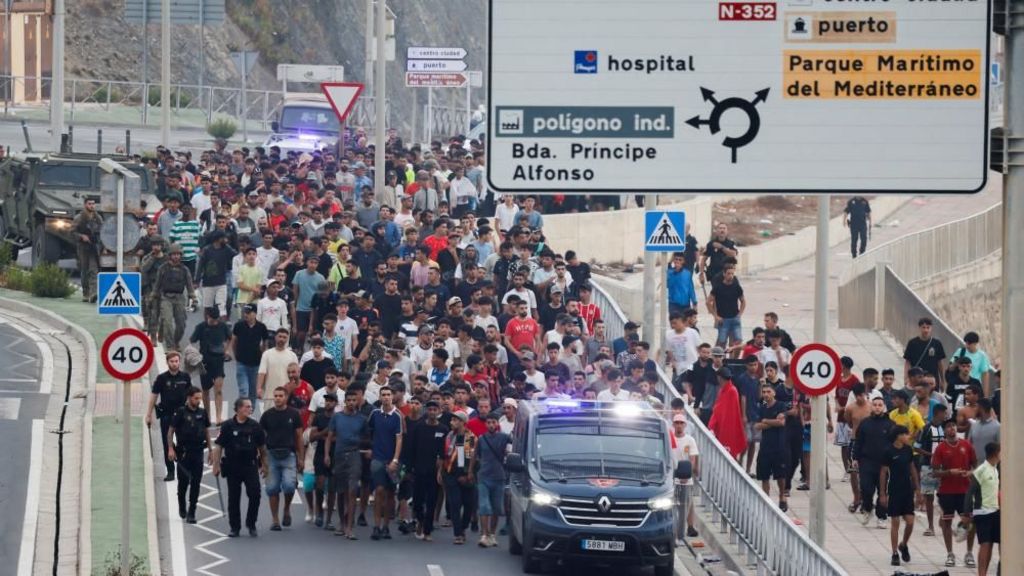
A sudden mass influx of roughly 60,000 migrants into the Spanish North African enclave of Ceuta has sparked deep political rifts across the European Union, with Madrid publicly condemning the harsh, unilateral actions of several member states as selfish, polarizing and unlawful. The crisis, which unfolded on July 30 when thousands of migrants crossed into Ceuta from Morocco, has already claimed at least 67 lives, Spain’s Interior Minister Fernando Grande-Marlaska confirmed Saturday. By the time of his announcement, local authorities had nearly resolved the on-the-ground emergency, with almost all of the migrants escorted back across the border and daily life in Ceuta resuming, including the reopening of local businesses. In response to the crisis, Spain has also begun deploying an inflatable maritime barrier to block future unauthorized crossings and reinforced security at its second North African enclave, Melilla, which saw smaller-scale crossing attempts.
Within 48 hours of the initial surge, the Spanish government announced it had fully resecured the Ceuta border and prevented any unapproved movement of migrants toward continental Europe, a fact later confirmed by EU officials who noted no irregular arrivals had reached mainland EU territory. Despite this rapid containment, several EU member states moved quickly to implement punitive measures against Spain. Italy, led by Prime Minister Giorgia Meloni, announced a 30-day temporary suspension of its participation in the EU’s Schengen open border arrangement with Spain, labeling the scenes of the migrant influx “shocking” and framing uncontrolled migration as a threat to European national security. Finland and Denmark quickly threw their support behind Italy’s action, with Czech Prime Minister Andrej Babiš going a step further to call for a full temporary suspension of Spain’s Schengen membership. Other states, including France and Portugal, moved to tighten internal border checks with Spain in response to the crisis.
Spanish Prime Minister Pedro Sánchez has pushed back fiercely against these actions in an open letter to European Commission President Ursula von der Leyen, pointing out that Ceuta has never been part of the Schengen open border area, making the unilateral border suspensions legally unfounded. Sánchez accused the dissenting governments of acting out of prejudice, misinformation, domestic political opportunism and ignorance, rather than a commitment to European collective responsibility. “While most member states have extended support and solidarity to Spain during this crisis, others have chosen to launch unprovoked attacks,” he wrote, adding that “the European Union cannot afford this kind of selfish, polarising and unlawful reaction.” The Spanish prime minister called for an urgent meeting of EU interior ministers to reaffirm a core principle of the bloc: security of the EU’s external borders is a shared responsibility of all member states, not just the frontline states that share direct land or sea borders with third countries.
The call for coordinated talks has gained broad traction across the bloc, with 22 of the EU’s 27 member states signing an open letter calling for emergency video conference talks to address the crisis. The group welcomed the ongoing cooperation between Spain and Morocco to facilitate the swift return of migrants, and argued that coordinated action is needed to mobilize existing EU funding and support instruments to help Spain maintain full border control and prevent future uncontrolled crossings. Von der Leyen has echoed criticism of the crisis, stating publicly that images from Ceuta were “unacceptable” and that “we cannot allow anyone to come to our Union without abiding by our rules.” German Chancellor Friedrich Merz also supported Spain’s border security efforts while demanding Morocco immediately take responsibility for accepting returned irregular migrants.
Outside the EU, the crisis drew sharp comment from the United States, where the State Department framed the incident as a direct consequence of Spain’s liberal immigration policies. Former President Donald Trump labeled the situation a “catastrophe”, falsely claiming it amounted to an “invasion” of hundreds of thousands of people, even though the actual number of arrivals was roughly 60,000, almost all of whom have been returned.
Spanish authorities have laid blame for the crisis on human trafficking gangs, who exploited a recent Spanish Supreme Court ruling to encourage mass crossings. In June 2026, the court ruled that migrants intercepted at sea attempting to reach Ceuta and Melilla could not be summarily returned to Morocco without full due process. Traffickers spread misleading interpretations of this ruling across social media, sparking the coordinated mass surge, Sánchez explained. He added that Moroccan authorities have been cooperating closely with Spain to resolve the crisis, despite longstanding diplomatic tensions over the two enclaves.
Ceuta and Melilla, Spain’s two North African enclaves, form the only land border between the EU and Africa, making them a persistent flashpoint for irregular migration attempts by people seeking entry to the bloc. Migrants often cross by swimming several kilometers from Moroccan territory into Ceuta, and surges are common during the summer months, with crossings frequently organized via social media. The 2026 surge is by far the largest on record, dwarfing the 8,000 arrivals that sparked a 2021 diplomatic crisis between Spain and Morocco.
Underlying demographic and economic pressures in Morocco have also contributed to the continued push for migration: the country faces persistent high youth unemployment, and saw widespread anti-government protests led by Gen Z activists in 2025, with demonstrators demanding better economic opportunities and improved public services. The current crisis also comes amid longstanding tensions over Spanish migration policy: earlier in 2026, the Spanish government approved a major regularization program granting legal status to 500,000 undocumented migrants already residing in Spain, allowing them to integrate into the formal workforce. Meloni, the right-wing Italian prime minister, criticized the policy at the time, claiming it would create spillover impacts for Spain’s neighboring countries. Just one month before the Ceuta crisis, the European Parliament approved a new set of stricter EU-wide migration rules granting broader powers to authorities to return irregular arrivals to their origin countries.