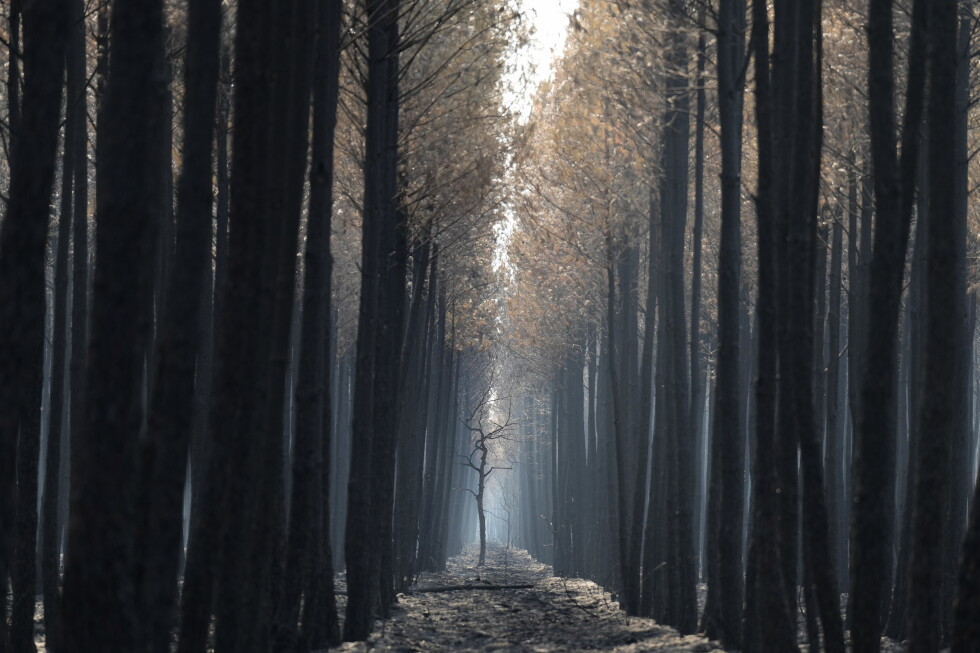
As climate change continues to push Europe’s temperatures well above global averages, a patchwork of progress and crisis has emerged across the continent’s wildfire response: while firefighters successfully corralled a massive blaze in southwestern France’s Gironde region that triggered France’s largest ever peacetime evacuation, fast-flaring new fires have displaced thousands more in southern France and coastal Greece.
After days of intense containment work, firefighters announced Saturday that the Gironde wildfire, which has already consumed 420 square kilometers of pine forest west of Bordeaux — an area four times the size of Paris — had been held within its existing perimeter, allowing roughly 198,000 evacuated residents and tourists to return to their properties. The blaze is not yet fully extinguished, however: active burning sectors and deep-buried hot spots remain across 240 kilometers of fire edge, and crews have spent nights conducting controlled tactical burns to clear remaining fuel and prevent the fire from spreading beyond containment lines.
The popular, upscale Cap Ferret peninsula remains under full evacuation order, a precautionary measure driven by its limited road infrastructure. Officials warn that a flare-up of a nearby hot spot could quickly cut off escape routes, trapping anyone who returns. “Today, the fire is still not fixed. It is contained,” Lieutenant Colonel Eric Pitault explained to reporters on Saturday. The ecological toll of the blaze has already extended far beyond human settlements: Allain Bougrain-Dubourg, president of France’s League for the Protection of Birds, estimates millions of wild animals have been displaced or killed by the fire.
Just hundreds of kilometers away in France’s Mediterranean Var department, a blaze that officials had already declared fully extinguished earlier this week roared back to life on Friday, spreading across 10 square kilometers of dry brush in just six hours — a pace Var’s prefecture described as “faster than a horse at full gallop.” The sudden resurgence, which Var Prefect Simon Babre called “defies understanding,” consumed an additional 1,250 hectares of land in a matter of hours, erasing days of hard-won progress in a single afternoon. As of Saturday, defensive lines protecting at-risk communities held and no additional land had burned, but the fire remains active. Some 2,500 people are still displaced, and 1,300 firefighters remain deployed to the site. Across France Saturday, 20 departments were under orange heat warnings, most concentrated in the east and southeast, with temperatures forecast to hit 35 to 39 Celsius near the Mediterranean, and eight departments categorized as facing high wildfire risk.
Across the Ionian Sea in Greece, strong gale-force winds have driven a fast-moving wildfire through the popular coastal resort of Porto Germeno, located on the Gulf of Corinth between Athens and Thebes. The blaze ignited Friday near the village of Agios Vasileios, and winds reaching speeds of 55 miles per hour pushed flames through dry vegetation quickly, forcing around 300 people to be evacuated by sea, with additional evacuation orders issued Saturday. Wildfire meteorologist Theodore Giannaros of the National Observatory of Athens called the level of damage “inconceivable,” and estimated 40 to 50 square kilometers of land has already burned, though official figures have not yet been released by Greek authorities.
Officials have reinforced response efforts, bringing total deployment to 420 firefighters, 20 specialized forest fire teams, 19 fixed-wing aircraft and 11 helicopters. Multiple homes have been confirmed destroyed, but full damage assessments are still underway. Strong winds continue to complicate response efforts, making it too dangerous for aircraft to conduct water drops in high-risk areas. Greece’s fire service reported crews battled 73 separate blazes across the country on Friday alone, and the Athens region and parts of Evia island were placed under the highest possible wildfire alert level Saturday.
Across the Iberian peninsula, the scale of displacement is even larger: at the peak of this summer’s fire season, wildfires in France and Spain combined have forced more than 330,000 people to flee their homes and vacation sites, stretching firefighting, aerial and emergency response resources thin across multiple simultaneous crises. Climate scientists have repeatedly warned that this season’s extreme wildfire activity is directly tied to human-caused climate change: data from the European Union’s Copernicus Climate Change Service confirms Europe is warming faster than any other continent on Earth, with temperatures rising more than twice the global average since the 1980s. Rising regional temperatures and prolonged multi-year drought have left vegetation parched across the Mediterranean, creating ideal conditions for fires to spread faster and burn with far greater intensity than historical averages.