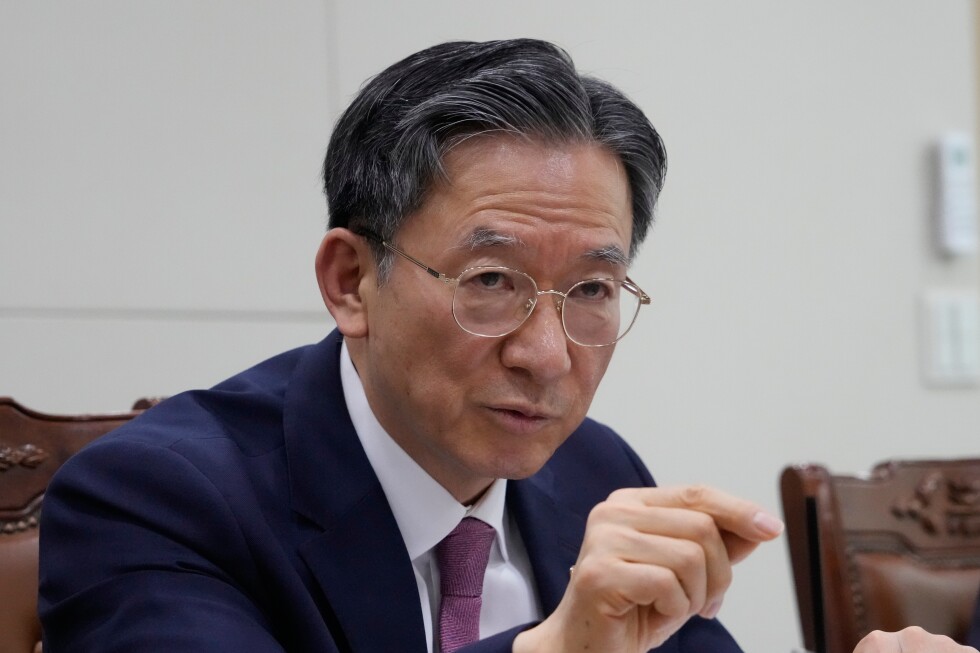
GWACHEON, South Korea — In a rare, frank acknowledgment of historical state wrongdoing, South Korean Justice Minister Jung Sung-ho has announced sweeping new measures to expand access to justice for survivors of government-sanctioned human rights abuses, most notably the mass, fraudulent overseas adoption scheme operated under decades past military regimes. Speaking to a group of journalists at a roundtable discussion Thursday, Jung used blunt, uncharacteristically strong language for a top South Korean official, describing the country’s mid-to-late 20th century overseas adoption program as nothing less than “forced child trafficking.” He added that the national government will largely stop appealing court rulings that favor abuse survivors seeking financial compensation for state misconduct. The announcement marks a major shift from decades of legal obstruction that has left many verified victims fighting for redress for years.
The issue of fraudulent Korean adoptions has reemerged as a national reckoning after South Korea relaunched its Truth and Reconciliation Commission (TRC) in February, following the expiration of the body’s original investigative mandate last November. Hundreds of Korean adoptees now residing in Western countries have already submitted requests for the TRC to investigate their cases, seeking official confirmation of government responsibility that they can use as legal backing for damage claims against the state or private adoption agencies that facilitated their adoptions. The first iteration of the TRC had already concluded that the South Korean government bore clear accountability for a corrupt adoption system rife with systemic fraud and misconduct. Backed by military leaders who saw the program as a tool to cut public welfare spending and reduce population growth, state-authorized private agencies systematically falsified children’s birth records, fabricated consent documentation from biological parents, and obscured their true origins to speed up international placements.
Prior to Jung’s announcement, victims who secured favorable court rulings after being recognized by the TRC often faced years of prolonged litigation, as state prosecutors routinely appealed positive rulings on the grounds of expired statutes of limitations or questioned the conclusiveness of the commission’s findings. That pattern is now set to change. Under a new law that came into force in February, survivors of verified state abuses have a three-year window to file damage claims even if the original statute of limitations for their case has already expired. Last week, Jung’s ministry — which represents the South Korean government in all civil legal claims against the state — announced it would withdraw time-limit-based appeals in more than 800 ongoing cases, and Jung confirmed Thursday that the same cooperative approach will be extended to adoptees’ future lawsuits. “Once the truth commission firmly establishes the basic facts (regarding the abuses), we intend to cooperate to ensure the process moves swiftly,” Jung stated.
The push for greater accountability builds on an apology issued by South Korean President Lee Jae Myung, a close political ally of Jung, for the historic adoption abuses last October. While the new framework clears major legal barriers for many survivors, some adoptees and advocates still point to ongoing delays in processing direct compensation claims. Yooree Kim, who was sent to a French adoptive family in 1984 without her biological parents’ consent and has spoken publicly about abuse at the hands of her adoptive parents, is one of the adoptees who has filed for compensation under South Korea’s State Compensation Act. This law theoretically allows survivors to secure damages without extended, costly court battles, but the Justice Ministry has missed its statutory 4-week deadline to rule on Kim’s and other adoptees’ claims, leaving them waiting more than six months for a decision, according to Choi Jung Kyu, a lawyer representing the group of adoptees. Jung responded to these concerns by saying he would order ministry officials to address backlogs and delays, though he stopped short of creating a new, standalone expedited process as some advocates have demanded.
Between the 1970s and early 2000s, South Korea facilitated the overseas adoption of roughly 200,000 Korean children, with annual placements peaking at more than 6,000 per year throughout the 1980s. At the time, the country was ruled by an authoritarian military government that framed rapid population growth as a major barrier to its ambitious economic development goals, and framed international adoption as a low-cost solution to reduce public welfare spending. The original TRC’s findings align with an independent investigation published by the Associated Press and PBS Frontline, which drew on thousands of government documents and dozens of survivor interviews to expose how South Korea’s government, Western adoption intermediaries, and receiving countries collaborated to move children overseas despite widespread documentation of corrupt and illegal procurement practices.
Beyond addressing the legacy of adoption abuses, Jung also outlined the government’s new commitments to root out human trafficking and forced labor in South Korea’s agricultural sector, particularly at remote salt farms off the country’s southwest coast, where decades of abuse against vulnerable migrant workers have drawn widespread international criticism. These efforts have gained new urgency in recent weeks, after the Trump administration launched investigations into dozens of countries accused of failing to curb forced labor, a move that paves the way for new tariffs and trade restrictions. The policy shift came after the U.S. Supreme Court struck down Trump’s earlier emergency power-based tariffs, clearing the way for this new enforcement structure. Last year, the U.S. already blocked all imports from one major South Korean salt farm over well-documented claims of slave labor, marking the first punitive trade action taken against the long-running abuse crisis in the country’s salt industry.
Jung said the South Korean government will strengthen its enforcement of anti-trafficking and labor laws, including directing prosecutors to pursue harsher criminal penalties for violators and increasing regulatory oversight of businesses that hire foreign migrant workers. “We cannot monitor every corner of the private sector, but I think we are capable of supervising these matters more thoroughly than almost any other country,” Jung said.