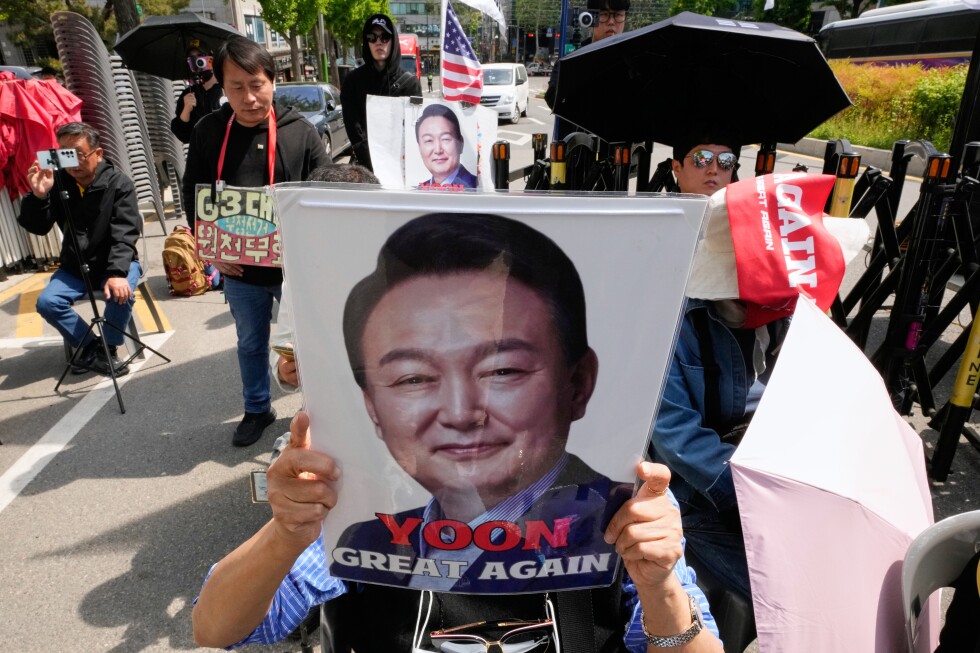
A key ruling on Wednesday from a South Korean appellate court delivered another heavy legal blow to impeached former president Yoon Suk Yeol, sentencing him to seven years in prison for obstruction of justice and a series of procedural violations tied to his short-lived 2024 declaration of martial law. The new conviction comes on top of a life sentence Yoon already received earlier for rebellion charges stemming from the unprecedented authoritarian power grab that pushed South Korea’s democracy into its most severe crisis in decades.
The Seoul High Court’s judge Yoon Sung-sik laid out the details of the guilty verdict in court, documenting that the conservative former leader intentionally skipped a legally required full Cabinet meeting before announcing martial law on December 3, 2024. To hide the violation of constitutional procedure, Yoon falsified official government documents, the court ruled. It also found that after Yoon was impeached and removed from office, he deployed presidential security personnel as what the ruling described as “a private army” to block law enforcement from executing an arrest warrant against him. Yoon stood silent throughout the verdict delivery and offered no public comment after the ruling.
This appellate decision reverses an earlier ruling from a lower court issued in January. The lower court had originally sentenced Yoon to five years in prison, but partially cleared him of abuse-of-power charges connected to the Cabinet meeting procedural violation, ruling he could not be held responsible for the absence of two invited Cabinet members. The Seoul High Court overturned that partial acquittal, convicting Yoon on all counts before the court. The judge emphasized that by convening only a small selection of loyalists to simulate a full Cabinet meeting, Yoon violated the constitutional rights of nine Cabinet members who were either uninvited or unable to attend the sham gathering.
Yoon’s short-lived martial law decree sent immediate shockwaves through South Korea’s political and economic systems. The move triggered weeks of national turmoil that paralyzed domestic lawmaking, disrupted high-stakes diplomatic operations, and caused significant volatility in South Korea’s financial markets. The political crisis only began to stabilize after liberal opposition leader Lee Jae Myung won a snap presidential election in June 2025.
The timeline of Yoon’s removal and legal process began on December 14, 2024, when the liberal-controlled National Assembly voted to impeach Yoon and suspend him from presidential powers. The Constitutional Court formally removed him from office in April 2025. After his suspension, Yoon refused to comply with a Seoul District Court detention warrant for questioning, leading to a tense public standoff in early January 2025. When dozens of criminal investigators arrived at the presidential residence to execute the warrant, they were turned away by barricades and Yoon’s security detail. Yoon was finally taken into custody later that month, only to be released by a separate court in March, and re-arrested on new charges in July. He has remained in custody since July, as a series of overlapping criminal trials against him continue to move through South Korean courts.
Wednesday’s ruling comes one day after the same Seoul High Court issued an upward adjustment to the prison sentence of Yoon’s wife, Kim Keon Hee, increasing her original term to four years. Kim was convicted on charges including accepting bribes in the form of luxury gifts from the Unification Church, a religious organization that sought favorable political treatment from Yoon’s administration, and participating in a multi-million dollar stock price manipulation scheme.
In a separate ongoing criminal trial last week, federal prosecutors formally requested a 30-year prison sentence for Yoon over another serious allegation: that he ordered South Korean military drones to conduct provocative flights over Pyongyang in 2024 to intentionally escalate cross-border tensions with North Korea. Prosecutors argue Yoon engineered the crisis to create a domestic pretext that would justify his declaration of martial law.